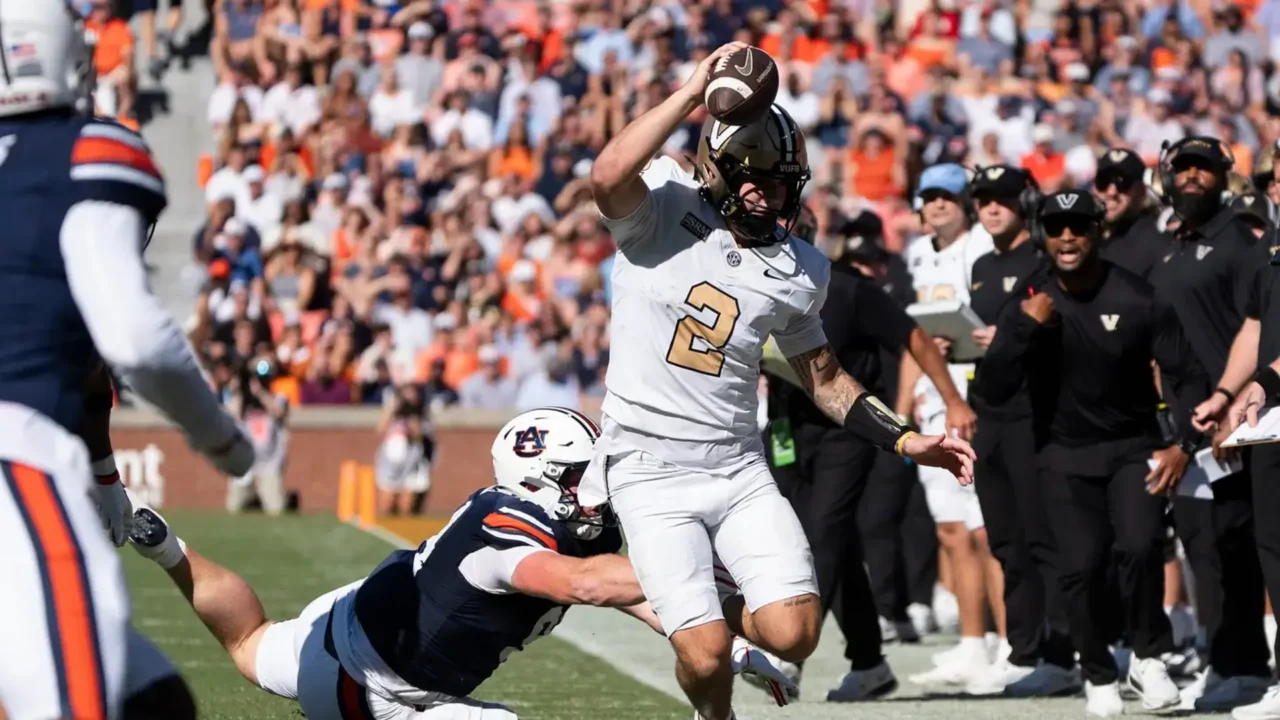
Jared Curtis left Jordan-Hare Stadium having shown enough to keep Vanderbilt competitive but not enough to escape with a win. The freshman started his first SEC road game and finished as the Commodores’ most reliable playmaker in a 21-15 loss at Auburn.
The game coverage and quotes used here are drawn from the original reporting on si.com, which provides the on-the-ground detail from Auburn.
Key Takeaways
- Jared Curtis completed 22 of 33 passes for 199 yards and added 46 rushing yards while taking on primary playmaking duties for Vanderbilt.
- Vanderbilt lost at Auburn 21-15 despite a strong defensive effort because the offense couldn’t consistently move the ball without Curtis creating plays.
- The running game struggled, finishing 2.7 yards per carry (3.6 when sacks are removed), and the team committed six offensive penalties that stalled drives.
How Vanderbilt leaned on Jared Curtis vs Auburn
Curtis was clearly Vanderbilt’s primary playmaker in his first SEC road start. He threw for 199 yards on 33 attempts with 22 completions and also ran for 46 yards while avoiding turnovers except for a late hail-mary interception.
That line tells two stories: Curtis has enough poise to manage the offense under pressure, and he remains a work in progress as a passer. Clark Lea framed that balance when he said the staff is “growing a quarterback up” and that Vanderbilt must keep building the offense around him.
Because of the way Auburn defended the game, Curtis often faced a front that tried to force Vanderbilt into one-dimensional play. He was sped up at times and missed throws, but he delivered the kind of measured decisions that prevented bigger mistakes.
Offensive line, penalties, and the running game
Vanderbilt’s inability to sustain a reliable run attack forced the offense to live through Curtis. The Commodores finished with 2.7 yards per carry; that improves to 3.6 yards per carry when sacks are removed from the box score.
Sedrick Alexander reached the end zone but managed just 13 yards on 11 carries, and Vanderbilt’s rushing woes were compounded by six offensive penalties that repeatedly stalled drives. The penalties and short runs increased the burden on Curtis to manufacture chunks of yardage.
When a quarterback is asked to be both the passing engine and a primary rushing threat, playcalling narrows and the margin for error shrinks. That dynamic showed up repeatedly at Jordan-Hare and kept Vanderbilt from converting critical possessions into points.
Rushing and passing context vs season trends
| Metric | Auburn game | Season trend through four games |
|---|---|---|
| Rushing yards per carry | 2.7 ypc (3.6 ypc without sacks) | Under 5.0 ypc in three of four games and under 3.0 ypc in two of four games |
| Leading rushing output | Curtis tied as leading rusher; Sedrick Alexander 13 yards on 11 carries and a touchdown | Running game has not consistently controlled opponents in the manner of Vanderbilt’s recent seasons |
| Penalties | Six offensive penalties that disrupted drives | Penalties and short-yardage failures have been recurring issues limiting sustained offensive drives |
SEC recruiting and roster implications for Vanderbilt
Clark Lea’s assessment that the staff is “growing a quarterback up” frames Vanderbilt’s immediate priorities. Curtis’ incremental progress gives the staff a tangible building block to sell to recruits and to shape roster construction around a quarterback capable of creating plays when the rest of the offense is struggling.
That framing matters on the recruiting trail because coaches will point to real opportunities for playing time and development with a young starter already handling SEC defenses. Roster construction must now prioritize playmakers and a more consistent rushing plan that can take pressure off Curtis and give the offense multiple ways to win, and reporting for this roundup relied on the linked local coverage and on-field reporting cited earlier.