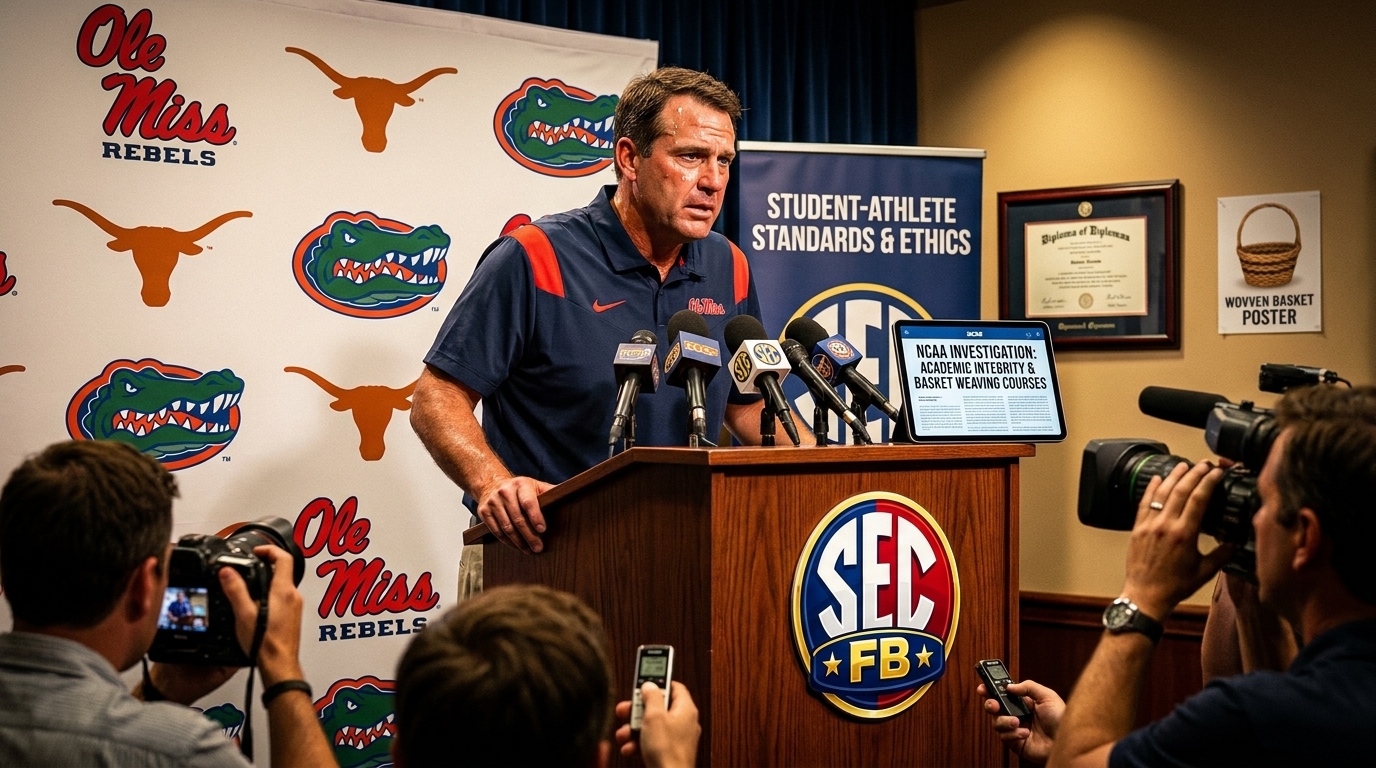
Steve Sarkisian’s basket weaving comment about academic standards in college football ignited a heated debate this week. He mocked Ole Miss, suggesting its degrees require nothing more than easy electives. That remark landed amid ongoing questions about recruiting, NCAA oversight, and academic integrity.
However, this is more than a gaffe about one program. It exposes systemic tensions between winning now and educating athletes. Texas and Florida boast stronger U.S. News rankings than Ole Miss, which raises concern. Yet the issue runs deeper because the NCAA rarely enforces academic standards. As a result, critics say coaches exploit transfer rules and easy credit policies.
Meanwhile, allegations of tampering and recruiting incentives compound the problem. This piece analyzes the fallout from Sarkisian’s comment and asks what it reveals. We examine recruiting consequences, the NCAA investigation, and the broader academic ethics debate. Finally, we consider how rankings, transfer portal dynamics, and public perception shape reform.
Throughout, we use evidence and critical analysis to separate rhetoric from reality. The goal is clear: to understand whether college football balances educational missions with competitive pressure.
Steve Sarkisian Basket Weaving Comment and Academic Standards in College Football
Steve Sarkisian’s jab at Ole Miss—calling its degrees attainable with ‘basket weaving’—struck a nerve. However, the remark reflected deeper anxieties about academic standards in college football. At Texas he said the Longhorns accept only 50 percent of a player’s academic credit hours. He suggested transfers can lose progress at stricter programs. Meanwhile he contrasted that with Ole Miss, calling its credits easier to obtain.
The comment matters for several reasons. First, rankings reinforce perceptions. Per U.S. News, Ole Miss sits tied for No. 169 nationally. By contrast Texas and Florida rank tied for No. 30. As a result, critics argue that selective admissions and transfer policies skew recruiting advantages. Second, NCAA enforcement appears weak, which fuels skepticism about academic oversight. Third, investigations and alleged tampering complicate truth telling; Ole Miss faces review over Luke Ferrelli recruitment.
- The core claim: Texas limits accepted transfer credit to 50 percent, according to Sarkisian.
- The implication: Transfers may restart degree progress at stricter programs.
- The ranking gap: Ole Miss No. 169 versus Texas No. 30 on U.S. News.
- The broader stakes: Less than 5 percent of these players reach the NFL, so degrees matter.
Therefore this comment functions as rhetoric and revelation. It reveals tension between competitive recruiting and academic integrity. Moving forward, stakeholders must ask whether policies prioritize athlete education or short term wins.

| Aspect | Ole Miss | Texas Longhorns |
|---|---|---|
| Academic standards | Sarkisian portrayed Ole Miss as lenient; critics cite easy electives; NCAA enforcement seen as weak. | Sarkisian says Texas enforces stricter transfer credit rules; accepts only 50 percent of credits; stresses academic rigor. |
| U.S. News ranking | Tied for No. 169 nationally (public and private). | Tied for No. 30 nationally (with Florida). |
| NCAA investigations | Under NCAA investigation for alleged tampering with Luke Ferrelli. | No investigation reported in this article. |
| Recruiting challenges | Recruiting hampered by association with Confederate symbols, per Lane Kiffin; alleged recruitment incentives cited by Dabo Swinney and Vanity Fair. | Strong brand and higher ranking aid recruiting; however stricter credit acceptance can deter some portal players. |
| Transfer portal notes | Perception of easier credit transfer may attract portal players; critics warn degree value risk since fewer than 5 percent reach the NFL. | Policy that limits accepted credits may force transfers to restart degree progress; as a result some recruits might avoid transferring. |
NCAA Concerns and Coaching Fallout: Steve Sarkisian Basket Weaving Comment Academic Standards College Football
The NCAA scrutiny around Ole Miss moves beyond rhetoric. The program now faces an investigation into alleged tampering with Luke Ferrelli. As a result, critics question recruiting ethics and institutional oversight. Moreover, these probes amplify concerns raised by Sarkisian’s comment about academic standards.
Coaching voices have fueled the controversy. Lane Kiffin said the association with Confederate symbols made recruiting more challenging, though he later apologized. Dabo Swinney added a punch: he claimed Rebels head coach Pete Golding texted a picture of a $1 million contract to Luke Ferrelli in January, as reported in Vanity Fair. These accusations create a climate of mistrust, because they suggest off record incentives and blurred recruiting lines.
Sarkisian’s basket weaving line frames the debate about what universities require academically. He said, “At Texas, we will only take 50 percent of a player’s academic credit hours.” He contrasted that with Ole Miss, implying easier course loads and transfer acceptance. Therefore the dispute is not simply about insult. It probes who benefits when academic standards loosen.
Key Facts and Implications:
- Ole Miss faces an NCAA investigation for alleged tampering with Luke Ferrelli.
- Lane Kiffin acknowledged recruiting headwinds tied to symbols and apologized.
- Dabo Swinney referenced a $1M contract text tied to Pete Golding and Ferrelli.
- Sarkisian says Texas limits accepted transfer credits to 50 percent.
These developments matter because most players do not reach the NFL. Less than 5 percent make it, so degrees retain value. As a result, lax academic practices would harm athletes long term. Meanwhile, weak NCAA enforcement compounds the problem, because institutions may exploit loopholes without fear of real consequences.
In short, the fallout mixes ethical questions, legal exposure, and reputational risk. Stakeholders must demand clearer academic standards, firmer NCAA enforcement, and transparent recruiting rules. Otherwise, the sport risks valuing wins over genuine student success.
Conclusion
Steve Sarkisian’s basket weaving comment crystallized a larger debate about academic standards in college football. It exposed how rhetoric masks deeper structural problems. Moreover, it highlighted contrasts between programs such as Texas and Ole Miss. As a result, observers must weigh recruiting pressures against the educational mission.
The controversy shows several linked risks. First, alleged tampering and aggressive recruiting create legal and reputational exposure for programs. Second, weak NCAA enforcement lets gray areas persist. Therefore athletes risk losing real degree progress when schools prioritize roster gains. Meanwhile fewer than five percent of these players reach the NFL, so degrees matter for most.
Moving forward, stakeholders should demand clearer policies and stronger oversight. Universities must protect academic integrity, because student outcomes matter beyond the field. In addition, the NCAA must apply consistent enforcement to deter exploitative practices.
This analysis was produced by SECFB LLC. For the source of this coverage, see Website: SECFB.com and @ZachGatsby. The aim remains critical and evidence based: to separate coach soundbite from institutional reality, and to press for reforms that keep scholarship and sport aligned.
Frequently Asked Questions: Steve Sarkisian basket weaving comment academic standards college football
What did Steve Sarkisian say and why does it matter?
He said Texas accepts only 50 percent of a transfer’s academic credits and quipped that an Ole Miss degree could be earned with basket weaving. The remark triggered scrutiny of transfer credit policy, academic integrity, recruiting incentives, and public perception.
What is the status of the NCAA investigation into Ole Miss?
Ole Miss is reported to be under NCAA review over alleged tampering in the Luke Ferrelli recruitment. The probe raises compliance, reputational, and recruiting consequences for the program.
How do academic standards differ between programs?
Standards vary by institution, transfer credit rules, and admissions selectivity. Texas’s stricter credit acceptance contrasts with perceptions of leniency at Ole Miss, a gap reinforced by U.S. News rankings and institutional policies.
How do these issues affect recruiting and the transfer portal?
Perceived easier credit transfer can attract portal players seeking to protect degree progress while stricter policies may deter transfers who would lose credits. Allegations of tampering and recruiting incentives further distort choices.
What reforms would address these problems?
Establish standardized transfer credit guidelines, strengthen NCAA enforcement, mandate transparency in recruiting communications, and audit academic programs supporting athletes. Clear rules would reduce incentives to prioritize short term wins over degree completion.
How would proposed reforms protect student athlete outcomes?
Standardized credits and consistent enforcement help prevent lost degree progress and improve graduation rates. Enhanced oversight supports long term career prospects and athlete welfare beyond sport.
Why should universities prioritize degree completion for athletes?
Fewer than five percent of college players reach the NFL, so a degree is essential for most. Prioritizing academic integrity protects student futures, institutional reputation, and ethical recruiting.