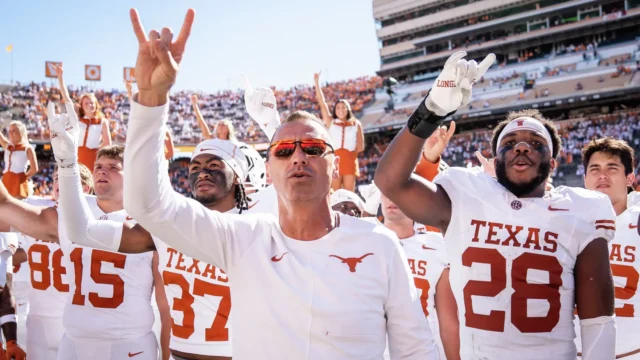
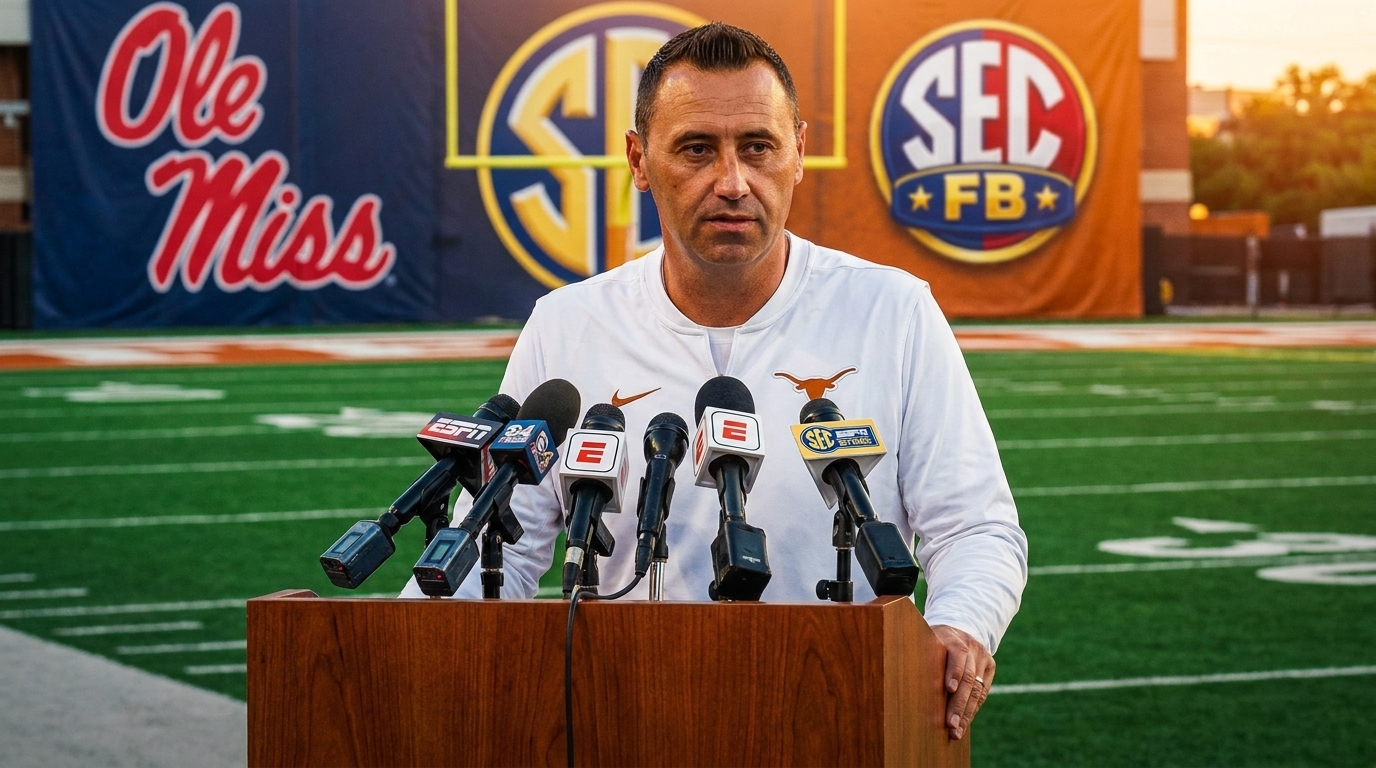
Steve Sarkisian basket weaving Ole Miss comments and college football inequalities
Steve Sarkisian basket weaving Ole Miss comments and college football inequalities set off a firestorm this week. The remark came during a USA Today interview and drew swift headlines. Sarkisian later clarified he meant systemic inequalities in transfer and degree rules, not a jab at Ole Miss. However, the basket weaving line still landed poorly for many fans and analysts.
The controversy matters because it exposes uneven transfer credit practices across the sport. At Texas, coaches require players to complete half their degree hours to earn a UT diploma, while Sarkisian said some programs can grant degrees after minimal coursework. He named friends like Lane Kiffin and Pete Golding to show he speaks from experience.
As a result, the exchange triggered PR headaches for Texas and fed SEC rivalry narratives. Beyond reputation, the episode reopened debates on transfer policy, competitive balance, and the shape of the College Football Playoff. Expect more scrutiny, deeper policy talks, and headlines as stakeholders weigh fairness across college football. The stakes are high because recruiting, transfers, and degrees shape programs and athletes’ futures. Fans and administrators will not let the issue fade quickly.
Sarkisian’s ‘basket weaving’ comments and Ole Miss context
Steve Sarkisian said his basket weaving line was meant to highlight systemic inequalities. He clarified the comment targeted transfer credit rules, not the Ole Miss institution. As he put it, “I probably shouldn’t have used basket weaving as my example for the class, OK?” The quote underscored his point while acknowledging the poor wording.
Sarkisian explained the concrete difference in policy. He said, “At Texas, we will only take 50 percent of a player’s academic credit hours.” Therefore, a transfer might need to finish 60 hours at UT to earn a Texas degree. By contrast, he argued some schools can award degrees after minimal coursework. He said, “Ole Miss is a fine institution — I’ll reference them that way — they can take one class (after transferring) and get a degree (from Ole Miss).”
He also noted personal ties to the topic. “The only reason the Ole Miss thing came up is because two of my best friends were there in Lane Kiffin and Pete Golding,” he said. He added he was a sociology major and did not take basket weaving.
Key differences outlined
- Texas requires transfer students to complete half their degree at UT, roughly 60 hours
- Sarkisian said Ole Miss can apply far fewer transfer credits
- The comment aimed to spotlight transfer inequality and competitive balance

The remark reopened debate over fairness in transfers. Moreover, it created PR friction for Texas and fed SEC rivalry narratives. Ultimately, the exchange pushed conversations about academic standards, recruiting, and the future of the transfer portal.
Transfer credit policies compared
This table compares Ole Miss, University of Texas, and Vanderbilt. It references Steve Sarkisian basket weaving Ole Miss comments and college football inequalities to frame the differences. Sarkisian raised the issue in a USA Today interview, arguing transfer rules can create competitive imbalances.
| Institution | Typical transfer credit accepted | Residency or credit hours required to earn degree | Notes and Sarkisian example |
|---|---|---|---|
| Ole Miss (University of Mississippi) | High acceptance of transfer credits, according to Sarkisian (may accept most credits) | Varies by program; Sarkisian claimed some transfers can graduate after minimal coursework | Sarkisian said “they can take one class (after transferring) and get a degree” and used “basket weaving” as an illustrative example |
| University of Texas (Austin) | Accepts up to 50 percent of a transfer student’s prior credits for degree eligibility, per Sarkisian | Must complete roughly 60 hours at UT to earn a University of Texas degree | UT requires residency and a higher on-campus credit threshold, which Sarkisian contrasted with other schools |
| Vanderbilt University | Case-by-case credit evaluation; institutional rules apply | Varies by college and major; typically evaluated individually | Sarkisian referenced Vanderbilt in comparing transfer rules; policies tend to be more individualized than a flat percentage |
The table highlights why Sarkisian argued inequalities exist. Therefore, transfer policy differences affect recruiting and competitive balance. As a result, the debate over fairness and degree standards continues in college football.
Analysis: broader college football policy inequalities and playoff debate
Steve Sarkisian’s basket weaving remark forced a bigger conversation about inequality in college football. He framed his argument around transfer rules and degree residency, and he said, “At Texas, we will only take 50 percent of a player’s academic credit hours.” As a result, he argued some programs can graduate transfers after minimal coursework. Moreover, he voiced a larger concern about how policy differences shape competitive balance across the SEC and beyond.
Sarkisian also weighed in on the CFP format. He said, “I’ve gone on record saying I’d rather go back to four,” and he explained why. He argued a bigger playoff risks undercutting the value of regular-season wins, and he warned that fanbases now live under a playoff-or-bust mentality. Therefore, his comments link academic rules, recruiting advantages, and postseason structure into one debate over fairness.
Key takeaways
- Transfer rules create practical inequalities because schools vary in how many credits they accept, which affects roster building and recruiting
- Sarkisian’s point highlighted that residency requirements at Texas can force transfers to redo coursework, while other programs may accept far fewer credits
- CFP debate ties to inequality since a larger field may reward depth and transfers, whereas a four-team playoff emphasizes season-long performance
- Consequently, policy changes to the transfer portal, credit acceptance, and CFP sizing will alter competitive balance across conferences like the SEC
In short, Sarkisian used a blunt metaphor to spark a policy debate. His remarks matter because transfers, academic rules, and playoff formats shape program strategy, recruiting, and perceived fairness in college football.
Sarkisian’s coaching success and Texas Longhorns performance in SEC
Steve Sarkisian has delivered immediate results at Texas. In his first two SEC seasons he compiled a 26-3 record. That winning percentage reflects roster building, scheme clarity, and recruiting gains. Moreover, his staff has converted transfer talent into on-field production quickly.
On the whole the Longhorns’ success changed expectations around the program. However, the basket weaving controversy created a PR moment that contrasted with on-field momentum. Texas still ranks as a national contender because Sarkisian has stabilized the locker room and produced consistent results. As a result, critics weigh wins against perceived off-field missteps more closely than before.
Context outside Austin underscores competitive balance across college football. Texas Tech defeated top-15 BYU twice, and they suffered only one Big 12 loss at Arizona State, 26-22, after a Sam Leavitt drive. Therefore, the wider landscape shows depth and parity beyond the SEC. Ultimately Sarkisian’s record matters because wins affect recruiting, playoff positioning, and the narrative around transfer policy and inequality.
Conclusion
Steve Sarkisian’s basket weaving remark sparked more than a headline; it reopened policy debates. He clarified he meant inequalities in transfer credits and degree residency, not a direct attack on Ole Miss. However, the phrasing amplified PR fallout for Texas and fed SEC rivalry narratives. Consequently, administrators, media, and fans now press for clearer transfer rules.
Beyond optics, Sarkisian tied transfer inequality to playoff format concerns. He said he prefers a four team CFP. He also warned that a 24 team field can undercut regular season value. Policy fixes could include uniform credit standards, residency rules, and transfer portal reform. Ultimately, the debate will shape recruiting, fairness, and the CFP landscape.
SECFB LLC will keep tracking this story and related policy shifts. For more analysis visit SECFB and follow Twitter/X @ZachGatsby. Expect the conversation to continue across campuses and conference offices.
Frequently Asked Questions (FAQs)
What did Steve Sarkisian mean by the “basket weaving” remark?
Sarkisian used the basket weaving line as a blunt example of transfer credit gaps. He said, “I probably shouldn’t have used basket weaving as my example for the class, OK?” However, he clarified the point concerned inequality in transfer credit acceptance. In short, he aimed to show that some programs can graduate transfers after minimal coursework.
Was the comment an attack on Ole Miss?
No. Sarkisian explicitly said he did not mean to attack Ole Miss. He stated, “Ole Miss is a fine institution — I’ll reference them that way.” Moreover, he noted personal ties to Ole Miss through friends Lane Kiffin and Pete Golding. Therefore, his comment targeted policy differences, not the university itself.
How do transfer credit policies differ between Texas, Ole Miss, and Vanderbilt?
Policies vary widely. At Texas, Sarkisian said the program accepts roughly 50 percent of a transfer student’s prior credits and requires about 60 hours at UT to earn a degree. By contrast, he claimed some schools can accept far more credits, sometimes requiring only a single class after transfer. Vanderbilt evaluates credits case by case. As a result, transfer rules shape roster construction and academic residency.
How does this debate connect to the College Football Playoff and competitive balance?
Sarkisian tied credit inequalities to playoff philosophy. He said, “I’ve gone on record saying I’d rather go back to four.” He warned a 24 team CFP might reward depth and transfer-driven rosters. Therefore, fans and administrators worry a larger playoff could reduce season-long stakes and amplify inequality across conferences like the SEC.
What is the likely fallout and next steps?
Expect PR scrutiny and policy talk. Administrators may face pressure to harmonize credit rules and tighten residency standards. Meanwhile, media and fans will debate CFP sizing, the transfer portal, and fairness. Ultimately, any reform will affect recruiting, degrees, and competitive balance.