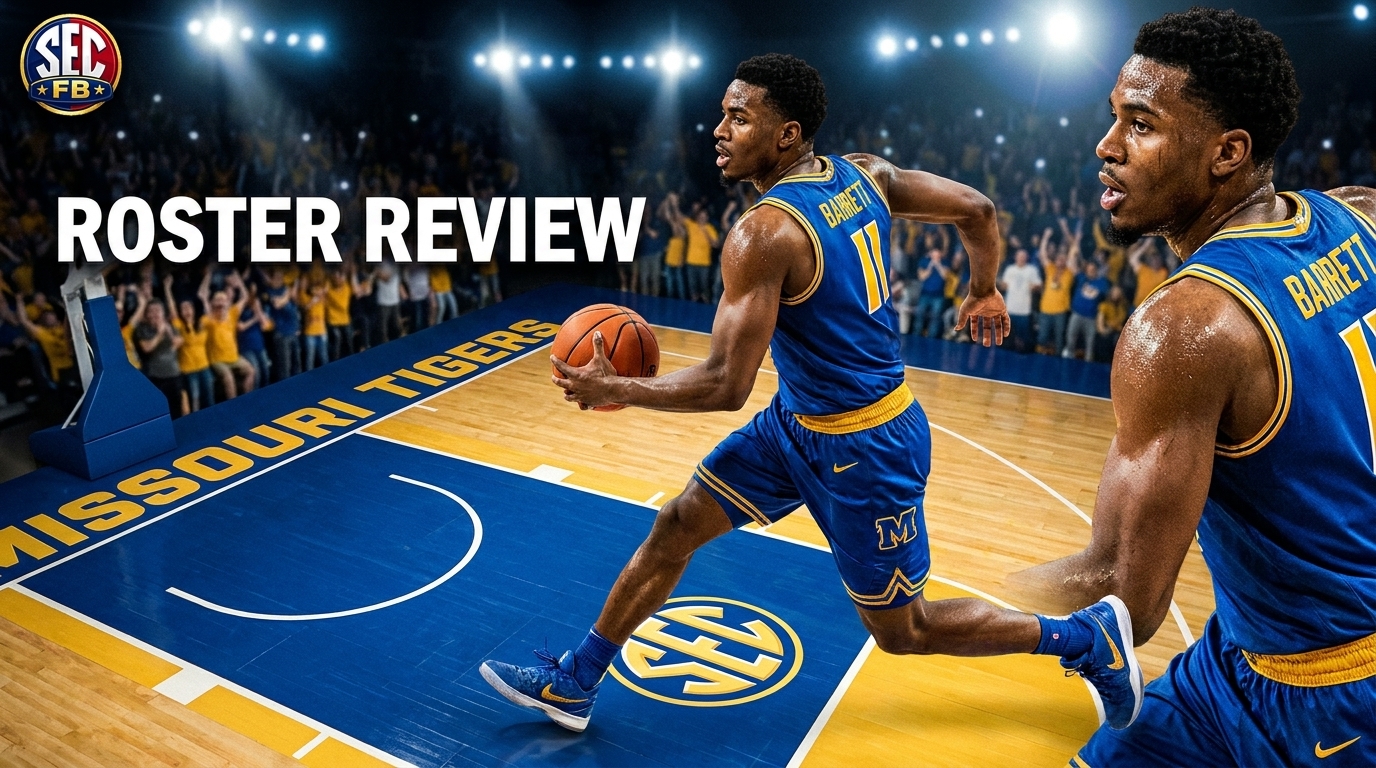
Mizzou Hoops Player Review: T.O. Barrett
Mizzou Hoops Player Review: T.O. Barrett examines a freshman who flashed real potential. He grew into a reliable starter by season end. However, questions remain about his range and long term fit. This piece balances praise with scrutiny.
Barrett played 19 games as a freshman and averaged 18.4 minutes per game. In the final 12 games he started all 12. During that stretch he averaged 28.9 minutes and 12.4 points per game, which mattered because Missouri needed steady scoring late in the season. At 6’4 and 200 pounds he attacks the rim with power. Yet he remains not a shooter, and that raises spacing concerns for Missouri’s 2026-27 roster.
This review will break down Barrett’s strengths and weaknesses. I will analyze shot patterns, finishing rates, and defensive impact. Finally, I will assess how he fits with new additions to the roster. Readers should expect a measured and analytical look at what Barrett can become.
Mizzou Hoops Player Review: T.O. Barrett — Performance Analysis
T.O. Barrett’s freshman season combined flashes of upside with clear limitations. He appeared in 19 games and averaged 18.4 minutes and 5.9 points per game. However, once he started the final 12 games he averaged 28.9 minutes and 12.4 points. As a result Missouri leaned on him more late in the year.
Key season snapshots
-
Minutes and scoring
- Freshman season average 18.4 minutes per game. However, over the final 12 games he averaged 28.9 minutes. This jump correlated with his scoring rise to 12.4 points per game in that stretch. Those minutes indicate the coaching staff trusted him when it mattered.
-
Inside scoring and shooting profile
- Barrett is a powerful driver, listed at 6’4″ and 200 pounds. He is not a shooter, which affects spacing. Season shooting inside the arc was 52.2%, while in the final 14 games it dipped to 46.6%. He finished frequently on two point attempts rather than by stretching the floor.
-
Three point and range notes
- He made seven three pointers all season. Six of those came in only three games, which shows the outside shot is inconsistent.
Notable performances and game level 2FG detail
-
Epic night vs Tennessee
- Barrett posted a 28 point game against Tennessee. He went 12 for 17 on two point attempts that night. Nearly all his makes came inside the paint, and that performance helped a must win late in the season.
-
Two point makes and attempts in the final 14 games
- Oklahoma: 8-11
- Alabama: 3-7
- Mississippi State: 1-7
- South Carolina: 4-9
- Texas A&M: 7-10
- Texas: 2-9
- Vanderbilt: 1-5
- Arkansas: 2-3
- Tennessee: 12-17
- Mississippi State: 4-8
- Oklahoma: 2-5
- Arkansas: 4-10
- Kentucky: 4-10
- Miami: 0-5
Quotes that summarize his season
- “Barrett flashed big potential once he was thrust into the starting role.” This view captures the promise he showed. However, as another blunt line put it, he remains “not a shooter.” Those two quotes together explain the evaluation tension.
Bottom line
Barrett projects as a high activity, interior scorer with finishing ability. Yet he needs consistent perimeter development to avoid clogging spacing. Therefore his role for 2026-27 should capitalize on drives and finishes, while the staff adds shooters and spacing around him.

| Opponent | 2FG Makes-Attempts |
|---|---|
| Oklahoma | 8-11 |
| Alabama | 3-7 |
| Mississippi State | 1-7 |
| South Carolina | 4-9 |
| Texas A&M | 7-10 |
| Texas | 2-9 |
| Vanderbilt | 1-5 |
| Arkansas | 2-3 |
| Tennessee | 12-17 |
| Mississippi State | 4-8 |
| Oklahoma | 2-5 |
| Arkansas | 4-10 |
| Kentucky | 4-10 |
| Miami | 0-5 |
Mizzou Hoops Player Review: T.O. Barrett — Roster Implications
T.O. Barrett’s post season uncertainty created real roster questions for Missouri. If he had left, the Tigers would lose a powerful interior finisher. However, his potential return kept options open for coach Dennis Gates and the staff.
Immediate roster effects
-
Rotation and minutes
- Barrett averaged 28.9 minutes across the final 12 games. Therefore his departure would free up heavy minutes at the wing and perimeter close to the paint. As a result the coaching staff would need to redistribute those minutes to guards and wings.
-
Spacing and offensive fit
- Barrett is an aggressive driver, not a shooter. Consequently Missouri must add perimeter shooters to preserve spacing. The team added Cord Stansberry to complete the 2026-27 roster, which helps shore up depth and wing versatility.
Scenario analysis
-
Barrett returns
- Missouri keeps a high activity inside scorer. However, the staff must surround him with shooters to avoid clogged drives. This path keeps continuity and late season chemistry intact.
-
Barrett departs or transfers
- The Tigers would need a new primary finisher near the rim. Adding a shooter and a slasher becomes a priority. For roster context, see Missouri Athletics and Vanderbilt Athletics for how programs manage transfers.
Tournament and team dynamic impact
Barrett’s presence increases Missouri’s chance to win contested Quad 1 games. In the final 12 games the team went 7-7 with four Quad 1 wins. Therefore his ability to finish inside mattered in meaningful contests. Conversely, his lack of consistent range could limit Missouri in spaced offensive sets.
Bottom line
Barrett’s decision mattered beyond one roster spot. Because he affects minutes, spacing, and matchup planning, Missouri’s staff must build complementary pieces. With Cord Stansberry onboard, the Tigers have more flexibility. Yet the staff still needs shooters and creators to maximize the roster for NCAA Tournament contention.
Conclusion
T.O. Barrett’s freshman year delivered clear value and clear questions for Missouri. In limited minutes he flashed finishing ability and growth when starting late. His two-point dominance, highlighted by a 28-point game against Tennessee, showed elite finishing near the rim. However, his inconsistent outside shot and dip in inside-arc rate late raise spacing concerns.
Barrett’s uncertain post-season status mattered for rotations and matchup planning. Because he considered a move to Vanderbilt, Missouri had to plan for either outcome. The addition of Cord Stansberry eases depth needs and adds wing versatility. Going forward, Missouri must surround Barrett or his replacement with reliable shooters to maximize drives and spacing.
For ongoing analytical coverage of Mizzou Tigers basketball, follow SECFB LLC at SECFB and on Twitter/X @ZachGatsby. Stay tuned for deeper breakdowns and roster updates.
Frequently Asked Questions (FAQs)
What is T.O. Barrett’s playing style?
Barrett is a powerfully built driver at 6’4″ and 200 pounds. He attacks the rim and finishes through contact. However, he is not a consistent shooter, so spacing can suffer. As a result, teams may clog the paint.
In Mizzou Hoops Player Review: T.O. Barrett, what were his key stats?
As a freshman he appeared in 19 games and averaged 18.4 minutes and 5.9 points. Over his final 12 starts he averaged 28.9 minutes and 12.4 points. Season two point accuracy inside the arc was 52.2%. In the final 14 games it fell to 46.6%.
Did Barrett enter the transfer portal or commit elsewhere?
After the season his status was uncertain. Reports suggested he could leave, return, or transfer. He ultimately committed to Vanderbilt but financial terms did not match for either party. Therefore Missouri planned for multiple outcomes.
How does Barrett affect Missouri’s roster and NCAA hopes?
His finishing boosts chances in close Quad 1 games. However, his lack of perimeter shooting reduces spacing. The addition of Cord Stansberry adds wing depth and flexibility. Consequently the staff must add shooters to maximize offense.
What are Barrett’s long term prospects?
He projects as an interior finisher with upside. If he develops a reliable three point shot, his value will rise. Otherwise he will need teammates who can stretch defenses.