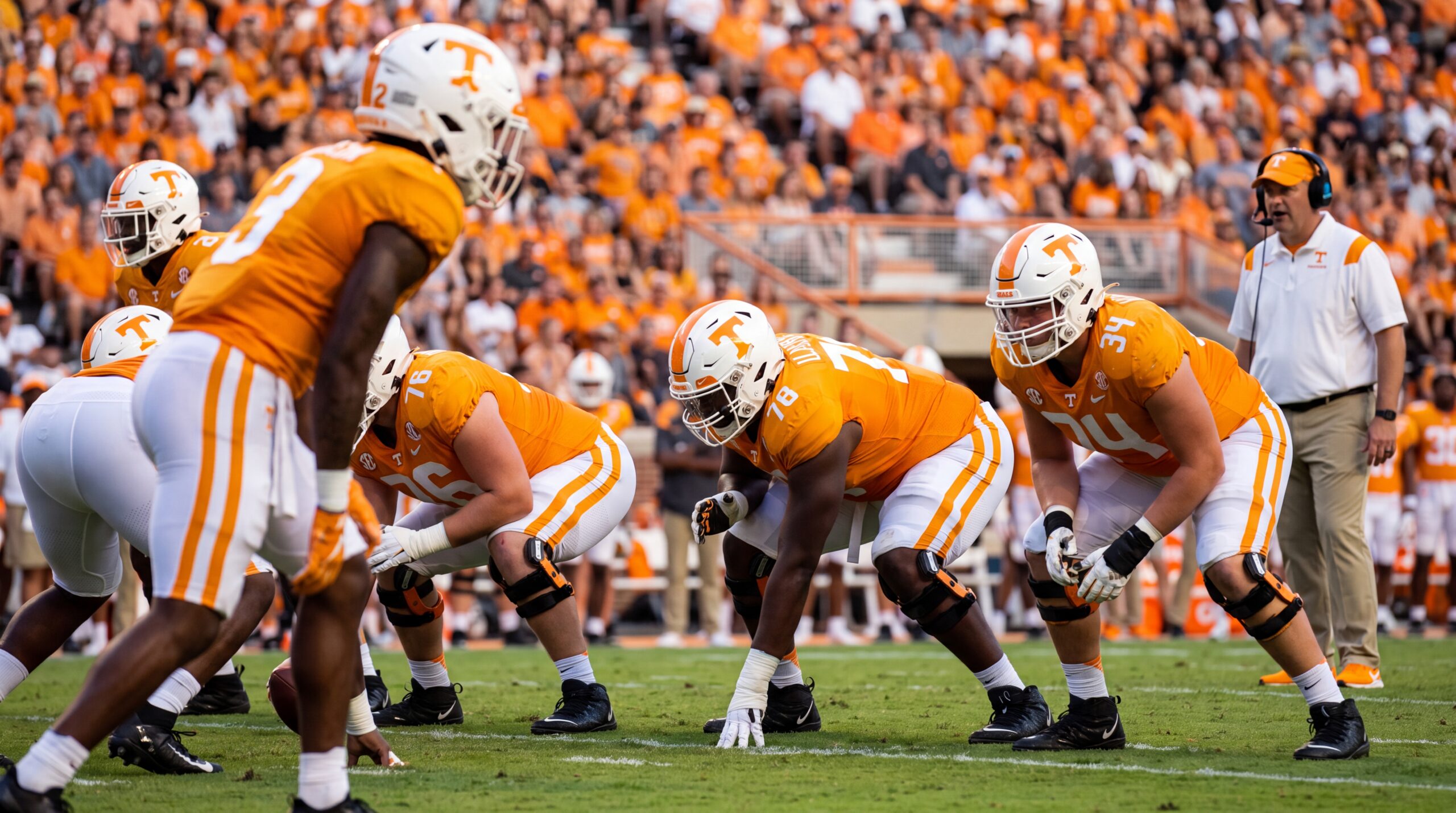
The 2026 Tennessee offensive line looks positioned to be a strength for the Vols, returning four starters while absorbing the departure of left tackle Lance Heard. Stability up front gives Tennessee continuity with both run-blocking and pass protection schemes heading into spring practice.
Expectations hinge on the availability and role of former five-star prospect David Sanders Jr., the group’s top name on the depth chart once healthy. Sanders Jr.’s status and how Tennessee replaces Heard will shape early camp narratives and snap distributions.
2026 Tennessee offensive line snapshot
The baseline projection for the 2026 Tennessee offensive line is straightforward: four starters return from last season, and only Lance Heard — the left tackle — is gone. That continuity offers a rare offseason advantage at the line of scrimmage and gives the coaching staff a clearer starting point for scheme work.
Per Rocky Top Insider (July 1, 2026), the unit projects as one of the Vols’ more stable position groups given the mix of experience and top-end recruiting talent (Rocky Top Insider preview). Short-term questions center on who fills the open left tackle spot and how quickly depth players can step up against Power Five competition.
“Possibly the strongest position group on offense for Tennessee football in 2026 will be its offensive line.” — Rocky Top Insider
Projected lineup and depth chart
With four starters back, Tennessee should be able to preserve continuity across the interior and one edge. While this preview does not list every starter by name, coaching continuity and returning reps should keep the five-man rotation competitive early in the year.
The most immediate projection need is identifying a new starting left tackle after Heard’s exit. That battle will likely determine early depth charts and could involve a veteran starter sliding out, a tackle conversion from the interior, or a younger tackle stepping into a starting role. Expect coaches to evaluate footwork, pass sets and recovery in team drills during spring camp.
Interior depth will be measured not only by reserve talent but by who can handle specialty snaps — short-yardage blocks, goal-line push sets and heavy rotational usage late in games. Players who can play multiple interior spots and contribute on special teams increase their value to a unit that aims for consistent performance over a long season.
Coaches will look for backups who show technique, discipline and the ability to process defensive fronts quickly. Those attributes matter more than sheer size when backup linemen are asked to fill in mid-game against varied fronts and blitz pressures.
David Sanders Jr.: health, role and upside
David Sanders Jr. is the headline name on this line — a former five-star recruit with the physical profile and recruiting pedigree to be a long-term anchor. The timeline for his return to full duty remains the key variable; public reporting has emphasized caution and a managed return-to-play plan.
When available, Sanders Jr. brings size and a ceiling that allows coordinators to stretch protections and run heavier inside sets. But coaches are expected to manage his early workload — limiting snap counts while increasing situational reps — to balance development and recovery. That approach preserves his long-term value while still allowing the offense to gain immediate benefits in favorable matchups.
Until spring camp and early practice reports provide clearer medical updates and rep counts, projecting Sanders Jr. as an every-down starter would be premature. The staff’s public messaging and controlled scrimmages will be the first indicators of how quickly he ramps up activity and the types of plays he will be trusted to execute.
What this means for Tennessee’s offense in 2026
Stability along the line matters because it determines what offensive coordinators can reasonably install. A settled starting five — or something close to it — means Tennessee can refine run concepts and expand pass protections without leaning heavily on quick-release schemes or simplified blocking calls.
If the offensive line performs at or above expectation, the Vols should see fewer negative plays, cleaner pocket time for quarterbacks and more consistent third-down conversions. A strong interior can also create the space needed for play-action, opening explosive passing opportunities downfield.
Conversely, if the left tackle spot or key backups struggle early, Tennessee will likely tilt toward quicker passing concepts, rollout protections and max-protect calls to mitigate edge pressure. Those schematic adjustments can blunt the potential of the run game and force the offense into higher-variance plays.
What comes next
There are a few concrete checkpoints that will clarify the 2026 Tennessee offensive line picture:
- Spring camp: watch the left tackle competition and early depth clarity from day-to-day reports.
- Injury updates: particularly around David Sanders Jr.’s availability and monitored snap counts.
- Preseason and early-season snap distributions: these will reveal how settled the staff is on the starting five and rotation patterns.
Coaches’ public comments during spring practice and controlled scrimmages will be useful indicators of who has earned the starting nod and how the staff plans to protect and develop its most valuable assets. Expect local beat coverage and site previews to update depth charts as reps are logged.
Key takeaways
- The 2026 Tennessee offensive line returns four starters and should provide stability for both run and pass schemes.
- Lance Heard’s departure creates a meaningful left tackle competition that will shape early depth charts.
- David Sanders Jr. is the unit’s top upside piece but will be managed based on health and monitored snap counts.
FAQ
Who left and who returns on Tennessee’s 2026 offensive line?
Tennessee lost left tackle Lance Heard and returns the other four starters from last season, giving the line continuity while opening a vacancy at left tackle.
Is David Sanders Jr. expected to start once healthy?
Sanders Jr. is the headline name and likely to play a major role if he reaches full health. The staff will monitor reps and may manage his workload based on medical updates and practice performance.
How secure is depth behind the starting five?
Depth is the primary concern. While the starters offer continuity, backups and rotational players must demonstrate they can handle longer stints, especially at the newly opened left tackle spot.
Source: Rocky Top Insider — 2026 Tennessee Football Position Preview: Offensive Line.
Next steps for readers: track spring-camp depth charts, coach comments and early snap counts for clearer answers on the left tackle competition, Sanders Jr.’s availability, and initial rotation trends.