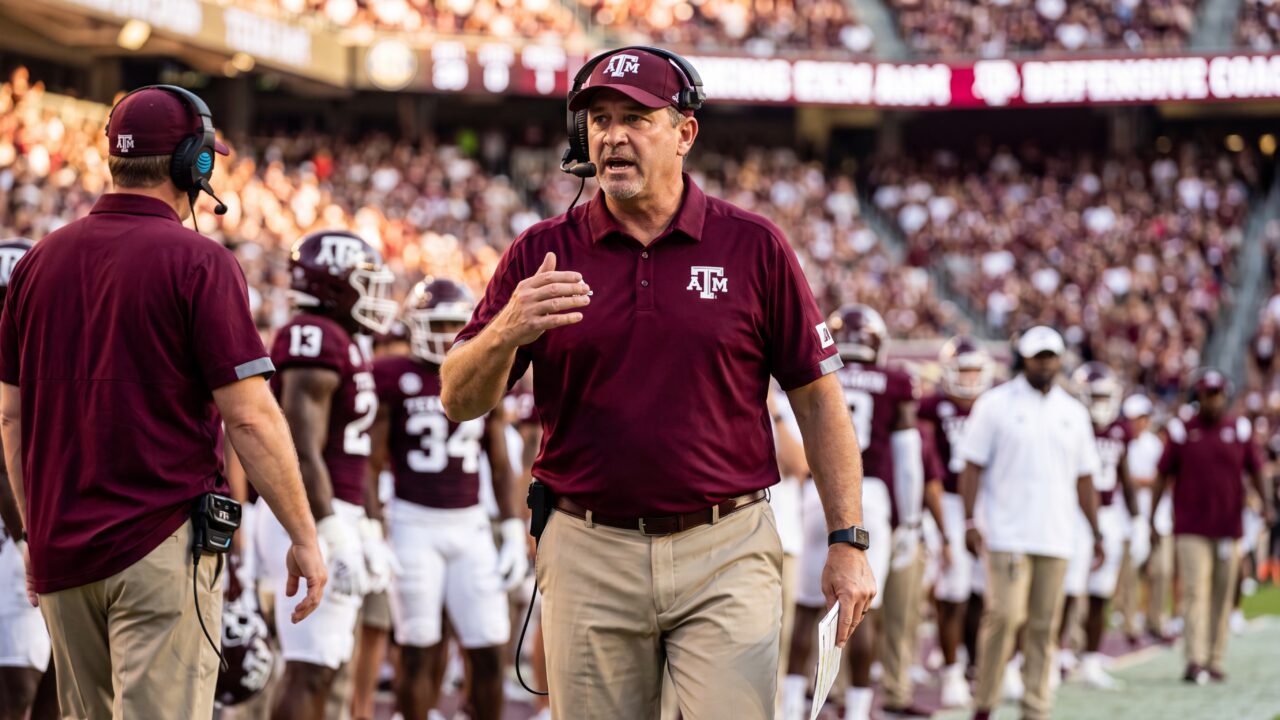
The Texas A&M defensive coaching staff has drawn attention this offseason for the unit’s clarity of approach and perceived impact on roster development.
The case that the Aggies’ defensive staff “might be the SEC’s best” is outlined by Sports Illustrated, and that evaluation matters for recruiting and short-term on-field outcomes.
Key Takeaways
- The Texas A&M defensive coaching staff is being singled out for coordinated scheme work and clear player development language.
- Perception of stronger defensive coaching can boost the Aggies’ recruiting pitch in the region and nationally.
- The staff’s continuity and approach could influence roster construction and on-field performance against top SEC offenses.
Texas A&M defensive coaching staff approach
On the field, the staff’s approach is described as cohesive and scheme-focused, emphasizing consistent messaging across position groups.
That coherence reduces learning curves for underclassmen and positions the staff to get faster returns from transfers and recent signees.
The ability to install repeatable game plans quickly can be decisive in close conference games where execution and discipline determine outcomes.
Coaching staff experience and recent moves
The staff profile appears to combine continuity with specific role clarity, creating predictable developmental pathways for players at each level of the defense.
Established position coaches who remain in place allow second- and third-year players to build on prior technique work rather than restart terminology or fundamentals.
That continuity also helps when integrating transfer portal additions because coaches can align newcomers to an existing system rather than retrofit scheme elements around personnel.
Staff comparison and context
Within the SEC, coaches are often evaluated on three practical axes: schematic clarity, player development, and recruiting traction.
The current attention toward the Aggies’ staff centers on how those three axes are being coordinated inside the program’s defensive room.
Evaluative coverage in national outlets has increased scrutiny on the unit, which raises expectations and clarifies what recruits and observers will watch for during the upcoming season.
Defensive staff evaluation versus SEC peers
| Aspect | Texas A&M evaluation | Typical SEC peer evaluation |
|---|---|---|
| Schematic clarity | Staff is portrayed as having unified terminology and installation methods | Many SEC staffs vary between high-level continuity and periodic schematic resets |
| Player development | Emphasis on coaching progressions across position groups | Some peers prioritize recruiting volume over in-system multi-year development |
| Recruiting traction | Perceived improvement in messaging tied to defensive identity | Recruiting strength among peers often ties to recent NFL placements and win streaks |
| Media attention | Receiving increasing national notice for staff cohesion | Top SEC staffs frequently attract similar attention during winning stretches |
SEC and College Football Playoff implications for Texas A&M
Reputational gains for a defensive staff can shift how opponents plan and how recruits view a program, altering the flow of roster construction over multiple cycles.
For the Aggies, a staff viewed as among the conference’s best raises expectations for defensive consistency, which matters for game-by-game SEC positioning and the broader CFP conversation.
If the unit sustains clear improvement, Texas A&M could gain both short-term wins from better on-field execution and long-term advantages in recruiting battles within the region.