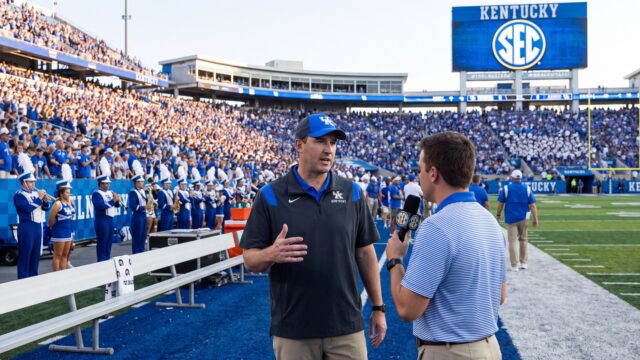

Eli Drinkwitz used his SEC Media Days platform to stake out a clear position on CFP expansion, arguing the playoff needs broader access for programs across Division I while rejecting greater committee control.
Speaking on a Day 1 panel that included Kentucky’s Will Stein, Oklahoma’s Brent Venables and Tennessee’s Josh Heupel, Drinkwitz said, “I am for expanded opportunities for schools in the playoffs” and emphasized that with 138 Division I programs there must be more access, as detailed by Saturday Down South.
Key Takeaways
- Eli Drinkwitz supports expanded College Football Playoff access and said more teams should be able to reach the postseason.
- Drinkwitz expressly warned against giving selection committees greater authority, calling committees a bad idea.
- Negotiations have split along lines with the SEC backing a 16-team, 5+11 model and the Big Ten pressing a 24-team concept that would change automatic qualification rules.
Comments at SEC Media Days
Drinkwitz framed his remarks on Day 1 in Tampa alongside several conference figures, making clear his view was a coach-level position rather than an administrative proposal.
He used simple arithmetic — pointing to 138 Division I programs — to argue the playoff should give more schools realistic postseason access.
Why coaches view committees as a problem
Drinkwitz’s critique of committees reflects a wider coaching concern about transparency and accountability when selections are subjective.
Coaches who favor on-field qualification argue that automatic paths or clear performance thresholds reduce controversy and protect competitive integrity.
When Drinkwitz said, “I am not for giving the committee more opportunities to put people in the playoffs,” he echoed a practical argument that coaches want rewards tied to results rather than subjective determinations.
CFP expansion negotiations and sticking points
Talks over expanding the playoff have centered on how many teams would participate and how they would qualify.
The SEC’s preferred route is a 16-team field built around a 5+11 model that preserves automatic spots for major conference champions while adding more at-large access, while the Big Ten has pushed a 24-team concept that would alter automatic qualification and has been a core point of disagreement.
CFP format comparison
| Format | Field size | How teams qualify |
|---|---|---|
| 12-team CFP | 12 teams | Current transitional 12-team format with seeded access and opening-round games at campus sites |
| 16-team proposal | 16 teams | SEC-backed 5+11 model: five automatic qualifiers for major conference champions plus 11 at-large spots to broaden access while preserving conference champions |
| 24-team proposal | 24 teams | Big Ten-driven concept that would expand the field and remove guaranteed automatic qualification for conference champions |
SEC implications for CFP expansion and recruiting
For Missouri and similar mid-tier SEC programs, a larger field changes the recruiting pitch by increasing the realistic pathway to playoff exposure without having to unseat the conference elite each season.
How the CFP is structured will also shape roster construction, scheduling priorities and NIL messaging, as coaches decide whether to prioritize conference wins, nonconference resume-building, or roster depth for an extended postseason.