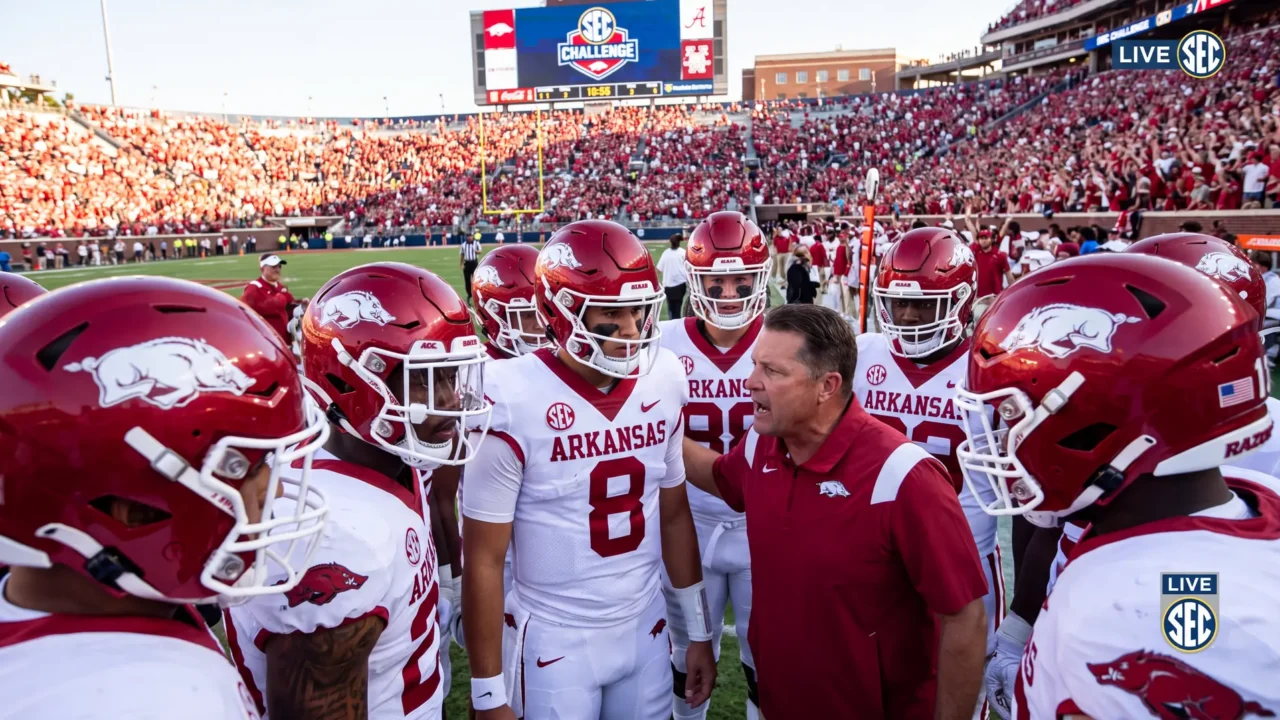
The Arkansas Razorbacks offense enters a season framed by local coverage as one of the program’s defining questions under Tim Cramsey. Offensive performance is now the primary variable that will set expectations for the team’s SEC trajectory.
Local reporting highlighted that challenge in blunt terms, calling this stretch the program’s “ultimate SEC challenge” and raising immediate questions about schematic fit and matchup preparedness for the fall. thv11.com characterized the offensive task in stark terms, setting the frame this piece builds on.
Key Takeaways
- The Arkansas Razorbacks offense is positioned as a focal point for the program’s season-long competitiveness under Tim Cramsey.
- The description of an “ultimate SEC challenge” signals heightened pressure from opposing conference defenses on schematic execution and consistency.
- How the offense adapts to SEC-level defensive speed and physicality will materially influence Arkansas’ standing in league play and its recruiting posture.
How Tim Cramsey will reshape the Arkansas Razorbacks offense
As the offensive architect credited in local coverage, Tim Cramsey’s priorities will be judged by the unit’s ability to sustain drives and produce points against top-level SEC opposition. The reporting frames his role as central to setting the offense’s identity for the season.
From a beat perspective, a change in play-calling emphasis or schematic balance is the most attainable lever to alter outcomes quickly. Expect focus on execution fundamentals and situational play design as immediate, verifiable areas of emphasis rather than wholesale personnel predictions.
Game planning against SEC front sevens and secondary speed typically forces offenses to simplify reads and maximize high-percentage plays. That kind of conservative, efficiency-first approach is a realistic pathway for any staff trying to manage an elevated schedule of defensive tests.
SEC defenses that create the ultimate SEC challenge
The phrase “ultimate SEC challenge” is shorthand for the cumulative quality of conference defenses Arkansas will face across a season. SEC defenses commonly present a mix of power at the point of attack and speed in the second level that tests both blocking schemes and route timing.
On a week-to-week basis, the Razorbacks’ offense will need to handle tempo changes, disguised coverages, and front-seven aggression without relying on speculative personnel claims. Preparing for these core defensive traits is a practical measure of readiness against the conference slate.
Successful offensive attacks in the SEC often hinge on quick decision-making from quarterbacks, clean protection sets, and consistent situational play-calling. Those are controllable elements that separate efficient units from those that struggle when the opponent elevates pressure and coverage complexity.
Offensive context versus SEC peers
| Area | Arkansas Razorbacks offense | Typical SEC benchmark |
|---|---|---|
| Coaching emphasis | Framed by local coverage around Tim Cramsey’s direction, with an emphasis on shaping identity for the season. | Benchmarks emphasize adapting to opponent strengths and defensive tendencies each week. |
| Matchup challenges | Described as facing an “ultimate SEC challenge,” implying consistent tests from physical front sevens and fast second-level defenders. | SEC peers routinely prepare for top-tier front alignment strength and secondary speed across the schedule. |
| Situational execution | Local reporting highlights situational play and execution as decisive for Arkansas’ offense this season. | SEC standards prize efficiency on third down, red-zone scoring, and two-minute offense management. |
SEC standing and recruiting implications
Offensive performance against the SEC slate will feed directly into Arkansas’ position in the league standings because conference wins are the currency that defines seasonal progress. When an offense struggles to move the chain against common conference defensive traits, the margin for error in the standings shrinks quickly.
Recruiting narratives for offensive prospects are influenced by on-field results and schematic clarity. A clearly articulated offensive identity under an established play-caller tends to resonate with recruits seeking developmental fit, while inconsistency can create doubts on the trail.
Longer-term College Football Playoff and postseason discussions for the program hinge on consistent offensive output. For Arkansas, meeting the SEC challenge offensively is a necessary condition to remain competitive for higher-tier objectives.