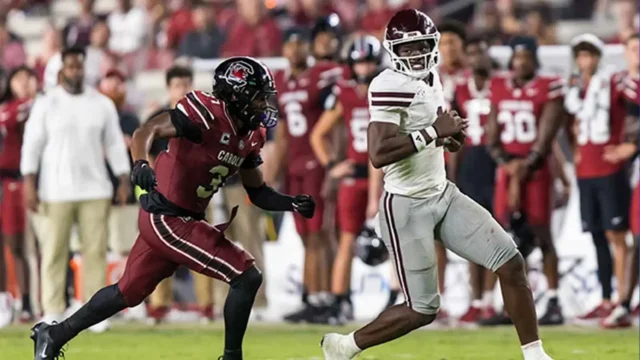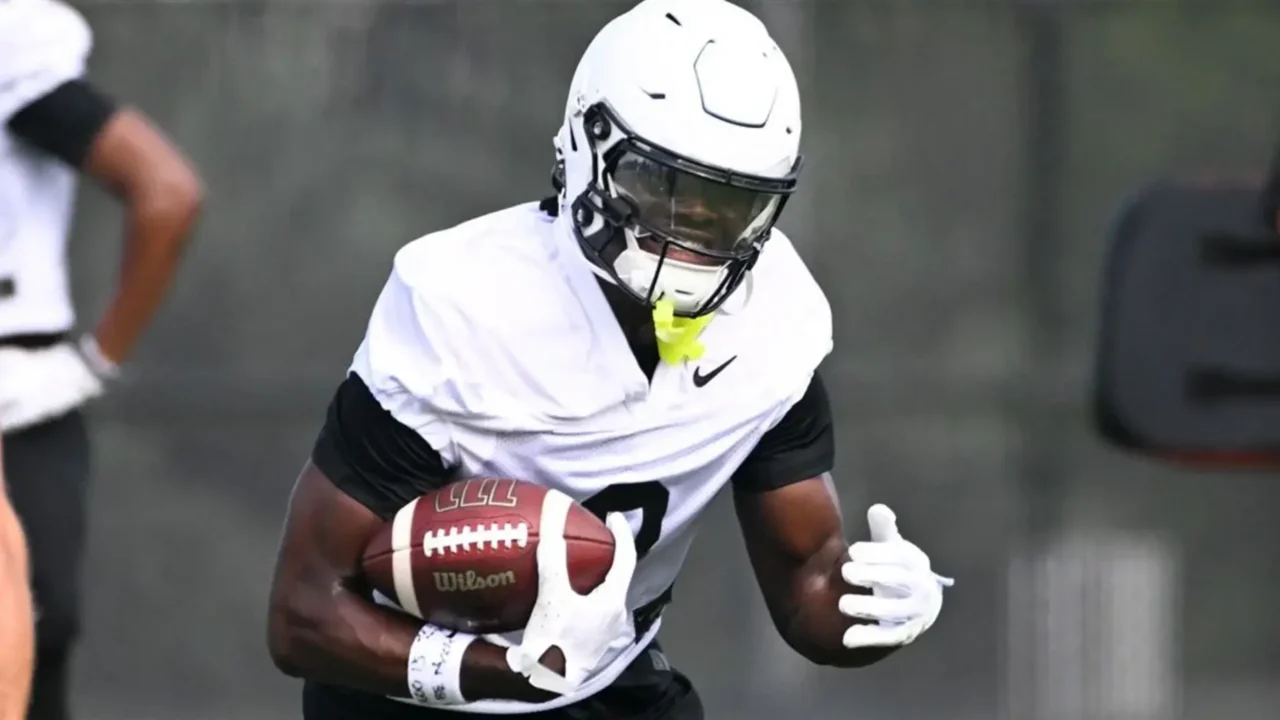
Bruce Feldman returned to a familiar theme for South Carolina, placing Nyck Harbor back atop his 2026 Freaks List and naming two other Gamecocks among college football’s most physically elite players.
Feldman’s reporting pushed national eyes toward Columbia by cataloging the measurable traits NFL scouts logged during the offseason; that reporting is summarized here from 247Sports and Bruce Feldman’s annual evaluation.
Key Takeaways
- Three South Carolina players made Bruce Feldman’s 2026 Freaks List, with Nyck Harbor returning to the No. 1 slot among 101 players.
- Feldman’s notes emphasize reported measurements, top-end GPS speeds and body-fat readings that explain why NFL scouts circled Columbia during testing.
- EDGE Dylan Stewart (No. 14) and QB LaNorris Sellers (No. 36) join Harbor on the list, reinforcing South Carolina’s profile for NFL evaluators and recruits.
Why Nyck Harbor tops Feldman Freaks List
Harbor’s combination of size, length and straight-line speed is the core reason Feldman bumped him back to No. 1 after a one-year slip.
Feldman cites NFL scouts who measured Harbor and noted a physical package that is rare for a running back: a tall frame with unusually long arms, elite track times, and a sprint speed that rivals perimeter skill players.
Those raw traits change how defensive coaches must approach schematic matchups in Columbia and how NFL evaluators project him at the next level, with his track work and top-end GPS bursts reinforcing a power-to-speed profile.
What Dylan Stewart and LaNorris Sellers bring physically and on tape
Dylan Stewart landed at No. 14 on the Freaks List after back-to-back production and a summer of testing that drew national attention; Feldman pairs those measurements with Stewart’s 2025 tackle-for-loss and sack production.
LaNorris Sellers appears at No. 36, a placement rooted in a two-way profile: significant passing production as a freshman combined with meaningful rushing output and offseason testing that elevated his projection.
Freaks List metrics for South Carolina players
| Player | Reported measurements | Speed notes | Body composition |
|---|---|---|---|
| Nyck Harbor | Noted for a very tall frame with exceptional arm length and wingspan as measured by visiting NFL scouts | Elite track sprinter for his size and reported to have reached the highest GPS top speed among the group | Extremely low body-fat reading reported, signaling rare power-to-speed balance |
| Dylan Stewart | Prototype edge frame noted for length and functional mass suitable for both pass rush and run defense | Reported to log high GPS velocities for a defensive lineman, marking him as a speed-to-power defender | Low single-digit body-fat reading reported for a two-year impact performer |
| LaNorris Sellers | Prototypical quarterback build with improved lean mass that supports both pocket play and zone-read mobility | Reported to have reached strong GPS speeds that align with his rushing production and big-play ability | Minor body-fat reduction reported this offseason as part of his physical refinement |
Freaks List impact on South Carolina SEC positioning and NFL draft stock
Having three players recognized on Feldman’s Freaks List gives South Carolina a tangible recruiting and roster-construction message about producing NFL-caliber testing and tape at Williams-Brice Stadium.
For the NFL draft, the list sharpens pre-draft narratives: Harbor as a rare physical prototype at his position, Stewart as a tested edge with production, and Sellers as a dual-threat quarterback with measurable traits that attract evaluators.
Feldman’s annual Freaks List and the scout measurements it collects in Columbia shaped the metrics and context cited above.