Big Blue Nation has carried a defensive skepticism around quarterbacks for more than a decade, a “16-year callus” that reshaped expectations heading into 2026.
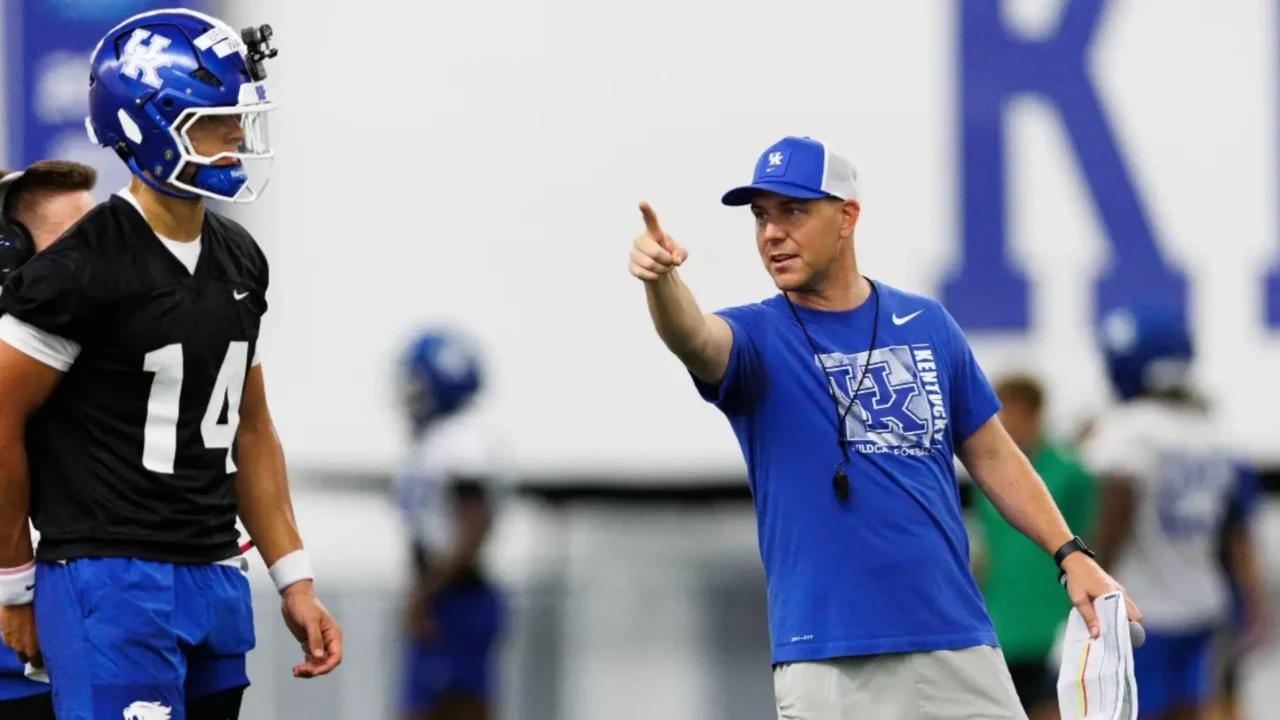
According to a report from On3, Will Stein’s recent work with quarterbacks offers a direct statistical contrast to what Kentucky has produced since 2022, and that contrast matters for how this program thinks about offense.
Key Takeaways
- Will Stein’s last four quarterbacks averaged 3,998 passing yards per season and completed 72.9% of passes, signaling efficiency Kentucky has lacked.
- Since 2022, Kentucky’s Total QBR sits at 54.2 and ranks 64th among 67 power conference programs, highlighting a clear performance gap at quarterback.
- Under Stein, Oregon quarterbacks posted a Total QBR of 85.8, second only to Ohio State in the cited breakdown and offering a proven high-efficiency template.
- Mike Hartline finished his Kentucky career with a 3,000-yard season in 2010, a benchmark that underscores how rare high-volume passing has been in recent program history.
Will Stein versus Kentucky quarterback history
Will Stein’s arrival in Lexington is best judged against the program’s history with passers from Tim Couch to Mike Hartline and Andre Woodson.
The Wildcats produced elite individual quarterbacks during the Air Raid era, a stretch once described as “basketball on turf” by CM Newton, and those names remain the bar for fan expectations.
Mark Stoops’ winning run at Kentucky did not coincide with a 3,000-yard passer, and that absence of high-end passing outputs contributed to the current skepticism among supporters.
Quarterback performance comparison
The raw numbers tied to Stein’s recent four-year window create a stark, verifiable contrast with Kentucky’s recent team-level passing metrics.
Those figures focus on passing efficiency and production rather than speculative rankings, and they clarify why the program’s messaging about offensive identity will be important this offseason.
Passing context and verified comparison
| Subject | Verified passing fact | Context |
|---|---|---|
| Will Stein’s last four QBs | Avg. 3,998 passing yards; 8.9 YPA; 72.9% completion; 40.3 total TDs; 398 non-sack rushing yards | Includes Stein’s final year at UTSA and recent Oregon seasons as compiled in the reporting |
| Kentucky team passing since 2022 | Total QBR 54.2, ranked 64th of 67 power conference programs | Team-level QBR highlights Kentucky’s comparative inefficiency at quarterback in the modern era |
| Dante Moore (under Stein) | 3,500 passing yards and 32 touchdowns | Used as a baseline for Stein’s top-end quarterback outcomes while at Oregon |
| Mike Hartline (Kentucky) | Finished career with a 3,000-yard season in 2010 | Hartline stands as the most recent Kentucky passer to reach the traditional 3,000-yard benchmark |
Why Stein’s methods matter for roster construction
Stein’s statistical footprint indicates he emphasizes accuracy, efficiency and an offense that sustains high-volume passing without sacrificing completion rate.
Kentucky’s recent portal usage at quarterback produced mixed results, and Stein’s arrival shifts the recruitment and development conversation toward quarterbacks who fit a high-efficiency profile.
That shift has immediate roster consequences because evaluation priorities will tilt toward completion rate, decision-making and scheme adaptability rather than purely arm strength or rushing upside.
Will Stein and Kentucky SEC and recruiting outlook
On the recruiting trail, presenting a clear quarterback development plan backed by Stein’s numbers can change class-level conversations across the expanded SEC membership.
Improved passing outcomes would affect game-day offensive ceiling and bolster Kentucky’s standing in position-by-position recruiting comparisons across the conference.
Higher offensive efficiency at quarterback directly improves the realistic ceiling for divisional wins and College Football Playoff positioning over multiple seasons.