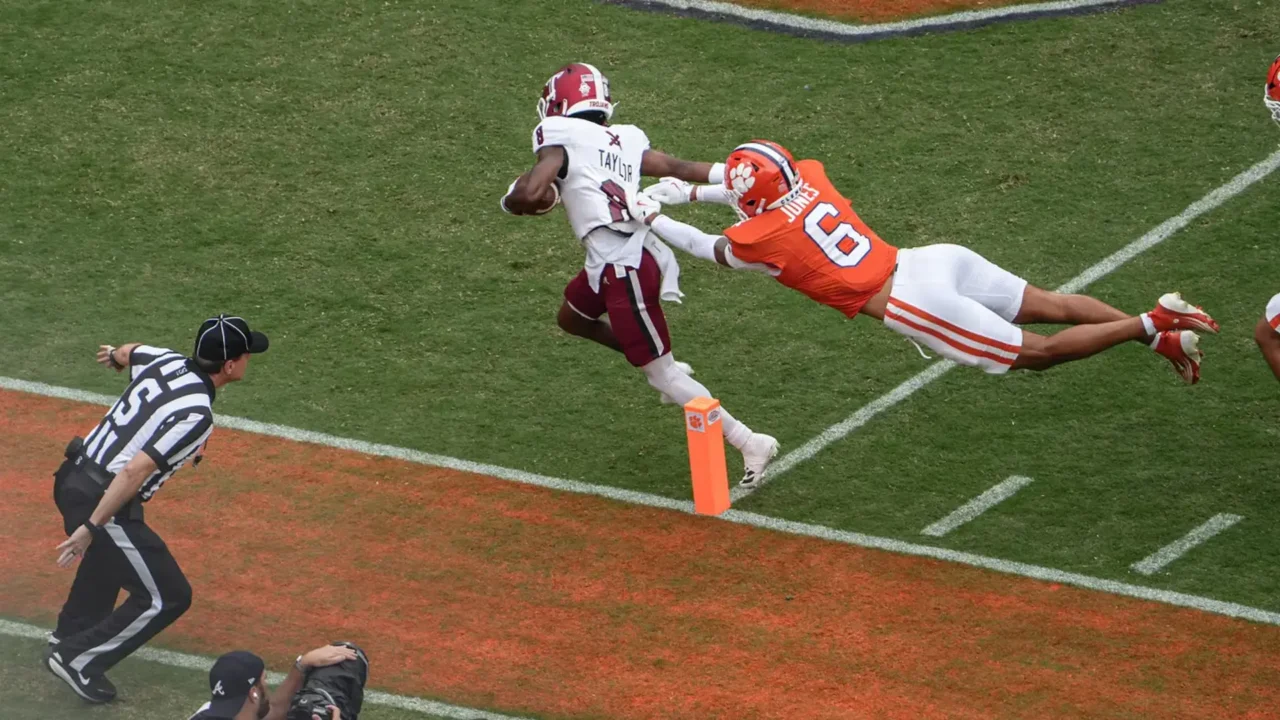
Tray Taylor Auburn transfer landed late in the preseason and immediately changes the depth chart conversation in the slot. Taylor arrives on the Plains with a fifth year of eligibility and a résumé that includes stops at Coastal Carolina and Troy.
The addition reinforces Auburn’s receiving room after heavy turnover this offseason, and it gives the roster a veteran slot option who can compete for immediate reps, according to Sports Illustrated.
Key Takeaways
- Tray Taylor joins Auburn with a fifth year of eligibility after playing at Coastal Carolina in 2024 and Troy in 2025.
- Taylor is listed at 5-foot-8 and 160 pounds and projects as a compact, versatile slot receiver who can provide immediate depth.
- The pickup comes amid significant receiver turnover and complements a group of transfer additions with experience in smaller conferences.
Tray Taylor Auburn transfer role
On the field, Taylor projects as a true slot receiver who will be asked to run short-area routes, work the middle thirds and provide quick separation over the middle. At 5-foot-8 and 160 pounds, his profile fits the archetypal SEC slot: compact, sudden and quick to the catch point.
Taylor’s pathway — from junior college to Coastal Carolina in 2024 and then Troy in 2025 — gives him a varied background against different competition and schemes. That variety should shorten his acclimation curve to Auburn’s playbook, but arriving late in preseason practices creates a steep learning curve for timing and route concepts.
Coaches will likely evaluate Taylor during early fall reps with a focus on quick communication, route precision and special-teams contributions. For a player joining this late, immediate impact often comes through reliability in short-yardage passing situations and early-down slot work.
How Taylor fits the rebuilt Auburn receiver room
Auburn’s receiving corps was rebuilt largely through the transfer portal this cycle, and Taylor arrives as another veteran piece among that group. The current core features former mid-major contributors alongside younger prospects who bring length and contested-catch profiles.
Because many of the incoming receivers have played together in similar offensive systems, Taylor must earn his role against a nucleus that already has growing chemistry and familiarity with the returning quarterback. That familiarity gives the established core a baseline advantage in timing and route sync.
Still, depth matters in the SEC. Taylor’s presence offers more rotation options in three-wide sets, and his skill set should pair naturally with perimeter targets who stretch the field vertically, creating mismatches underneath.
Experience comparison for Auburn receivers
| Player | Previous stop | Role or note |
|---|---|---|
| Tray Taylor | Coastal Carolina (2024), Troy (2025), JUCO earlier | Veteran slot receiver profile; late addition with a fifth year of eligibility |
| Jeremiah Koger | USF | Established transfer target who joins Auburn as part of a USF group |
| Keshaun Singleton | USF | Former USF contributor and part of the incoming receiving core |
What Taylor means for Auburn roster and SEC outlook
With the Tigers identifying a returning signal-caller for 2026, the addition of experienced slot pieces like Taylor gives the offense more route-to-route options on game day. Depth in the slot helps protect against attrition and allows rotation packages that can keep opponents guessing.
From a roster-construction standpoint, Taylor represents a low-risk, veteran add who can compete for snaps immediately while the younger transfers and true freshmen continue to develop. That competition should lift practice standards and prepare the wideout room for the physicality of SEC defenses.
On a conference level, Auburn’s accumulation of varied receiving experience — players who have competed in Group of Five, Sun Belt and JUCO ranks — tests the common assumption that only Power Five returners can produce in SEC play. Preparing those receivers against a top-tier conference defense in practice will be an important barometer for how quickly they translate production to game situations.
Reporting in this piece is based on local coverage and the original report.