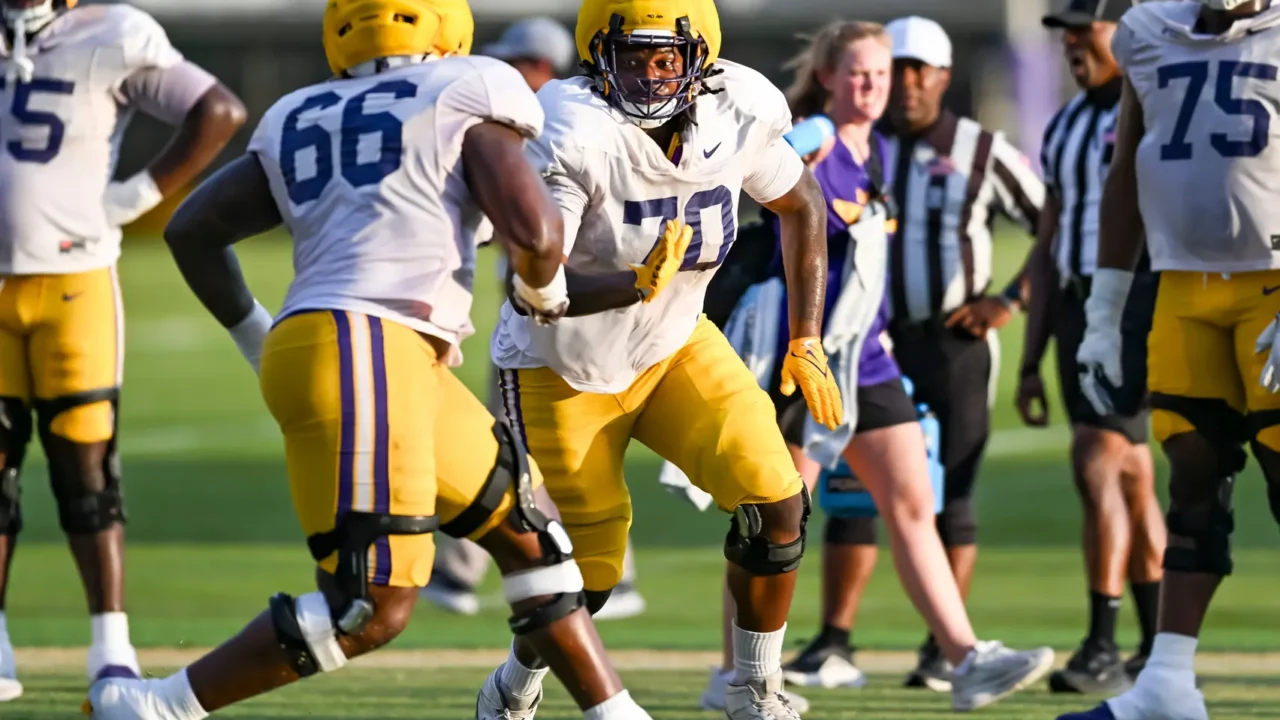
Through the Tigers’ first 14 practices of fall camp Lane Kiffin put LSU offensive line depth squarely on the short list of concerns for the roster. That assessment matters because Kiffin’s quick-tempo attack depends on reliable rotation and protection beyond the starting five.
The fall-camp snapshot, reported by AOL.com, shows a clear starting unit but a backup room that still needs work to earn consistent game reps. Kiffin’s blunt appraisal—”It’s a concern, something that is high on our list”—frames how staff are prioritizing practice reps and preseason snaps.
Key Takeaways
- Lane Kiffin said depth on the offensive line hasn’t coalesced through the first 14 practices of fall camp.
- LSU’s projected first-team offensive line has been set since spring drills with Seaton, Bordelon, Moore, Bah and Weston Davis as the starters.
- The Tigers added 10 linemen from the transfer portal this offseason but most of those arrivals remain down the depth chart.
- Kiffin dismissed the idea of relying on more than five offensive linemen in competitive games until backups improve.
LSU offensive line depth breakdown
The starting five has been consistent since spring: Jordan Seaton at left tackle, Bo Bordelon at left guard, Braelin Moore at center, Aliou Bah at right guard and Weston Davis at right tackle. That continuity gives the offense a defined front but also hides the thinness behind it if injuries or fatigue force rotation.
Outside of Bah and Seaton, only William Satterwhite II and Sean Thompkins Jr. have logged limited first-team repetitions in fall work. The other transfer additions—Adrian Lamb, Ja’Mard Jones, Ja’Quan Sprinkle, Devin Harper, Darrin Strey and JaKolby Jones—have been described in practice as mired deep on the chart and still developing positional consistency.
Where backups must improve during fall camp
Kiffin and offensive coordinator Charlie Weis Jr. run a tempo that requires backups to be technically sound and physically ready to sustain blocks in rapid succession. That makes every practice rep for reserves more consequential; coaches are treating the preseason as a crash course to close the gap between starter-level performance and backup reliability.
Coaching language has been direct: “They got to improve so that we feel more confident with that,” Kiffin said, and the staff has publicly dismissed the idea of inserting more than five linemen on game days until those improvements are shown. The priority is clear—get the second group functioning cleanly in the scheme, not simply increase roster depth on paper.
Experience and reps comparison
| Group | Practice status and context |
|---|---|
| Projected starters | Seaton, Bordelon, Moore, Aliou Bah and Weston Davis have held first-team roles consistently since spring drills and remain the primary unit. |
| Limited first-team reps | William Satterwhite II and Sean Thompkins Jr. have seen spot duty with the first group but have not yet earned regular rotation minutes. |
| Other transfer arrivals | Six additional portal linemen (Adrian Lamb, Ja’Mard Jones, Ja’Quan Sprinkle, Devin Harper, Darrin Strey, JaKolby Jones) have been operating deeper on the depth chart while adjusting to LSU’s system. |
How LSU offensive line depth shapes short-term roster construction
Depth status impacts practice plan, special-teams roles and how aggressively LSU can run its tempo without risking breakdowns late in drives. If backups aren’t comfortable in the scheme, coaches must either slow the rotation or increase individual snaps for reserves, both of which affect game-day conditioning and play-calling flexibility.
On the recruiting and roster-construction front, the current snapshot puts pressure on summer evaluators and staff to convert portal additions into dependable pieces before the season opener. That conversion isn’t instantaneous; it requires technique work, communication with the starting five and live reps against LSU’s defense in practice.
How LSU offensive line depth affects SEC and CFP hopes
In the SEC a thin offensive line room can tilt competitive margins against premier front sevens and undermine both run consistency and quarterback protection—factors that matter for conference standings and College Football Playoff positioning. For a program chasing long-term title windows, short-term depth setbacks force coaches to balance immediate play-calling plans with longer-range roster development.
Recruiting and roster management will remain focal points as staff assess whether more portal movement or internal development will supply the dependable depth Kiffin wants, and those decisions have clear implications for how LSU competes inside the conference and on the CFP trail.
Reporting for the positional observations was filed originally by Cory Diaz of the Lafayette Daily Advertiser and informed this beat update.