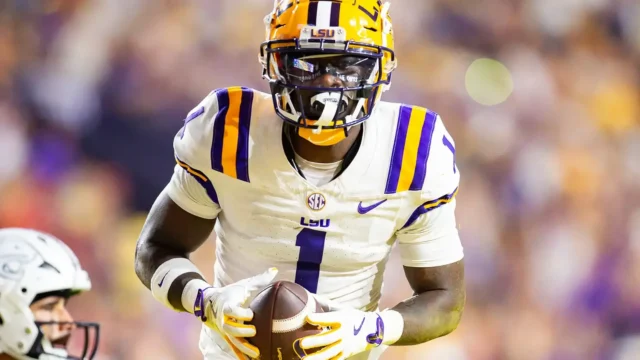

Jordan Seaton’s arrival in the LSU transfer class changes the early roster calculus in a way that matters on every down. The Tigers signed multiple high-profile transfers, but Seaton’s profile as a dominant left tackle addresses a glaring need that cost the offense last season.
As reported by Sports Illustrated, Seaton was the highest-rated offensive lineman in the portal after two seasons with Colorado and brings second-team All-Big 12 credentials and strong left-tackle tape.
Key Takeaways
- Jordan Seaton was identified as the highest-rated offensive lineman in the transfer portal after two seasons at Colorado.
- Seaton earned second-team All-Big 12 honors and hardly allowed pressure at left tackle in his most recent season.
- LSU added Seaton as a direct upgrade to an offensive line that allowed 29 sacks last season.
- Seaton’s technical pass-protection skill set projects to improve blind-side stability and run-block sustain for the Tigers.
How Jordan Seaton fits LSU’s offensive scheme
Seaton’s tape from Colorado shows a tackle who consistently won one-on-one pass sets and held the edge against speed and power rushers. That trait is immediately relevant given LSU surrendered 29 sacks last year; improving the left side is a short path to fewer negative plays and cleaner down-and-distance situations.
What makes Seaton a plug-and-play pickup is his combination of footwork and hand placement at the point of attack, traits that translate to both slide-protection concepts and gap-run schemes. The staff has emphasized running the football as a core part of the offense, and Seaton’s ability to sustain blocks at the second level should help open lanes for perimeter and inside zone looks.
Seaton has also been vocal about the cultural shift he sees in Baton Rouge.
“It’s just different here,” he said in the spring. “Being here really is just different from how we train, to how we work. And the word ‘extra’ around here—everybody, we’re big on extra, because doing what’s required is not enough.”
Pass protection and run game context
| Area | Last season | With Seaton |
|---|---|---|
| Pass protection (sacks allowed) | LSU allowed 29 sacks, a clear weakness that disrupted timing and third-down conversion | Seaton’s left-tackle play should reduce blind-side pressure and stabilize early-down pass sets |
| Run game | LSU finished as the worst rushing attack in the SEC, limiting play-action and finishing drives | Seaton brings sustain and second-level reach required to improve run lanes inside and on the edge |
Tape fit and roster construction implications
Watching Seaton on film explains why he was rated so highly in the portal: he sets a consistent base, mirrors quicker rushers without over-committing, and finishes with quality hand placement. Those are rare traits to find in one transfer who also projects to start immediately.
Beyond the individual matchup wins, Seaton’s presence changes how opponents must allocate their best rushers. If defenses are forced to account for a reliable left tackle, pressure schemes that previously exploited LSU’s edge weaknesses become harder to execute.
That shift has a downstream effect on younger linemen and quarterbacks, too. A dependable edge allows the offense to call more intermediate throws and sustained drives, which in turn helps the running backs and play-action game return to earlier form.
Seaton impact on LSU recruiting and CFP hopes
LSU’s current roster is heavily constructed through the transfer portal, and adding a top-tier offensive tackle signals continued willingness to build through experienced portal pieces. That approach can attract complementary transfers and reassure recruits looking for immediate player development.
From a College Football Playoff perspective, fewer negative plays and better pass protection are non-glamorous but critical upgrades. Protecting the quarterback and improving the run game make the offense less boom-or-bust and more consistent against quality SEC defensive fronts.
The original reporting that informs these observations is linked earlier in the story and provides the profile and quotes used here.