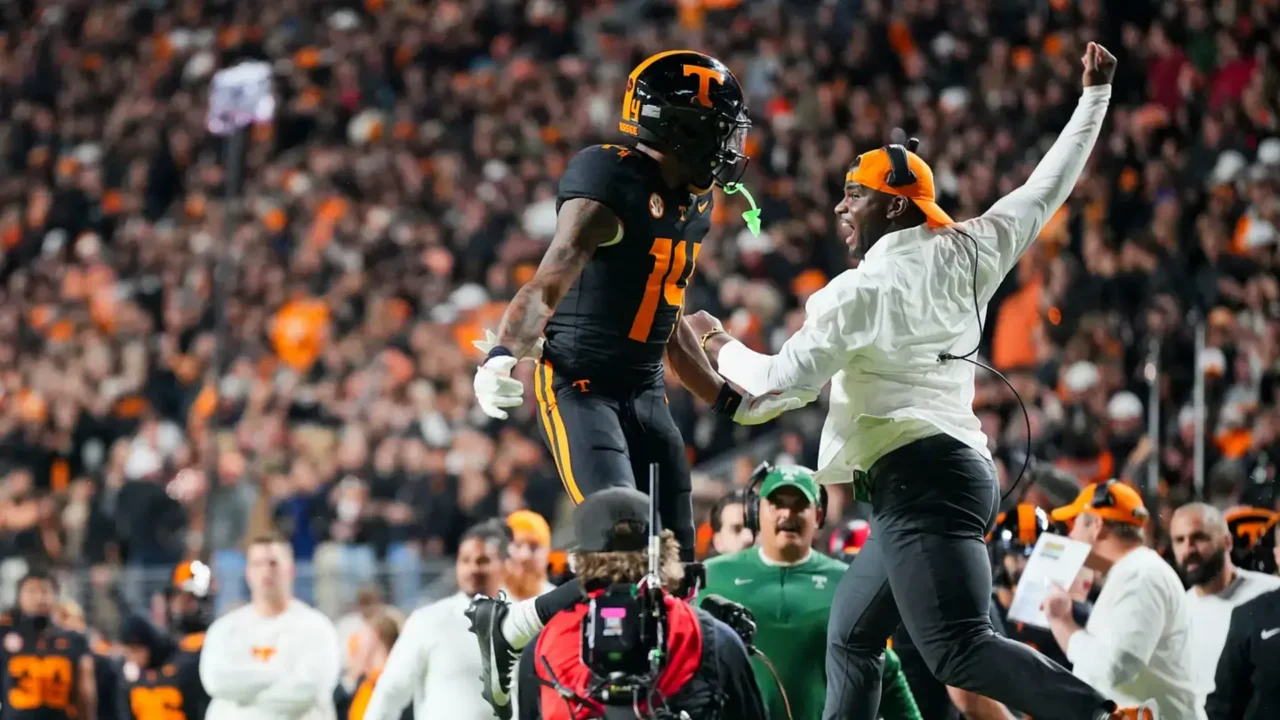
Tennessee’s receivers spent part of the offseason working with eye patches as a concentration drill designed to attack a persistent problem with drops. The experiment was deliberately focused on changing stimulus and mental processing rather than overhauling catching mechanics.
The idea came to the program after game coordinator and wide receivers coach Kelsey Pope heard a podcast on stimulus and vision. As detailed by Tennessee Volunteers On SI, the staff purchased about 25 eye patches and logged what Pope described as thousands of catches with the group.
Key Takeaways
- Kelsey Pope introduced eye patches to Tennessee’s receiver room after hearing a podcast about triggering different stimulus in the brain.
- The staff purchased about 25 eye patches and logged what Pope described as thousands of catches with one eye covered.
- Pope said the team viewed drops as a focus-related issue rather than a true hand-eye coordination problem.
- The drill complements technique work and habit-building exercises used by the Tennessee staff.
How the eye patches drill works
The drill is straightforward in execution but deliberate in intent: players cover one eye and complete high-volume catching work to force a different visual and cognitive stimulus. That altered visual input changes how the brain processes an incoming ball and removes some reliance on automatic depth cues.
Pope described the origin in simple terms: “I was watching a podcast late and they talked about triggering different stimulus in your brain and covering one eye.” He said receivers responded, the staff bought patches and the group “caught freaking a thousand balls.”
On the field the drill shifts practice emphasis from pure hand technique to sustained concentration under an unusual constraint. Coaches can then watch which players sustain focus, adjust body alignment and secure the ball consistently when their normal visual routine is interrupted.
Pope’s path and receiver development record
The patch experiment fits a coach whose resume centers on receiver play and player development. Pope starred at Samford, finishing his playing career with 250 receptions and later spent time with the Arizona Cardinals before entering coaching.
His coaching ascent led through smaller programs and into Knoxville as an offensive analyst in 2021, followed by promotion to wide receivers coach in 2022 and additional pass game coordinator responsibilities ahead of the 2026 season. During his Tennessee tenure he has been credited with developing players such as Jalin Hyatt and others who bought into his methods.
Pope frames the patches as another tool in a development toolbox that also includes technique work, physical blocking drills and habit-building exercises. He emphasized that becoming a complete Volunteer receiver requires attention to details beyond catches and touchdowns, including the aggressiveness and focus needed on blocks.
Eye patches experiment in program context
| Topic | Verified detail |
|---|---|
| Eye patches experiment | About 25 patches purchased and thousands of reps focused on concentration to reduce drops. |
| Pope playing and coaching background | Played at Samford (2010–13) with 250 career receptions; spent time with the Arizona Cardinals; rose to WR coach and pass game coordinator at Tennessee. |
Why the patch work matters for receiver development
Practically, the patch drill provides coaches an observable way to separate players who are catching through routine from those who are catching with deliberate focus. Pope framed the problem as mental; he said he didn’t believe the group had a raw hand-eye issue but rather a concentration lapse on certain plays.
For a development staff, that distinction changes which drills are emphasized and how reps are structured. If drops stem from mental lapse, repetition under novel stressors like vision changes can rewire attention and habit formation in practice, which the staff hopes will translate to more reliable performance on game days.
Pope also tied the drill to broader habits he wants to build, praising plays that show effort and physicality beyond receiving. Those same traits are used by coaches as recruiting and teaching points when pitching the program to prospects who value development and positional polish.
SEC receiver development and College Football Playoff implications
In the SEC, marginal gains in receiver reliability can swing close games and influence conference standings. A receiver room that reduces drops and sustains effort on blocks strengthens both the passing game and the run game by keeping drives alive and setting edge blocks.
From a recruiting and roster-construction angle, specific, defensible development methods can be persuasive. High school prospects and their evaluators track how position coaches improve players; demonstrating novel drills that produce measurable practice buy-in can be useful in recruitment conversations and roster planning aimed at long-term depth for CFP runs.
This article draws on the linked original reporting.