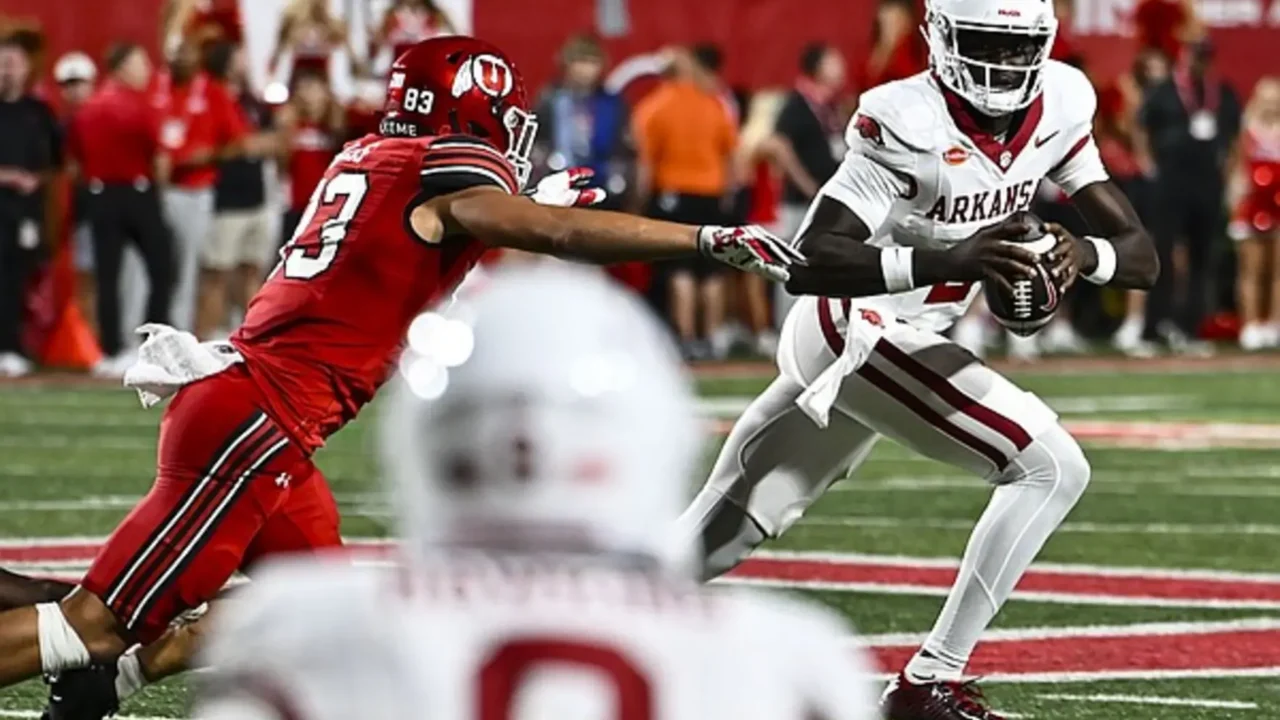
The AJ Hill debut came under clear duress, inserted with 12:47 remaining in the fourth quarter of a 43-10 loss at Rice-Eccles Stadium and with the score already 43-3.
As detailed by Whole Hog Sports, Hill completed 8 of 14 passes for a touchdown and a 143.7 rating but was sacked on Arkansas’ final two plays for losses of 14 and 9 yards.
Key Takeaways
- AJ Hill completed 8 of 14 passes with one touchdown and a 143.7 quarterback rating in his Arkansas debut.
- KJ Jackson finished the game 14 of 34 for 139 yards and one interception with a 69.6 rating.
- Hill was sacked on Arkansas’ final two offensive plays for losses of 14 and 9 yards, which coach Ryan Silverfield characterized as “not necessary.”
- Silverfield said he would “probably” stick with Jackson as the starter for next Saturday but had not made a final decision.
AJ Hill debut and Arkansas QB race
The late-game switch to AJ Hill was both tactical and evaluative, a chance for the coaching staff to see the sophomore transfer from Memphis under live pressure.
Hill’s first pass was tipped and nearly intercepted, showing timing and chemistry issues the offense has struggled with all night, and his scoring drive produced Arkansas’ lone touchdown after the ball bounced off a Utah defender into Ismael Cisse’s hands.
Coach Ryan Silverfield allowed that “AJ did some good things, but it’s clearly not good enough,” and he insisted he would review film before finalizing the starter decision, leaving the quarterback conversation unsettled for the week ahead.
What went wrong for the Arkansas offense in Salt Lake City
Arkansas managed just three points and four first downs in the opening half hour against a Utah defense that started fast.
The Razorbacks’ passing game was inconsistent, receivers dropped passes at key moments, and protection breakdowns produced sacks and hurried throws that stalled drives.
Turnovers and stalled drives forced Arkansas into a reactive posture and Silverfield said the unit must “be better in all facets,” starting with coaching adjustments.
Adam Hawkes homecoming and defensive highlights
Adam Hawkes entered at right tackle in the fourth quarter against the same Utah program where his grandfather, Thomas Hawkes, played from 1964-66, adding a personal subplot to the trip.
Christian Harrison recorded his second career interception, and Arkansas’ defense generated a handful of plays that prevented even larger deficits.
Receiver Monte Harrison finished with three receptions for 18 yards, a modest uptick in usage during a night dominated by defensive pressure.
Quarterback stat snapshot at Rice-Eccles Stadium
| Player | Comp-Att | Yards | TD/INT | QB Rating | Notes |
|---|---|---|---|---|---|
| KJ Jackson | 14-34 | 139 | 0 TD / 1 INT | 69.6 | Starter for most of the game; inconsistent accuracy and decision-making. |
| AJ Hill | 8-14 | — | 1 TD / 0 INT | 143.7 | Scored on a tipped ball turned into a TD; sacked for losses of 14 and 9 yards on final plays. |
Starter uncertainty complicates Arkansas SEC outlook
The immediate consequence of the Hill appearance is a checklist of questions heading into an 11 a.m. kickoff at No. 2 Georgia next Saturday, including protection, timing and ball security.
Silverfield’s comment that he would “probably” stick with Jackson preserves short-term continuity, but the staff must now prepare for both quarterbacks in practice and game planning.
How Arkansas handles starter clarity will affect messaging to recruits and NIL positioning as the program balances immediate results with longer-term roster construction.