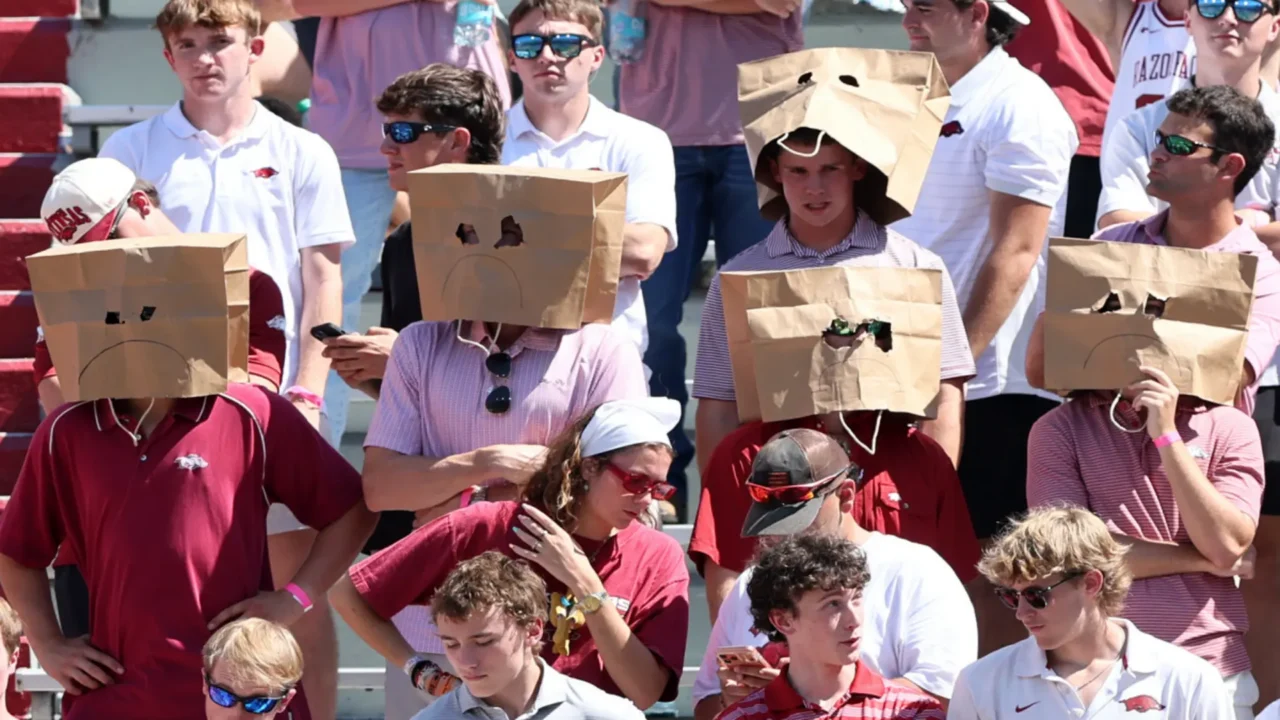
Arkansas football walked into a crisis moment on Saturday when a 45-17 loss punctuated an afternoon of empty seats and visible fan frustration at Razorback Stadium.
As reported by CBS Sports, the defeat extended a school record 12-game losing streak to FBS opponents and coincided with a formal Board of Trustees directive to review athletics competitiveness and resources.
Key Takeaways
- The announced attendance was 66,123 in a 76,212-seat stadium, and several sections appeared notably sparse at kickoff.
- The loss marked Arkansas’ 12th straight defeat to an FBS opponent, tying the longest active streak in the sport.
- The Board of Trustees passed a resolution ordering a review of the athletics department focused on football competitiveness and resource allocation.
- Reportedly, Arkansas’ roster spending and NIL/revenue-share budget rank near the bottom of the SEC, raising questions about on-field competitiveness.
Why Arkansas football collapsed vs Georgia
The game was a stark illustration of a gap in depth and execution against a top opponent. Arkansas trailed at halftime and never found consistent answers, ultimately losing by 28 points to a No. 2 opponent.
On-field miscues and short benches have compounded since the season began, producing two early losses by an average margin north of 30 points. Those results have fed the narrative that talent distribution and depth remain primary problems.
Board review and internal accountability
Frustration among the fan base translated into action when trustees approved a resolution directing a system review of the athletic department’s competitiveness. The resolution specifically asked the system president to identify steps to enhance resources for the football program.
The review’s scope and timeline are not yet public, and administrators reported they had not received formal communication from the system president at the time of reporting. Trustees framed the move as a necessary step to assess resourcing and strategy.
Roster funding, NIL and local donor patterns
Financial context has become central to the debate about competitiveness. Reporting places the program’s roster spending near the lower tier of the SEC, and one published estimate lists a believed roster spend of roughly $24 million for the season.
Local philanthropic patterns complicate the picture. Major donors and corporate headquarters in northwest Arkansas have favored basketball and Olympic sports in recent high-profile gifts, which has left football with a smaller share of concentrated private NIL resources than some peers.
Revenue moves and fan response
Athletic leaders have pursued internal revenue initiatives to shore up resources. Reseating efforts in basketball generated nearly $20 million, and a baseball reseating plan produced about $8.8 million in new revenue.
Board requests for additional support included a January resolution asking for $15 million more in funding, with $6 million annually from the university. The university approved $3.4 million toward that request.
Financial and attendance comparison
| Context item | Verified detail |
|---|---|
| Announced attendance vs stadium capacity | 66,123 announced in a 76,212-seat stadium, with several upper-deck sections notably empty at kickoff. |
| Reported football roster spending | Believed to be roughly $24 million for the season, a figure reported in coverage of program finances. |
| Recent one-time reseating revenue | Basketball reseating produced nearly $20 million and Baum Stadium reseating produced about $8.8 million in new funds. |
| Student athletics fee | The university does not charge a student athletics fee, though sources say it remains an option as pressure mounts. |
SEC recruiting and College Football Playoff ramifications
The funding and competitive questions have direct recruiting consequences in a 16-team College Football Playoff era where roster construction and NIL access influence landing power. Prospects weigh program trajectory and resource commitments when choosing among power-conference offers.
A visible trustee review and public donor pattern favoring other sports risk complicating recruiting pitches and long-term roster planning. Donors, prospects and regional stakeholders will be watching how the review translates into budgetary changes or new resource commitments.