Arkansas football enters the 2026 offseason with durable optimism, but a clearer view of worst-case scenarios matters for fans and staff calibrating expectations and resource allocation for the year ahead.
Jackson Fuller originally framed these hypothetical outcomes in local coverage, and the full piece is republished on Yahoo Sports as a local snapshot of the risks the program faces, which helps ground the discussion in reporting from the Ft. Smith market rather than rumor or projection alone.
Key Takeaways
- Arkansas football faces a credible worst-case path in 2026 driven by roster attrition and thin depth at critical positions.
- Quarterback uncertainty and offensive-line vulnerabilities are identified as chokepoints that would accelerate a negative trajectory for the season.
- Recruiting response and roster construction during the offseason will largely determine whether a worst-case slide materializes for the 2026 season.
How roster attrition could trigger a 2026 slide
The most direct path to a worst-case 2026 for Arkansas football runs through unexpected turnover and a failure to replace starters across multiple position groups, which strips the team of continuity and experience.
Local reporting emphasizes that layered departures — whether via transfer, NFL decisions, or attrition tied to coaching changes — set off a chain reaction where depth players are thrust into roles before they are ready, creating persistent schematic holes.
Those gaps tend to show up as late-game breakdowns, special teams slippage, and a rising injury toll as backups take on heavier workloads than projected in spring practice.
Quarterback and line play risks
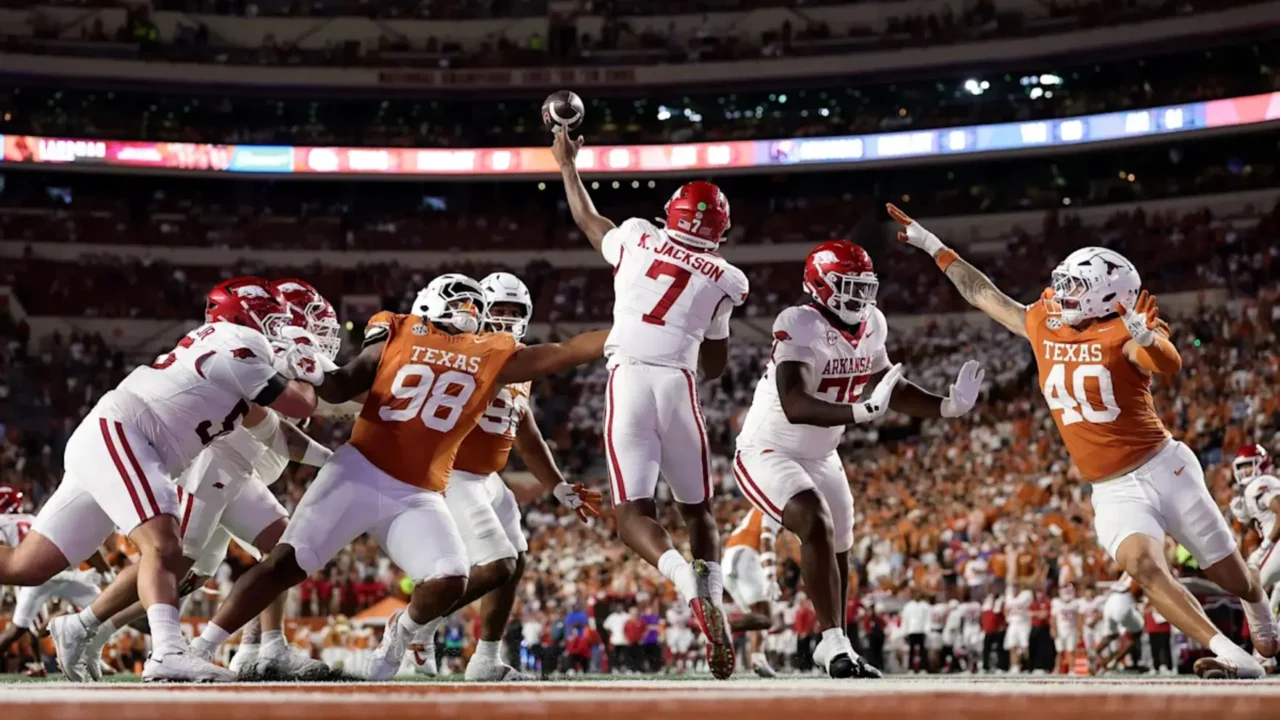
Quarterback depth is a binary limiter for Arkansas football: an injury, a freshman-operated series of starts, or prolonged inconsistency at the position compresses play-calling options and forces the offense into conservative game plans that are easier for SEC defenses to defend.
Offensive line instability compounds quarterback worries by shrinking the timing windows for the passing game and reducing the effectiveness of run schemes, which in turn increases three-and-outs and shortens possessions for a defense already tasked with high snap counts.
Recruiting wins that shore up those two areas would blunt the worst-case scenario, while recruitment shortfalls or slower-than-expected player development widen the margin for error and force staff to lean heavily on schematic adjustments rather than talent-based solutions.
Roster construction pressure points
Beyond the obvious quarterback and offensive-line concerns, secondary and linebacker depth can morph from manageable to critical when the offense cannot sustain drives, exposing Arkansas football to opponent scoring runs and field-position swings.
Local analysis points out that special teams and rotational depth are often the first casualties of a thin roster, creating hidden deficits in net punting, kickoff coverage, and late-game situational execution that cost tight contests.
Coaching continuity and the ability to develop underclassmen at a faster clip are practical levers the program can use to address those pressure points, but they require both time and consistent practice reps that a rapidly deteriorating win-loss ledger can erode.
How 2026 risk compares to recent Arkansas seasons
| Context | Verified facts or established context |
|---|---|
| Reporting source and perspective | Local coverage by Jackson Fuller for the Ft. Smith Southwest Times Record framed speculative worst-case scenarios; that reporting is republished on the linked outlet |
| Typical risk drivers for Arkansas seasons | Recent Razorback vulnerability patterns have centered on turnover at quarterback and thin depth on the offensive line, which are consistent risk drivers noted in local analysis |
| Offseason corrective levers | Recruiting focus and targeted development of young players are the primary mechanisms available to avoid a slide, according to the local assessment |
SEC standings and CFP impact for Arkansas
A sustained slide in 2026 would carry immediate consequences in the SEC pecking order, making divisional wins harder to come by and shrinking the margin for error in an already demanding conference slate for Arkansas football.
Arkansas football’s path to the College Football Playoff is narrow even in a best-case construct, and a season that resembles the worst-case framing would effectively remove CFP consideration and redirect program priorities toward damage control and roster rebuilding.
Recruiting implications are direct: visible depth shortfalls and missed development timelines complicate the pitch to prospects, shift NIL leverage, and increase the urgency of landing impact transfers and recruits who can contribute quickly.
Program messaging, targeted recruiting, and development plans become the practical tools to arrest any downturn, and those levers demand coherent narratives from the coaching staff and demonstrable opportunity for incoming players to see early playing time.
Credit to the Ft. Smith Southwest Times Record and reporting by Jackson Fuller for the original local coverage that formed the basis of this analysis