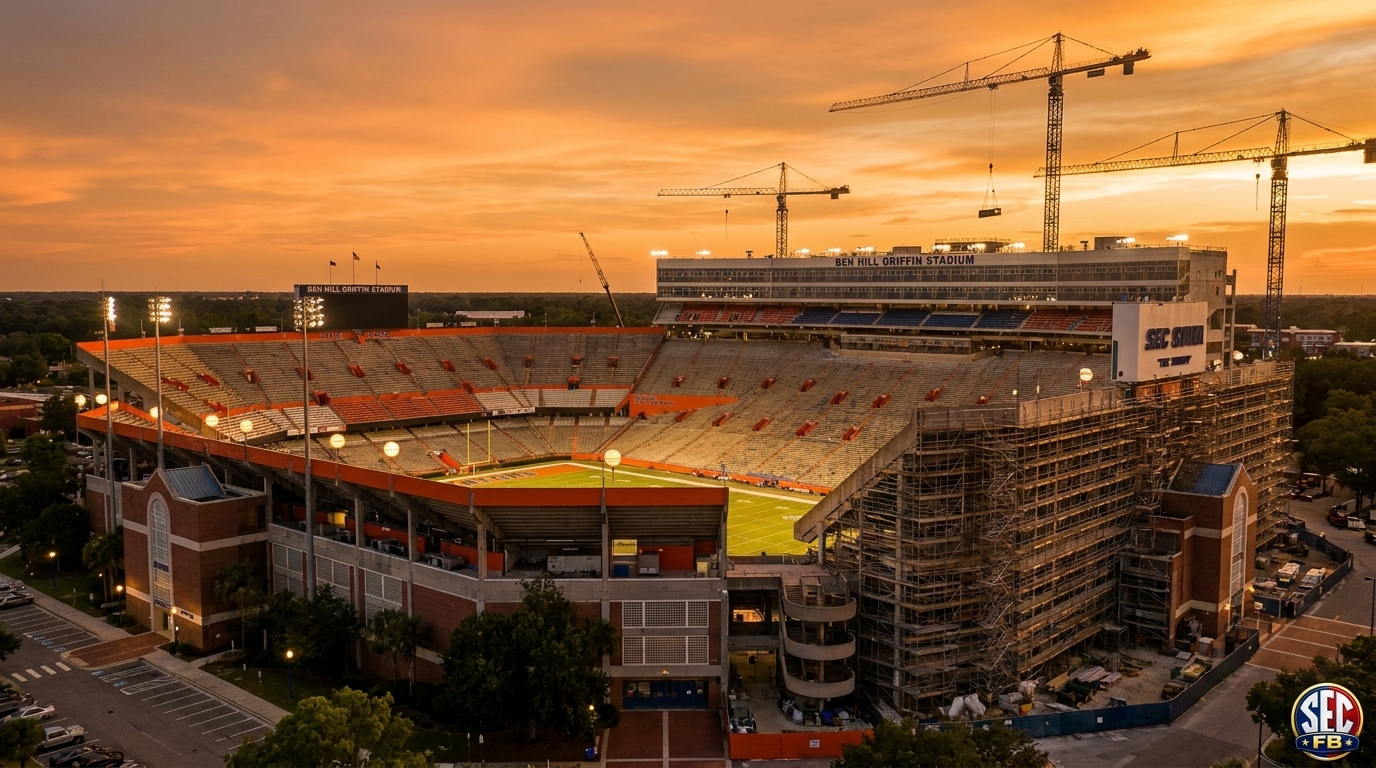
The Ben Hill Griffin Stadium renovation begins a bold $1.45 billion overhaul to remake The Swamp.
It upgrades premium seating, concourses, video boards, audio, and ADA compliance to match elite college venues.
Moreover, designers will preserve the beloved lower bowl and orange wing walls while adding modern touches.
As a result, the plan dedicates $500 million to deferred maintenance and infrastructure, revamps suites, and creates open air premium areas to boost experience and revenue.
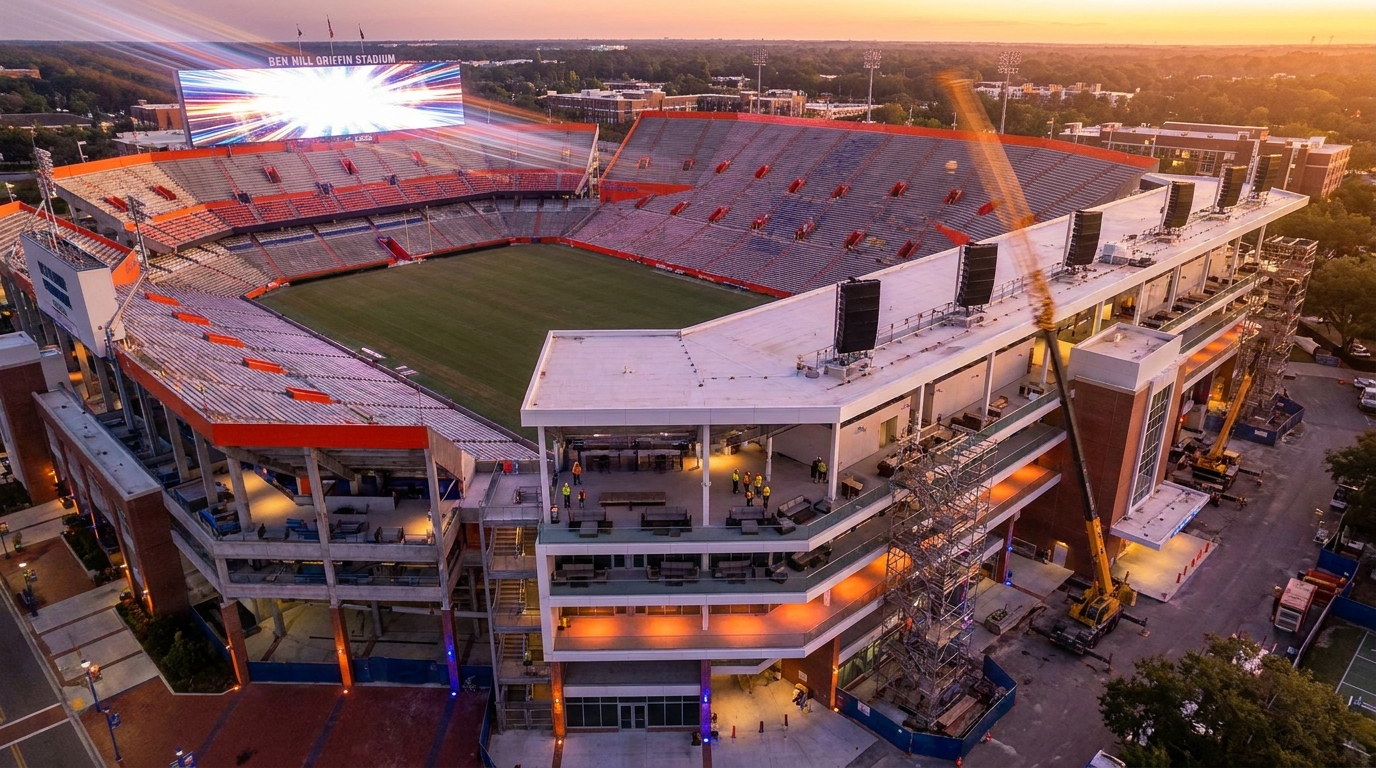
Picture an aerial animation sweeping around Ben Hill Griffin Stadium, with cranes, illuminated new video boards, refreshed suites, fans roaring, and the bowl glowing under night lights.
Ben Hill Griffin Stadium renovation: major upgrades and features
The Ben Hill Griffin Stadium renovation lays out a sweeping, amenities first plan that balances tradition with modern spectacle. Moreover, the project aims to preserve The Swamp’s soul while delivering state of the art upgrades. As a result, fans will see dramatic enhancements to sightlines, audio, and premium spaces. The tagline says it plainly: “Bigger, Better, Louder.”
- Capacity and bowl preservation: the stadium will hold 88,548 fans, and the plan intentionally does not expand beyond that number. Because the design preserves the lower bowl and orange wing walls, the iconic feel remains while circulation improves.
- Suites and premium seating: 82 current suites receive full renovations, and 63 new suites will rise atop the east side. Consequently, the venue expands its premium inventory to increase hospitality and corporate partnerships. As one insider said, this will become “a $75 million ATM machine” for the program.
- Open air premium areas: new open air clubs and loge spaces will blend outdoor energy with premium comfort. Therefore, fans get intimate game day views and elevated service without losing the stadium atmosphere.
- Video boards and audio: brand new high resolution video displays and a world class audio system will transform sightlines and sound. Moreover, the upgrades mirror the evolution seen at Lambeau Field, Fenway Park and other legendary venues.
- ADA compliance and infrastructure: $500 million is earmarked to modernize infrastructure and meet ADA standards. As a result, accessibility, restrooms, and circulation will meet 21st century expectations.
- Deferred maintenance and mechanical systems: a large portion of funds address aging systems, roofing, and structural repairs. Therefore, the renovation aims to “breathe new life into one of the nation’s most iconic college football venues.”
- Revenue and funding: the overhaul projects a $65 million annual revenue lift and total venue revenue around $140 million. Funding mixes private donations, capital reserves, and long term debt approved by the Florida Board of Governors.
Inside the Ben Hill Griffin Stadium renovation experience
Every inch of this stadium is going to be affected, and fans should expect fresh concourses, expanded sponsor zones, and upgraded concessions. Additionally, designers will create flexible spaces for NIL activations and corporate hospitality because organizers want to unlock new revenue streams. Fans will walk into a modernized Swamp that still feels familiar, and many will say, “I’m very excited because I think when people walk in it for the first time, they’re going to be blown away.”
Ben Hill Griffin Stadium renovation: how it compares
Below is a concise comparison of The Swamp’s $1.45 billion overhaul versus notable stadium overhauls referenced in the design study. The table highlights budgets, capacity shifts, premium seating work, and timelines for context.
| Stadium | Renovation budget | Capacity change | Premium seating and suites | Timeline / Notes |
|---|---|---|---|---|
| Ben Hill Griffin Stadium (The Swamp) | $1.45 billion | Final capacity set at 88,548; no net increase beyond current seating | 82 existing suites fully revamped; 63 new suites atop east side; new open air premium clubs and loge areas | Start: 2027 offseason; Completion: 2030 offseason; $500M for deferred maintenance; aims to preserve lower bowl and orange wing walls |
| Lambeau Field (2012-13 evolution) | Major multi phase investment (reported in the low hundreds of millions) | Minor net capacity changes; focused on fan experience rather than huge expansion | Added premium spaces, renovated concourses, upgraded video and audio systems | Phased work around 2012-2013; informed Florida design choices and fan-first focus |
| Kyle Field (Texas A&M redevelopment) | Large scale redevelopment (mid hundreds of millions range) | Increased capacity significantly to exceed 100,000 | Major premium bowl additions, club spaces, suites and modern hospitality zones | Multi-year project completed in the 2010s; transformed bowl and premium inventory |
| Beaver Stadium (Penn State expansions) | Phased expansions and renovations over decades with varied budgets | Capacity increased across phases to exceed 100,000 | Added premium suites, club areas, and upgraded concourses | Multiple projects across years focused on capacity and premium amenities |
This table places the Ben Hill Griffin Stadium renovation among modern college and pro venue upgrades. Consequently, Florida’s plan emphasizes premium hospitality, audiovisual upgrades, ADA compliance and long term revenue growth.
Ben Hill Griffin Stadium renovation: funding and financial impact
The renovation ballooned from an initial $400 million estimate to a bold $1.45 billion plan, and funding will come from several sources. Private donations, capital reserves, and long term debt approved by the Florida Board of Governors will finance the project. Moreover, planners set aside $500 million specifically for deferred maintenance and infrastructure upgrades to modernize mechanical systems and accessibility.
Key financial facts and projections
- Budget shift and reserves: the budget rose to $1.45 billion, reflecting expanded scope and premium amenities. Consequently, project leaders prioritized durability and revenue generating assets.
- Funding mix: private donations, university capital reserves, and long term debt approved by the Florida Board of Governors will cover construction and infrastructure costs.
- Revenue impact: the stadium currently produces about $75 million annually. The renovation projects a $65 million annual lift, targeting approximately $140 million in total venue revenue.
- Return drivers: renovated suites, 63 new east side suites, open air premium clubs, and upgraded sponsor inventory should increase hospitality income. As one insider noted, these premium spaces could become “a $75 million ATM machine.”
Because organizers aim to unlock new sponsorships and NIL activations, the project doubles as a financial strategy. Therefore, Florida expects stronger corporate partnerships, more naming and activation opportunities, and elevated game day monetization. As a result, administrators believe the investment will not only modernize The Swamp but also create long term revenue stability for the program.
The Ben Hill Griffin Stadium renovation stands as a transformational project that preserves The Swamp’s heart while bringing the venue into the modern era. Moreover, the $1.45 billion overhaul keeps the beloved lower bowl and orange wing walls intact, and it adds world class premium seating, revamped suites, cutting edge video boards, and improved audio. As a result, fans will enjoy a familiar game day feeling with modern comforts and accessibility upgrades. The tagline Bigger, Better, Louder serves as a rallying cry that sums up the ambition and energy driving this plan.
Because the project balances tradition and innovation, it positions Florida to compete with elite venues nationwide. Additionally, the renovation unlocks sponsorship, NIL and hospitality opportunities that should grow annual revenue and long term stability. For timely coverage and informed perspective on SEC football developments and facility projects, follow SECFB LLC. Visit SECFB.com for deep reporting, and connect with commentary and updates on Twitter at Zach Gatsby’s Twitter. Finally, expect to see The Swamp emerge in 2030 as a preserved classic and a modern spectacle that delivers a bolder, brighter, louder game day experience.
Frequently Asked Questions (FAQs)
What is the timeline for the Ben Hill Griffin Stadium renovation?
The project begins in the 2027 offseason and aims for completion in the 2030 offseason. Work will proceed in phases to protect game day routines. Consequently, construction will target offseasons and low activity windows to limit disruption.
Will stadium capacity change after the renovation?
Capacity will be set at 88,548 and the plan does not seek a net increase. Instead, designers preserve the lower bowl and orange wing walls. Therefore, fans keep the classic sightlines while enjoying upgraded facilities.
How is the $1.45 billion renovation funded and what changed from earlier estimates?
Funding combines private donations, university capital reserves, and long term debt approved by the Florida Board of Governors. The budget rose from a $400 million estimate to $1.45 billion. Moreover, planners allocated $500 million for deferred maintenance and infrastructure updates.
What major features and premium upgrades should fans expect?
Expect fully revamped suites, 63 new east side suites, open air premium clubs, high resolution video boards, and upgraded audio. The renovation also improves ADA compliance and modernizes mechanical systems. As a result, hospitality, sightlines, and sound will feel markedly improved.
How will the renovation affect fans and revenue long term?
Fans gain a modernized game day experience while preserving The Swamp’s identity. The overhaul projects a $65 million annual revenue lift, targeting roughly $140 million in total venue revenue. Additionally, Florida plans to leverage sponsorships and NIL opportunities to boost long term financial stability.