
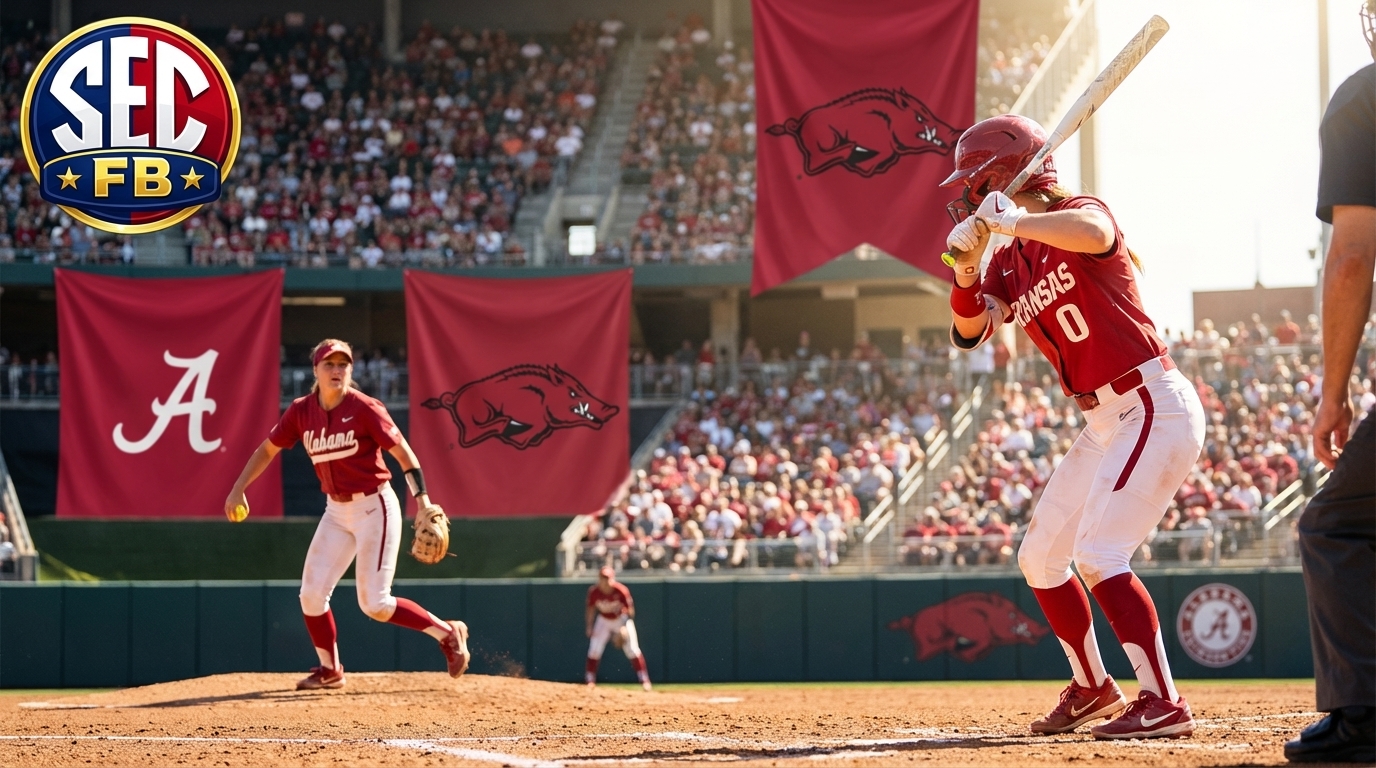
College Softball Power Rankings: Alabama-Arkansas Series and Arkansas Momentum
College softball power rankings shifted after the Alabama-Arkansas series concluded this weekend. Arkansas won the high-scoring middle game and split the series, with a narrow loss in game three. As a result, the Razorbacks showed lineup depth and offensive firepower. However, Alabama’s pitching in games one and three still raised questions about Arkansas consistency.
Analytically, this series matters because it tested Arkansas against top-tier opposition. Therefore, the outcomes offer clearer data for rankings models that weigh head-to-head results and run differential. Arkansas scored fourteen runs in game two, which demonstrates offensive upside but also defensive lapses. Consequently, metrics that emphasize run prevention will temper Alabama’s drop and moderate Arkansas gains.
Momentum matters in polls and predictive power ratings, since streaks influence perception and selection committees. Moreover, Arkansas gains confidence and resumes a narrative of upward trajectory in the SEC. Nevertheless, evaluators should weigh pitching ERAs, bullpen depth, and strength of schedule before reordering the top twenty. In short, the series provides useful signals but not definitive proof of long-term ranking changes.

College Softball Power Rankings: Pitching Implications
Pitching decided the Alabama-Arkansas series more than hitting. Game one stayed scoreless until the fifth inning. Therefore, run prevention showed immediate value. Game two skewed the box score with Arkansas scoring fourteen runs. However, that offensive outburst can mask pitching weaknesses. Game three returned focus to pitchers when Alabama won 4-1.
Leila Ammon entered the series with a 0.72 ERA this season. That level of run suppression forces rankings models to weight her heavily. Because ERA underpins many predictive metrics, Ammon’s presence reduces variance in Arkansas matchups. Moreover, a sub-one ERA signals that opposing offenses must manufacture runs to win. As a result, evaluators will view Arkansas as more resilient when Ammon starts.
Peja Goold also influenced perceptions. He posted a 0.95 ERA and reached 100 strikeouts this year. Strikeout volume matters because it limits defensive variability. Therefore, a 100-strikeout mark offers repeatable evidence of dominance. Consequently, power rankings that incorporate strikeout rate and ERA will favor teams with pitchers like Goold.
Bullpen depth and long relief mattered in the series as well. Arkansas allowed middle-game runs in game two despite strong starters. Conversely, Alabama’s staff closed games one and three efficiently. Evaluators should therefore penalize teams whose starters outperform but whose relievers do not hold leads. In analytic models, bullpen instability increases projected runs allowed and lowers win probability.
In sum, the pitching performances in this series should nudge college softball power rankings. However, the change will not be dramatic because sample sizes remain small. Analysts must balance head-to-head results with season-long ERAs, strikeout data, and bullpen reliability. Only then will rankings reflect sustainable team strength.
| Team | Notable Pitcher | Season ERA | Season Strikeouts | Game 1 | Game 2 | Game 3 | Series Impact |
|---|---|---|---|---|---|---|---|
| Alabama | Peja Goold (notable) | 0.95 | 100 | Scoreless through four innings; late runs (low-scoring) | Allowed 14 runs in 14-9 loss | Won 4-1 | Staff closed games one and three; bullpen efficiency favored Alabama |
| Arkansas | Leila Ammon (notable) | 0.72 | — | Scoreless through four innings; late runs | Won 14-9 (offense masked pitching issues) | Lost 1-4 | Ammon’s sub-1.00 ERA stabilizes rotation; bullpen depth questioned |
Offensive takeaways and college softball power rankings implications
Arkansas’s 14-run outburst in game two altered perceptions. However, that single game does not guarantee a permanent ranking jump. The Razorbacks showed lineup depth and situational hitting, which matters because rankings reward run production against quality opponents. Nevertheless, evaluators will balance that output against Arkansas’s pitching swings in games one and three.
Kaitlyn Terry remains a useful benchmark for offensive dominance. She sits 11-0 with a .574 batting average and a 1.576 OPS, which demonstrates elite contact and slugging ability. Therefore, teams with hitters like Terry increase their teams’ projected win totals and ranking value. Grace Jenkins also reinforced the power narrative. She hit two home runs and drove in seven RBIs in Arizona’s win, which signals game-changing capability from the middle of the lineup.
Run production metrics such as RBIs, home runs, batting average, and OPS influence computer models and voters. As a result, Arkansas gains short-term momentum in metrics that weigh run differential and slugging. However, because rankings also weigh consistency, single-game explosions will be partially discounted. For a deeper ranking context and historical comparison, see SECFB’s series analysis at this link.
Momentum from big offensive performances can alter poll narratives. Consequently, Arkansas enters the week with more credibility. Yet, sustained ranking movement will require repeated offensive output and better bullpen support. For broader SEC context and related series previews, consult this resource for modeling parallels.
Conclusion: series takeaways and rankings outlook
The Alabama-Arkansas series delivered mixed signals for college softball power rankings. Arkansas showed clear offensive upside in game two, but Alabama’s pitching response in games one and three kept the series balanced. Therefore, evaluators must weigh head-to-head outcomes against season-long pitching metrics. Leila Ammon’s sub-1.00 ERA and Peja Goold’s 100 strikeouts provide durable evidence of quality. Consequently, Arkansas gains momentum, but not definitive proof of a leap in ranking.
Analytically, the series nudges models and voters toward a modest Arkansas upgrade. However, sample size remains small, and bullpen inconsistency limits confidence. As a result, any ranking movement should be cautious and provisional. Going forward, sustained offensive production and reliable relief pitching will determine whether Arkansas converts momentum into a lasting climb in the polls and predictive ratings.
SECFB LLC will continue tracking these indicators and updating its analysis. For more coverage, see SECFB.com and follow our updates on Twitter at @ZachGatsby.
Frequently Asked Questions
How does the Alabama-Arkansas series affect college softball power rankings?
The series supplies head-to-head data and run differential. Therefore, ranking models will nudge Arkansas slightly upward. However, analysts will balance that gain with season-long pitching metrics and bullpen consistency.
Did pitching or offense matter more for ranking implications?
Pitching mattered more overall because it controlled low-scoring games. As a result, Leila Ammon’s sub-1.00 ERA and Alabama’s bullpen wins carry weight in predictive models. Offense mattered in one game only.
Which player performances should voters and computers notice?
Notice Leila Ammon for run prevention and Peja Goold for strikeouts. Also track high-impact hitters who drive RBIs. Because models weigh ERA and strikeout rate, those names improve team profiles.
Will Arkansas keep momentum in the rankings after this series?
Momentum can influence polls short-term, but sustained ranking movement requires repeated wins. Therefore, Arkansas must follow this split with consistent pitching and continued run production.
How quickly will college softball power rankings update after similar series?
Most polls and computer ratings update weekly. However, models that run daily will incorporate new box scores faster, so changes can appear within days.