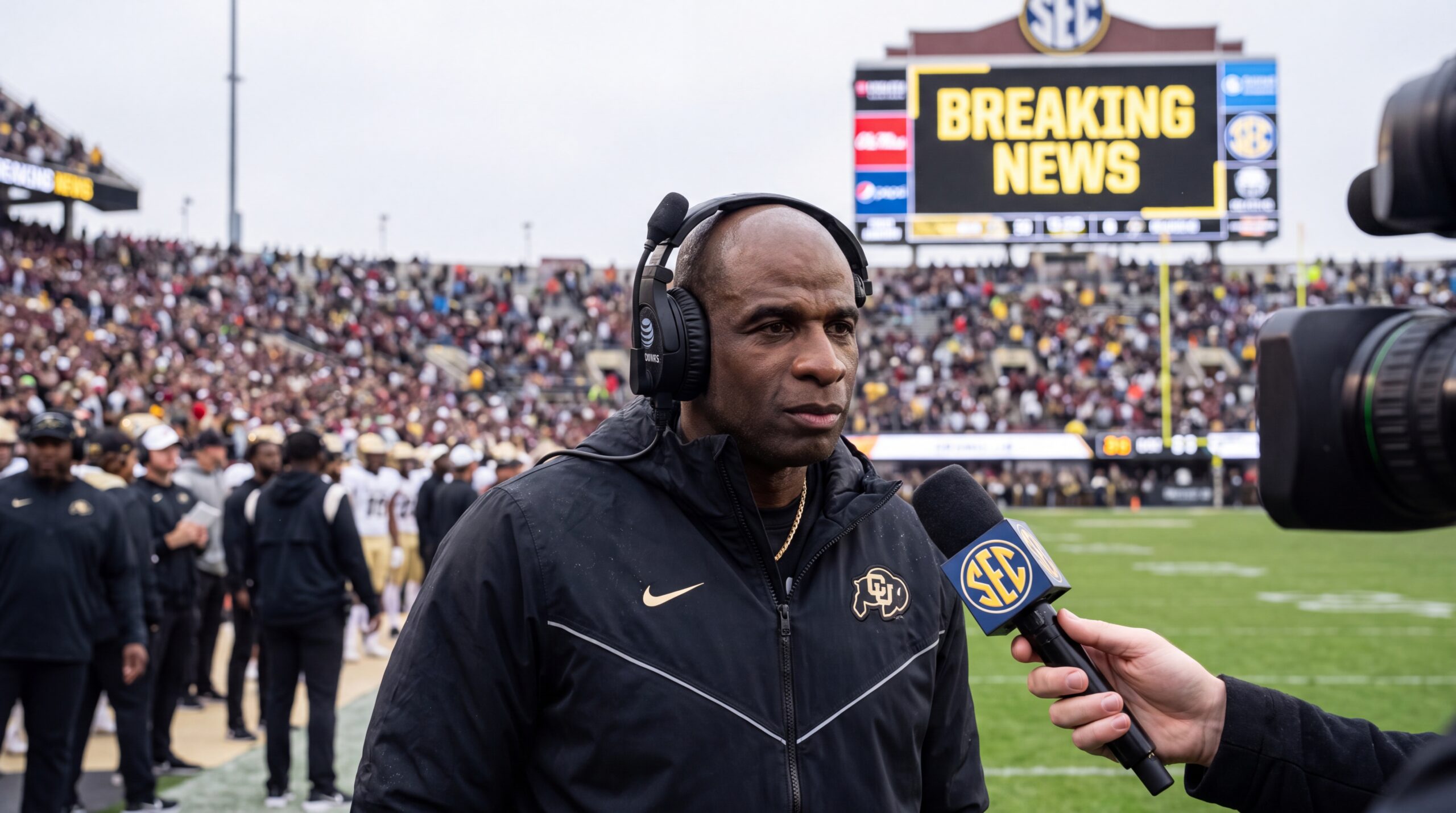
Deion Sanders told ESPN, ‘I consider myself cancer-free,’ a year after undergoing surgery to remove a cancerous bladder. The coach of the Colorado Buffaloes gave the update in comments to ESPN, which reported the remarks as his personal assessment.
Sanders’ statement has drawn attention because of his profile in college football and the timing of the comments roughly a year after major surgery. The network’s report presents the coach’s own words as his view of his health rather than as an independent medical finding.
Deion Sanders update
According to ESPN, Sanders said he considers himself cancer-free one year after surgery to remove his cancerous bladder. The comments were made publicly to ESPN and are being reported as Sanders’ assessment of his recovery.
The update follows a period in which Sanders has remained visible at team events and public appearances tied to the Colorado program. ESPN’s coverage notes his remarks and frames them in the context of his role as Colorado’s head coach.
Medical context and limits
Sanders’ declaration is self-reported. The ESPN report makes clear that the coach described his condition in his own words; it does not supply independent confirmation from treating physicians or medical records.
When public figures discuss their health, outlets typically distinguish between an individual’s statement and verification from clinicians. That distinction matters because medical privacy and patient confidentiality often limit what treating teams can disclose without authorization.
In practical terms, a self-reported statement means Sanders assessed his condition publicly. It does not equate to additional documentation or an independent evaluation appearing in the public record. Reporters and editors usually note that difference to avoid presenting personal statements as verified medical conclusions.
Readers should also understand that follow-up care and monitoring after cancer-related surgery can be ongoing and private. The ESPN report does not detail any specific tests, timelines, or medical follow-up, and this article does not attempt to fill those gaps with new clinical claims.
Ultimately, the key fact reported by ESPN is Sanders’ own characterization of his health: he considers himself cancer-free. Any broader or clinical interpretation of that phrase would normally require confirmation from treating clinicians or official medical documentation.
What this means for the Colorado Buffaloes
Coach health is a material issue for a college football program because the head coach is central to game planning, practice oversight, recruiting and public representation. Sanders’ update — presented as his personal assessment — will likely influence how fans, recruits and the media view the program’s near-term stability.
At the time of ESPN’s report, there was no indication of an immediate change to Colorado’s official coaching plans. The university and the football program are the entities that would announce any changes to coaching duties, practice schedules or game-day responsibilities.
For players and staff, a coach’s health status can affect day-to-day operations in subtle ways: availability for meetings, travel plans, in-person recruiting visits and press availability. Those practical considerations are usually handled privately between a coach, the staff and athletic department officials unless a formal announcement is made.
Recruiting and team morale are areas that observers will watch. Public confidence in a program often hinges on perceived continuity of leadership; an update framed as a positive development from Sanders could provide reassurance, while uncertainty can prompt questions from recruits and supporters.
Colorado fans and stakeholders should expect the program to manage official communications. Any adjustments to responsibilities or long-term plans would likely be communicated by Colorado athletics rather than emerging first from personal remarks.
What to watch next
Likely follow-ups include further comments from Sanders, any official statements from the Colorado Buffaloes athletic department, and additional reporting or context from ESPN or other outlets. Reporters may seek clarification about coach availability for upcoming practices, press conferences and games.
If the program or Sanders’ representatives choose to provide more detail, media coverage will typically note whether new information constitutes independent confirmation from medical professionals or remains a personal update. Expect outlets to make that distinction clear in subsequent reporting.
For now, key items to monitor include official team communications, scheduled press availability involving Sanders, and any ESPN follow-up stories that add context or independent reporting to the initial comments.
This article is based on reporting from ESPN and frames Sanders’ words as his personal assessment rather than as independently verified medical news.
Key takeaways
- Deion Sanders told ESPN, “I consider myself cancer-free,” one year after bladder surgery.
- The claim is self-reported; ESPN’s coverage does not include independent medical confirmation.
- The coach’s health status matters to the Colorado Buffaloes because it can affect availability, recruiting and day-to-day operations.
- Watch for official Colorado program statements, Sanders’ future comments and any follow-up reporting from ESPN.
- Source reporting: ESPN; medical privacy limits public detail about treatment and follow-up.
Source: ESPN — “Buffs’ Sanders: ‘I consider myself cancer-free'”