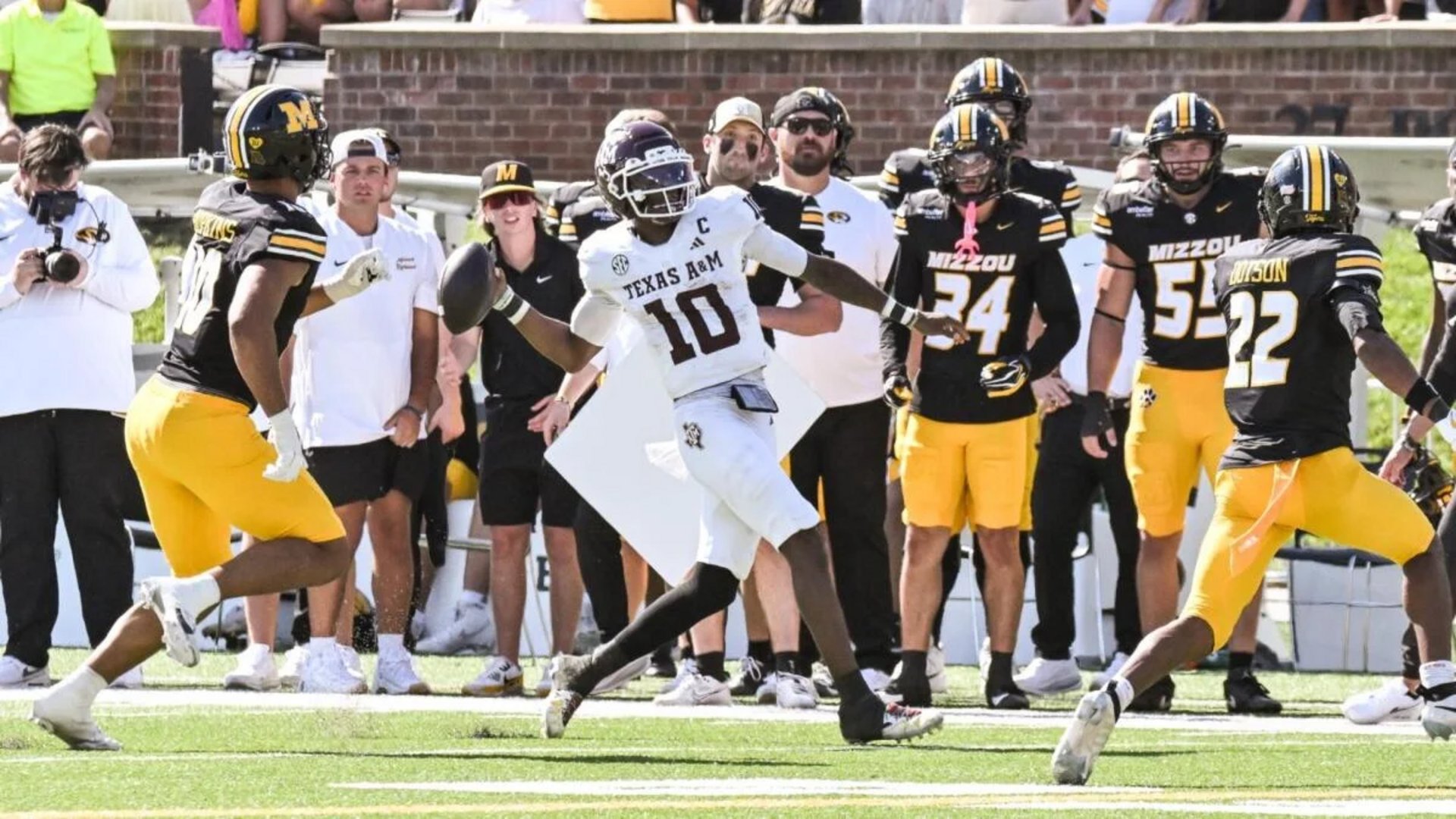
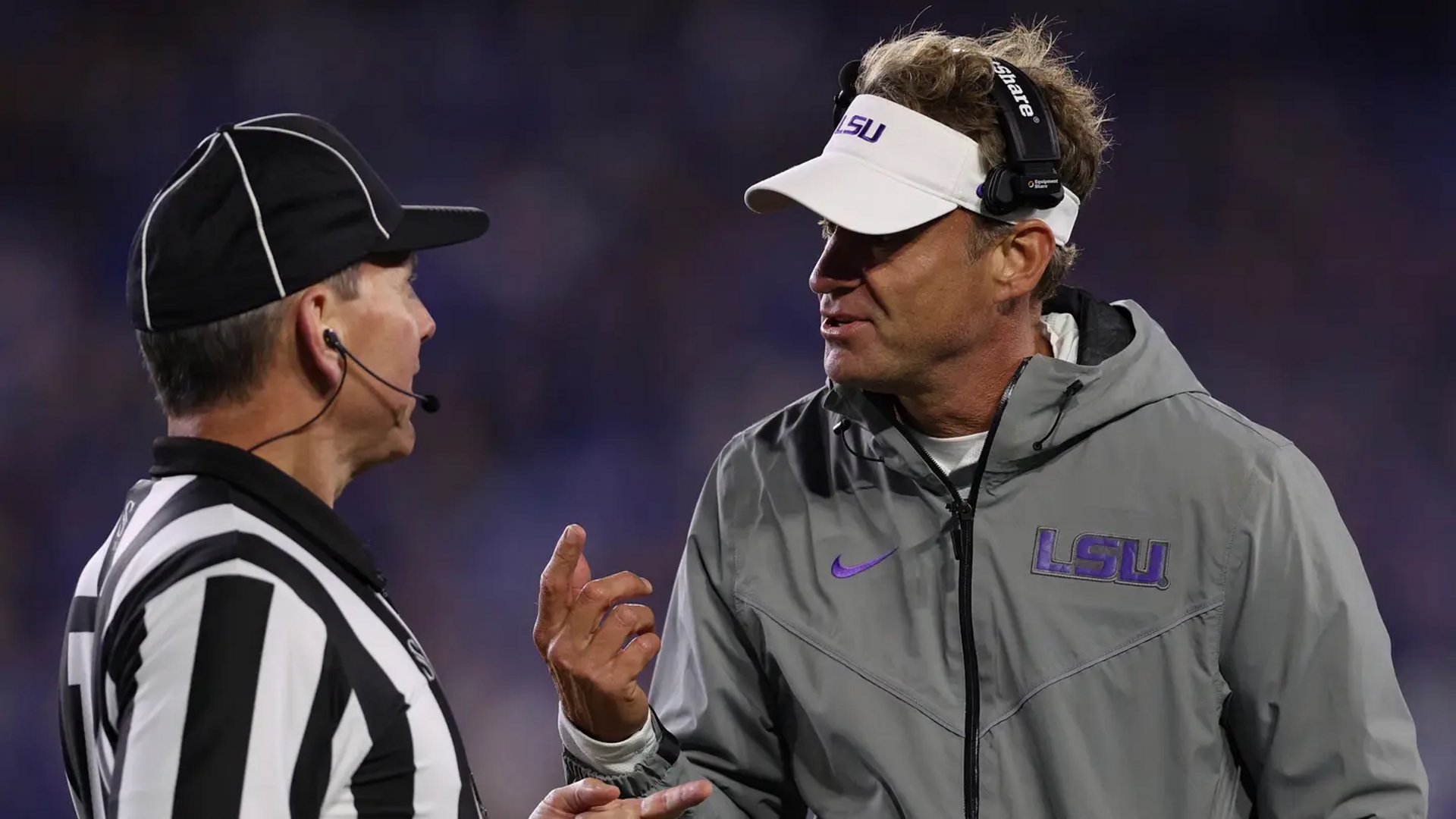
Lane Kiffin questioned LSU’s controversial Kentucky touchdown on Oct. 10 after officials allowed Kenny Minchey’s fourth-down run to reach the goal line. The score gave Kentucky a 21-17 halftime lead.
The LSU Tigers On SI reported that Kentucky faced fourth-and-goal at LSU’s 1-yard line with three seconds remaining in the first half when Minchey took the snap and tried to push through the middle of the defense.
LSU initially stopped Minchey short, but the play remained live as players from both teams converged around him. Kentucky’s offensive line eventually moved the quarterback across the goal line, and officials awarded the touchdown.
Key Takeaways
- Kentucky faced fourth-and-goal at LSU’s 1-yard line with three seconds left in the first half.
- Kenny Minchey’s touchdown put the Wildcats ahead 21-17 at halftime.
- Lane Kiffin attributed remarks about the stakes of the play to the line judge involved in the decision.
Lane Kiffin Kentucky Touchdown Controversy Centers on Forward Progress
The Lane Kiffin Kentucky touchdown controversy began with the question of whether Minchey’s forward progress had ended before he crossed the goal line. LSU Tigers On SI reported that the Tigers initially stopped the quarterback, but officials did not rule the ball dead before the pile continued toward the end zone.
The decision had immediate scoreboard consequences. Kentucky received seven points and carried a four-point lead into halftime, while LSU lost the opportunity to take possession after a turnover on downs.
Had officials stopped the play before Minchey reached the goal line, LSU would have taken over, with the remaining time in the half determined by when the whistle sounded. That alternate outcome does not establish that LSU would have won the game, but it shows why the ruling mattered in a contest ultimately decided by one point.
Kiffin questioned the decision in postgame discussions with officials and revisited the play during his Sunday press conference. LSU Tigers On SI reported that Kiffin said a line judge told him there was “too much at stake” to stop the play and claimed the official said “he’d be killed” if he blew the whistle.
Those remarks are Kiffin’s account of the conversation, not an independently established statement from the official. The central officiating question remains whether Minchey was still advancing when he reached the goal line.
The NCAA Rules Leave Forward Progress to the Officials
Rule 2-9-2 of the NCAA Football Rules Book defines forward progress around the end of a ball carrier’s advancement and the location of the football when the ball becomes dead. Rule 4-1-3 covers when the ball becomes dead, including situations in which a runner is held and forward progress has stopped.
Those rules require officials to judge whether a runner is continuing to advance or whether the defense has ended the play. They do not establish a fixed number of seconds that a runner must remain stationary before the whistle is required.
That judgment can produce difficult goal-line decisions. A quarterback may remain upright after his progress has stopped, while a runner who briefly meets resistance may still be considered in forward motion if the officiating crew believes the play remains live.
The rulebook does not create a separate forward-progress standard for a play with major competitive consequences. It also does not authorize officials to extend a play simply because stopping it could generate criticism.
At the same time, the rules do not automatically prove that the touchdown was awarded incorrectly. Whether Minchey’s progress had stopped requires an evaluation of the play itself, while Kiffin’s description of the conversation raises a separate concern about the stated reasoning behind the decision.
NCAA Instant Replay Could Not Fully Resolve the Dispute
The forward-progress issue also explains why a scoring review could not necessarily fix the controversy. Under Rule 12, NCAA instant replay can examine certain goal-line details, including whether the football crossed the goal line while the play was still live.
Replay does not give officials unlimited authority to revisit every judgment made during the action. Reviewing the ball’s location is different from retroactively deciding that the whistle should have sounded before the quarterback reached the end zone.
Once officials allowed the play to continue and Minchey crossed the goal line, LSU could not simply secure a reversal by arguing that forward progress should have been stopped earlier. The initial live-ball judgment therefore shaped what replay could and could not correct.
That distinction is central to the Kentucky touchdown. The review process could address whether the ball crossed the goal line, but it could not necessarily replace the on-field decision about when Minchey’s progress ended.
Lane Kiffin Awaited the SEC Officiating Review
LSU Tigers On SI reported that Kiffin said LSU had not received the Southeastern Conference’s response concerning the disputed touchdown at the time of his press conference. “We haven’t got that back yet,” Kiffin said.
Kiffin also criticized the conference’s restrictions on publicly discussing officiating evaluations. “We’re not allowed to tell you what we get back,” he said.
His comments described a system in which the SEC can review an officiating decision internally while limiting what teams can disclose publicly. An evaluation could provide LSU with an assessment of whether forward progress should have been ruled stopped, but it would not restore possession, remove Kentucky’s points or change the completed result.
The dispute therefore involves two separate issues: whether Minchey’s forward progress had ended before the goal line and whether the official’s decision was influenced by the stakes of the moment. The NCAA rulebook addresses the first question, while Kiffin’s account places the second question at the center of the SEC’s review.