Why Missouri Tigers 2026 SP+ ranking (No. 20) matters?
The Missouri Tigers 2026 SP+ ranking (No. 20) landed higher than many expected, sparking surprise and curiosity. SP+ rates teams per play. It blends returning production, recent performance, recruiting and transfer history to measure efficiency. Therefore, this placement rewards Eli Drinkwitz’s efficiency focused offense and steady fundamentals.
However, that ranking arrives despite massive roster turnover on defense with ten starters gone and a mostly rebuilt secondary while the front seven lost multiple NFL caliber players; key offensive pieces also need replacement on the line and at wide receiver, so the roster looks less experienced but still contains talent and room to grow, which means Missouri can translate per play strength into wins if young contributors develop quickly, the transfer portal adds impact, and coaching maintains discipline, making No. 20 a cautious nod to potential rather than a promise.
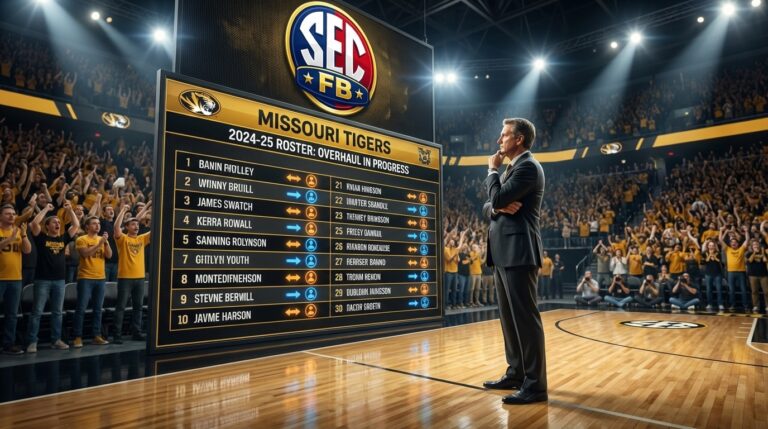
Missouri’s roster turnover centers on defense. Ten defensive starters from last year are gone, and the secondary was almost rebuilt. As a result, the front seven also lost multiple NFL caliber players. That level of turnover creates immediate questions about gap discipline and pass coverage.
On offense, Missouri must replace key contributors on the line and at wide receiver. Those positions affect both short yardage efficiency and big play creation. Drinkwitz runs an efficiency focused scheme. Therefore, losing experienced linemen raises concerns about protection and penalties.
SP+ values returning production and per-play efficiency, so turnover matters. However, the metric still gives Missouri credit for roster talent and recruiting. Therefore, the Tigers keep a higher SP+ despite inexperience. The transfer portal could blunt losses if it brings immediate starters. Moreover, younger players can grow into roles by midseason. Still, efficiency may wobble early, because chemistry and technique need time. Consequently, SP+ projects potential rather than guaranteeing immediate wins.
Rookie defensive backs face a steep learning curve in coverage and tackling. Consequently, opposing offenses may test them early through quick passes and run after catch. Replacing NFL caliber front seven talent could make run defense less stout initially. On offense, depth at wide receiver matters for third down efficiency and explosive plays. Finally, SP+ treats recruiting and transfers as predictive inputs, which explains Missouri’s favorable slot despite the heavy roster turnover.
| Year | Preseason SP+ Ranking | Final SP+ Ranking or Projection | Notes on roster experience or changes |
|---|---|---|---|
| 2024 | No. 11 | No. 19 | Started high on returning production; finished with young depth showing; moderate turnover |
| 2025 | No. 15 | No. 21 | Some departures; defense began losing starters; offensive line continuity needed |
| 2026 | No. 20 | Projection No. 20 | Significant roster turnover including ten defensive starters lost; secondary nearly rebuilt; OL and WR needs; transfer portal could provide impact |
Missouri Tigers 2026 SP+ ranking (No. 20): The efficiency blueprint
Bill Connelly’s SP+ frames team quality on a per play basis. As he wrote, “SP+ has never been about perception. It is not a poll. It is not a projection based purely on returning starters or headline names. It is an efficiency-based metric built on a combination of returning production, recent performance, recruiting and transfer history. It tries to measure how good a team is on a per-play basis rather than how explosive it might be.” Therefore, Missouri’s No. 20 slot rewards consistent execution more than eye-catching plays.
Missouri Tigers 2026 SP+ ranking (No. 20): Offense and staying ahead of the chains
Eli Drinkwitz runs an offense that prizes positive plays and ball security. His staff schemes to avoid negative yardage and penalties. As a result, third down efficiency and time of possession improve. “Efficiency is the whole point,” and that mantra shows in play selection. Moreover, short gains that keep drives alive translate directly to better per-play numbers.
Missouri Tigers 2026 SP+ ranking (No. 20): Defense and limiting damage
Defensively, the Tigers prioritize assignment football and tackling fundamentals. Consequently, they limit big plays and reduce variance. However, the recent turnover complicates matters. Ten defensive starters left, and the secondary nearly rebuilt. Therefore, early season coverage breakdowns could spike. Still, an efficiency focus helps younger players fit simpler, repeatable roles.
How per-play emphasis feeds the SP+ projection
SP+ uses returning production, recruiting, and transfer history as inputs, so disciplined systems get credit. Because Missouri grades well in efficiency metrics historically, the model keeps the Tigers near the top 25. That placement reflects process rather than promise. If young players adapt and portal additions contribute, Missouri can hold or improve its SP+. If not, per-play numbers will likely dip, and the ranking will follow.
Missouri’s No. 20 SP+ slot reflects an efficiency-first identity under Eli Drinkwitz, and it deserves cautious optimism. However, roster turnover reshaped the defense, with ten starters gone and the secondary largely rebuilt, creating real short-term risk.
Because SP+ measures per-play efficiency, Missouri still receives credit for recruiting, returning production, and system continuity despite youth and uncertainty. If emerging players develop quickly and transfer portal additions provide immediate help on the offensive line and at receiver, the Tigers can convert efficient drives into wins, stabilize the front seven against the run, and limit explosive plays through smarter coverage and simplified assignments that fit younger personnel; therefore analysts should view No. 20 as a reflection of system strength and roster potential rather than a guarantee.
Still, the margin for error remains small because early-season miscues could depress per-play metrics and alter outcomes, so fans and evaluators should watch early nonconference tests and transfer integration closely while appreciating that SECFB LLC offers deeper analysis at SECFB LLC and on Twitter at @ZachGatsby.
Frequently Asked Questions (FAQs)
What is the SP+ ranking, and why is Missouri Tigers ranked No. 20 for 2026?
The SP+ ranking, developed by Bill Connelly, is an efficiency-based metric that evaluates teams on a per-play basis rather than by total yards or points. It considers returning production, recent performance, recruiting, and transfer history. Missouri Tigers’ No. 20 placement for 2026 reflects their system and potential growth under Coach Eli Drinkwitz, despite significant roster turnover.
How has roster turnover affected the Missouri Tigers for the 2026 season?
Missouri faces considerable roster changes, losing ten defensive starters and nearly rebuilding its secondary. The front seven lost key NFL caliber players, and key offensive linemen and wide receivers need replacement. This turnover challenges efficiency but also opens opportunities for new recruits and transfers to step up.
What is Missouri’s playing style under Coach Eli Drinkwitz, and how does it influence the SP+ ranking?
Eli Drinkwitz instills a strategy of efficiency in both offense and defense. His offense focuses on positive plays, avoiding penalties, and sustaining drives, while defense limits big plays through solid fundamentals. This style aligns with SP+, emphasizing consistency and execution on each play.
What can fans expect from the Missouri Tigers in the 2026 season?
Fans can anticipate a season where young players and transfers have crucial roles. With a focus on efficiency, Missouri aims to translate per-play strength into game wins. Watching the integration of new talent and early performance in nonconference games will provide insight into their season prospects.
How does Missouri use the transfer portal to address roster gaps for 2026?
The transfer portal offers Missouri immediate opportunities to fill gaps left by departures. Immediate talent from the portal could impact both the offensive line and receiver positions significantly, potentially stabilizing performance and preserving the team’s SP+ efficiency.