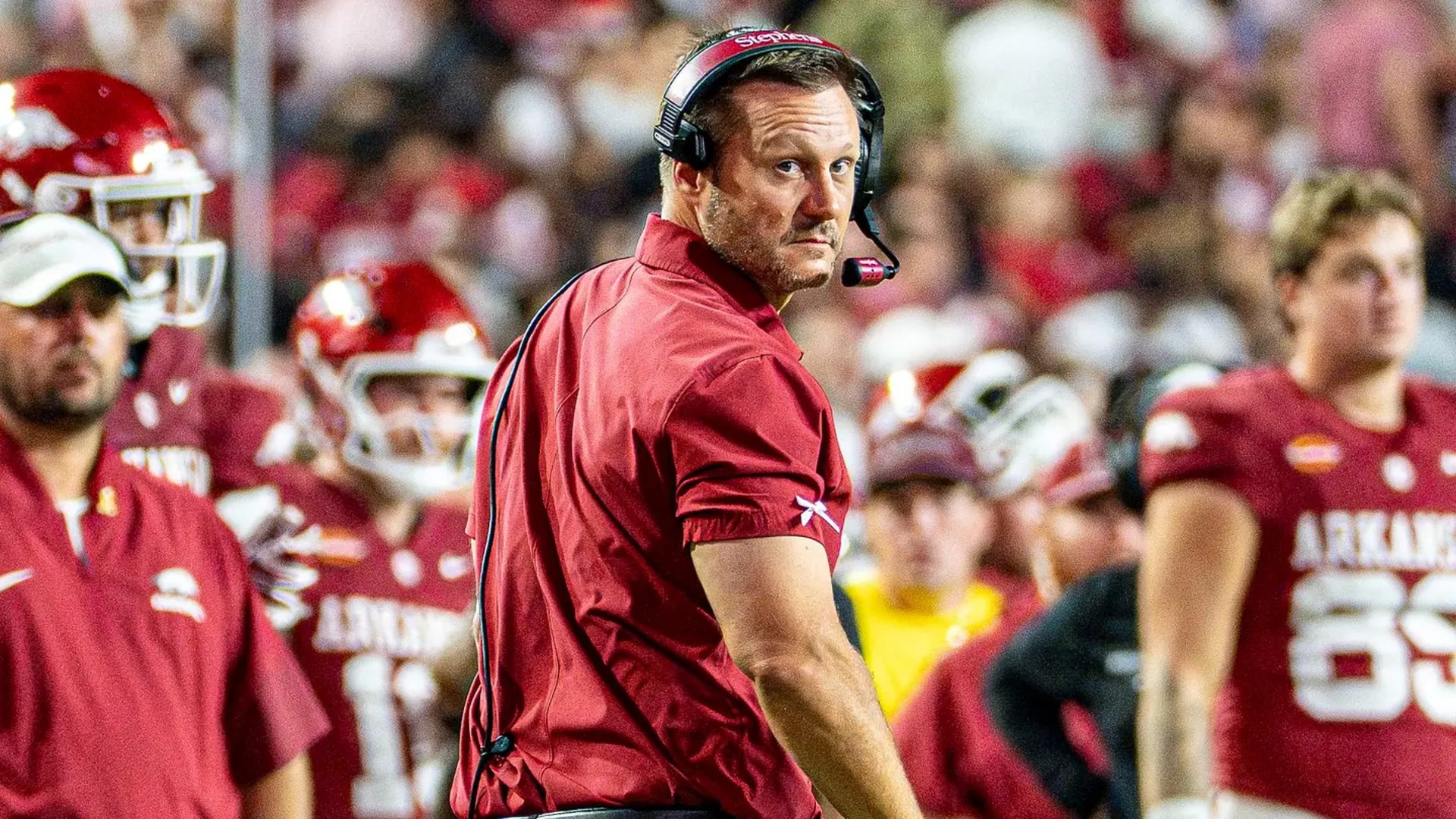
Rhett Lashlee disputes Arkansas schedule ranking and did so bluntly on the Andy & Ari On3 show, challenging the idea that any program can be labeled the season’s toughest before a single snap. His comments matter because they come from an Arkansas native and former Razorback quarterback who now coaches at a program that has held a national presence under his leadership.
Lashlee makes a basic but important point about preseason metrics: they are projections built on past results, not a real-time measure of team quality. Reporting by Saturday Down South captured his remark that “no one’s played a game” and thus you cannot fairly declare a schedule the hardest to start the year.
Key Takeaways
- Rhett Lashlee is the head coach at SMU entering his fifth season with a 38-16 record, and he pushed back on preseason strength-of-schedule rankings that place Arkansas first.
- ESPN FPI listed Arkansas as having the top preseason strength of schedule, a placement Lashlee called premature because no games have yet been played.
- Market predictions from Kalshi show high College Football Playoff odds for several teams, underscoring how early projections and betting markets shape preseason narratives.
Rhett Lashlee disputes Arkansas schedule ranking and explains why
Lashlee’s critique is straightforward and rooted in both personal ties and coaching experience. Born in Arkansas and a Razorbacks quarterback from 2002–04, he spoke as someone who respects his alma mater while disputing the methodology that would crown a team with the “hardest” schedule before the season begins.
On the Andy & Ari On3 show Lashlee said, “No offense to Arkansas, they can’t have the hardest strength of schedule in America to start the season because no one’s played a game. We don’t even know who’s good, so we don’t know what a good and an easy schedule is right now.” That line crystallizes his larger argument: schedules earn their reputations during the fall, not in January rankings.
As an on-field measure, Lashlee’s SMU record entering the 2026 season—38-16 over four seasons—gives him credibility when assessing how schedules translate to results. His perspective is useful for fans and analysts who rely on preseason lists to frame expectations, because it prompts a reminder that projection-driven rankings carry inherent uncertainty.
How ESPN FPI and preseason strength of schedule systems operate
ESPN FPI and comparable models assemble preseason strength-of-schedule evaluations by blending prior-season results, returning personnel assessments, and projected performance. Those inputs create a probabilistic forecast rather than a definitive ranking of how difficult a slate will prove to be.
That approach is valuable for early conversation because it standardizes comparisons across teams. It is also limited because projections cannot account for in-season development, injuries, or unforeseen breakouts that change a team’s profile once play starts.
Coaches like Lashlee view those limitations as reason to temper public claims that a team already possesses the “toughest” schedule, arguing the true test is head-to-head competition over consecutive weeks.
Preseason metrics and prediction markets compared
| Metric or Market | Notable Placement or Odds |
|---|---|
| ESPN FPI preseason strength of schedule | Arkansas ranked first in preseason strength of schedule |
| Kalshi College Football Playoff qualifier market odds | Notre Dame 86%; Ohio State 77%; Indiana 76%; Oregon 76%; Miami (FL) 75%; Georgia 72%; Texas 66%; Texas Tech 64%; Alabama 43%; LSU 39% |
What Lashlee’s comments mean for SEC playoff positioning and recruiting
When a coach of Lashlee’s background pushes back on preseason SOS lists it shifts the narrative around how fans, recruits, and analysts judge a program before games are played. That matters in the SEC because perception influences ballot placement, early-week national attention, and the frame around which recruiting conversations begin.
Preseason labels can create psychological advantages or burdens—teams tagged with a brutal schedule can be given more leeway for early losses while teams seen as having easier paths might face harsher scrutiny. Lashlee’s point encourages evaluators to wait for on-field evidence before allowing preseason rankings to calcify into entrenched narratives.
For Arkansas specifically, being listed atop a strength-of-schedule chart feeds both respect and expectation. Lashlee’s contention is that respect ought to be earned in-game, and that early proclamations may skew how voters and markets judge a season as it unfolds, and Cory Nightingale’s reporting formed the basis of the quote and the Kalshi market snapshot used here.