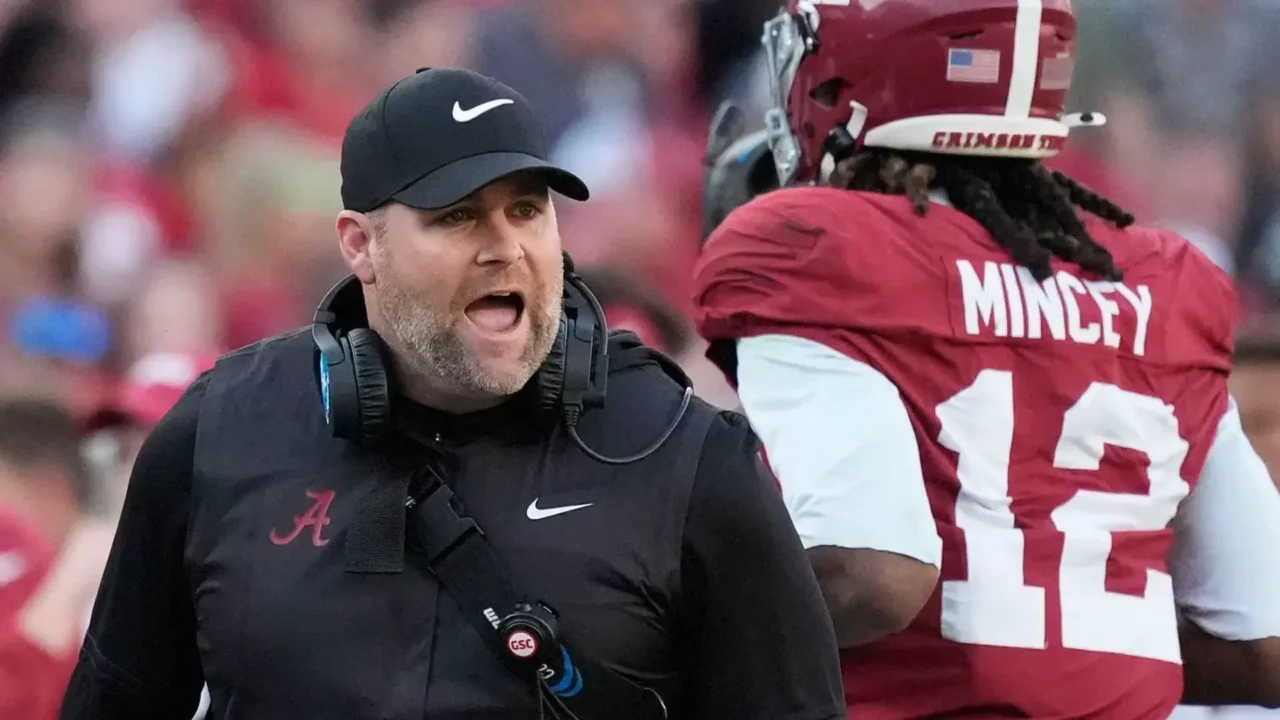
Kane Wommack’s defense sits at the center of Alabama’s offseason argument about upside and risk. The unit’s trajectory will decide whether the Tide treads water or vaults back into national title contention.
One clear read of the current conversation comes from recent reporting by Bama Hammer, which frames two specific, measurable predictions about how far Wommack’s group can improve this season.
Key Takeaways
- Alabama will record its best Scoring Defense figure in seven seasons, backed by a more aggressive scheme and better third-down defense.
- The Crimson Tide will finish the regular season inside the nation’s top five in Scoring Defense while still conceding the SEC lead to the Georgia Bulldogs.
- If both predictions happen, Alabama’s win total will climb and the Tide will be a legitimate national title contender rather than a team facing a rebuilding season.
How Kane Wommack’s defense can cut scoring
Wommack has built a reputation for sound positional coaching and pressure packages that create turnovers and short fields. On paper, those traits translate to fewer points allowed and a clearer path to improving Alabama’s scoring defense numbers.
Concrete adjustments that would drive the gains include cleaner late-game situational play-calling, improved red-zone tackle consistency, and more disruptive interior rushes that reduce explosive plays. Each of those areas shortens opponent drives and compresses opponent scoring averages over a season.
Coaching nuance matters; Wommack’s emphasis on technique and quarterback pressures should help the Tide squeeze scoring chances on third down and force opponents into longer, lower-percentage possessions.
Personnel and returning production under Kane Wommack
Personnel continuity is central to any defensive rebound, and returning production is part of the projection that Alabama posts its best scoring defense since 2020. The Tide’s line play and secondary cohesion will determine whether the scheme changes stick.
Keelon Russell and other returning contributors give the staff experienced pieces to execute more complex packages without sacrificing assignments. That depth matters late in games and across a long SEC schedule.
Recruiting and young depth are also in view; if younger defenders take clear steps, the unit can sustain pressure across the season and avoid the midseason drop-offs that have plagued previous iterations.
What a top-five scoring defense would change for Alabama
A top-five Scoring Defense does more than lower opponent points per game; it reshapes game plans and roster construction. Offensively, Alabama can be more balanced and face fewer must-pass late-game scenarios.
In SEC competition, a top defensive profile narrows the gap with the conference’s elite, even if Georgia remains the league’s defensive standard. The prediction foresees Georgia holding the SEC lead while Alabama moves into national top-five territory.
On a practical level, limiting opponents keeps Alabama out of shootouts that expose young offensive line play and quarterback inexperience. That steadiness is often the difference between a three-loss regular season and a one-loss CFP-caliber resume, and defensive success under a young coordinator becomes a selling point on the trail for edge rushers and hybrid linebackers who fit Wommack’s system.
Historical scoring defense comparison
| Season | Scoring Defense (points per game) |
|---|---|
| 2016 | 13.0 |
| 2017 | 11.9 |
| 2022 | 18.2 |
| 2023 | 19.2 |
These season figures are drawn from public scoring-defense records and leaderboards.
SEC and CFP implications for Wommack defense
Within the SEC, defensive identity matters as much as offensive stars; if Wommack’s unit reaches the projected levels, Alabama’s path through the conference becomes more straightforward even with Georgia occupying the defensive pole position. A top defensive profile reduces reliance on high-variance offensive snaps in late-game windows against elite league opponents.
For College Football Playoff calculus, a top-five scoring defense paired with an efficient offense creates a resume that pollsters and committee members respect. Recruiting, NIL positioning, and midseason national attention all reset upward when a program shows clear defensive improvement under a coordinator in his developmental window.