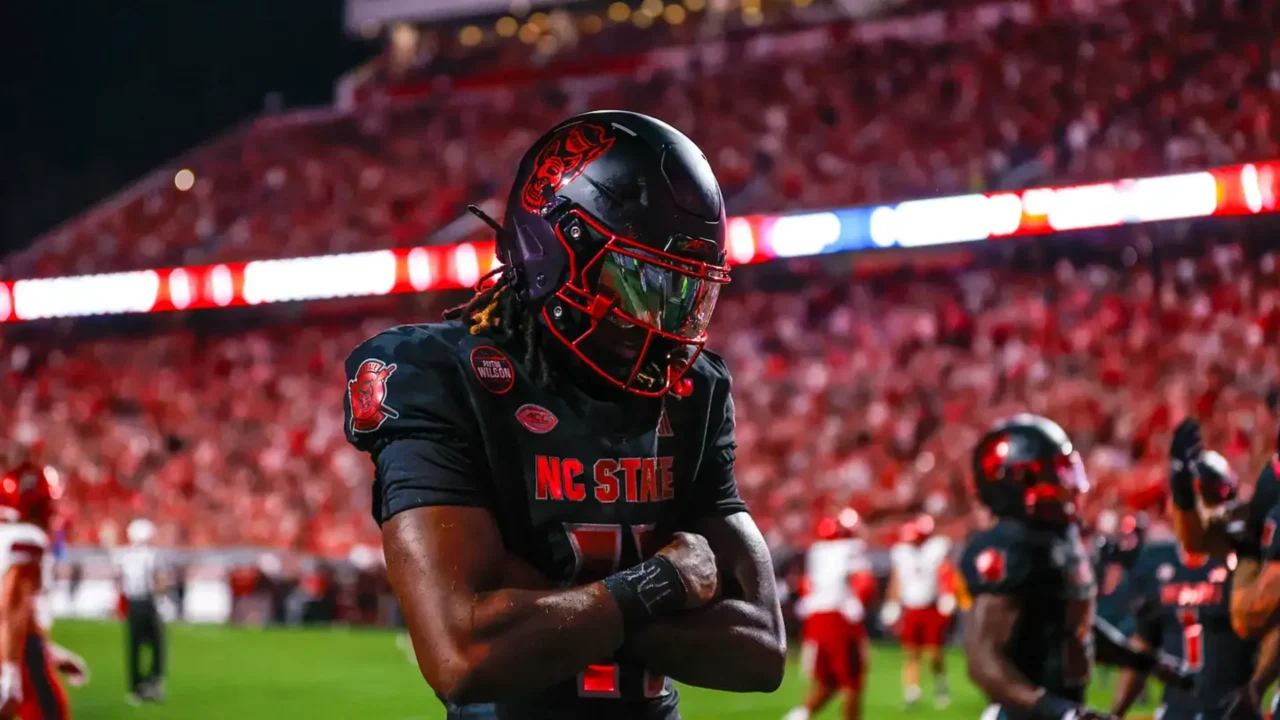
Vanderbilt faces NC State this Saturday in what the staff is calling the season’s first true benchmark, and the matchup centers on one player: CJ Bailey. The Commodores will measure their progress by how well they can limit Bailey’s ability to turn pass attempts into explosive plays.
The team’s preparation and coach commentary were summarized in reporting by Vanderbilt Commodores and highlight why Vanderbilt’s staff sees Bailey as a different kind of dual-threat. Coaches believe the passing element of his game creates the real matchup problem for a developing Vanderbilt defense.
Key Takeaways
- CJ Bailey is a dual-threat quarterback whose passing ability sets him apart from other rush-capable signal-callers.
- Vanderbilt’s defensive plan hinges on collapsing the pocket and taking away Bailey’s comfort in extending plays.
- Limiting explosive pass plays and forcing Bailey into one-dimensional reads will be the deciding factors in Saturday’s game.
Why CJ Bailey’s passing separates him
Clark Lea framed Bailey’s profile around one clear trait: his effectiveness as a passer.
Lea said the arm strength and downfield tendencies are what make Bailey a real threat, not just his legs.
The reporting notes Bailey threw for 3,105 yards last season with 25 passing touchdowns and nine interceptions, and that he contributed 215 rushing yards with six rushing scores in 2025. That combination forces defenses to respect both vertical passing and quarterback run lanes.
Lea’s assessment was blunt and specific.
“I think his effectiveness as a passer,” Lea said. “I mean, the arm strength you see shows up.”
“That’s really how he wants to win the game. His ability to extend plays in the pocket, his ability to escape outside and make it a long down,” Lea added.
“I think a lot of explosiveness comes off that,” Lea said.
Even with lofty counting stats from last season, Bailey’s start to this year was uneven; Week 0 saw him limited to 84 passing yards with one interception in a 34-8 loss to Virginia. Vanderbilt’s staff is treating that game-line as context, not proof that Bailey is neutralized.
Vanderbilt’s plan to collapse the pocket and force one dimensional play
Vanderbilt’s defensive messaging has been consistent: contain the quarterback, create rush lanes, and funnel Bailey into predictable reads.
Rinaldi summarized that approach directly in the pregame dialogue.
“We’ve faced good quarterbacks, too,” Rinaldi said.
“So it’s just about containing him, collapsing the pocket, making him one-dimensional,” he continued.
“That’ll be a big deal in this game and we’re looking forward to facing another good quarterback,” Rinaldi said in pregame comments cited in the source reporting.
On a practical level, the Commodores will look to force quicker decisions, eliminate time for downfield throws, and take away the late-developing plays that turn routine downs into explosive gains. Turnovers and limiting long downs were explicitly referenced as priorities in the coaching dialogue.
Vanderbilt’s staff can point to recent tape where the defense handled mobile quarterbacks well; the game against Austin Peay and Chris Parson two weeks earlier provided a controlled environment to practice containment and rush concepts. Against a more dangerous passer, the execution margin will be narrower.
Season context and verified comparison table
| Item | NC State / CJ Bailey | Vanderbilt context |
|---|---|---|
| Last season passing | 3,105 yards and 25 passing TDs with nine interceptions | Vanderbilt faces a passer-first dual-threat as a key early-season test |
| Rushing contribution | 215 yards and six rushing TDs in 2025 | Commodores will need assignment-loyal containment to limit QB rush production |
| Week 0 note | 84 passing yards and one interception in a loss to Virginia | Vanderbilt treats that game as context, not definitive proof of decline |
| Recent Vanderbilt prep | — | Defense used the Austin Peay game (Chris Parson) to sharpen containment and pass-rush timing |
SEC stakes for Vanderbilt’s early season benchmark
This game carries outsized significance for Vanderbilt’s season narrative and roster development. A strong defensive showing against a passer of Bailey’s profile would validate the staff’s offseason work and provide a tangible early-season recruiting message about the program’s ability to defend pro-style offenses.
Conversely, failure to limit Bailey’s downfield passing and pocket escapes would expose gaps the Commodores must correct before heading into the middle of the SEC slate. The result will influence internal roster confidence and the tone of local recruiting conversations, even if it does not directly alter conference standings after a single week.
Coaching chatter and the tactical emphasis on creating one-dimensional reads make this more than a single-game evaluation; it is a structural test of whether Vanderbilt’s front seven and coverage unit can consistently remove the explosive elements from a quarterback who prefers to win with his arm.
According to local reports and coach quotes included in the original team report, Vanderbilt’s staff sees the matchup with CJ Bailey as a primary measuring stick for the Commodores this weekend.