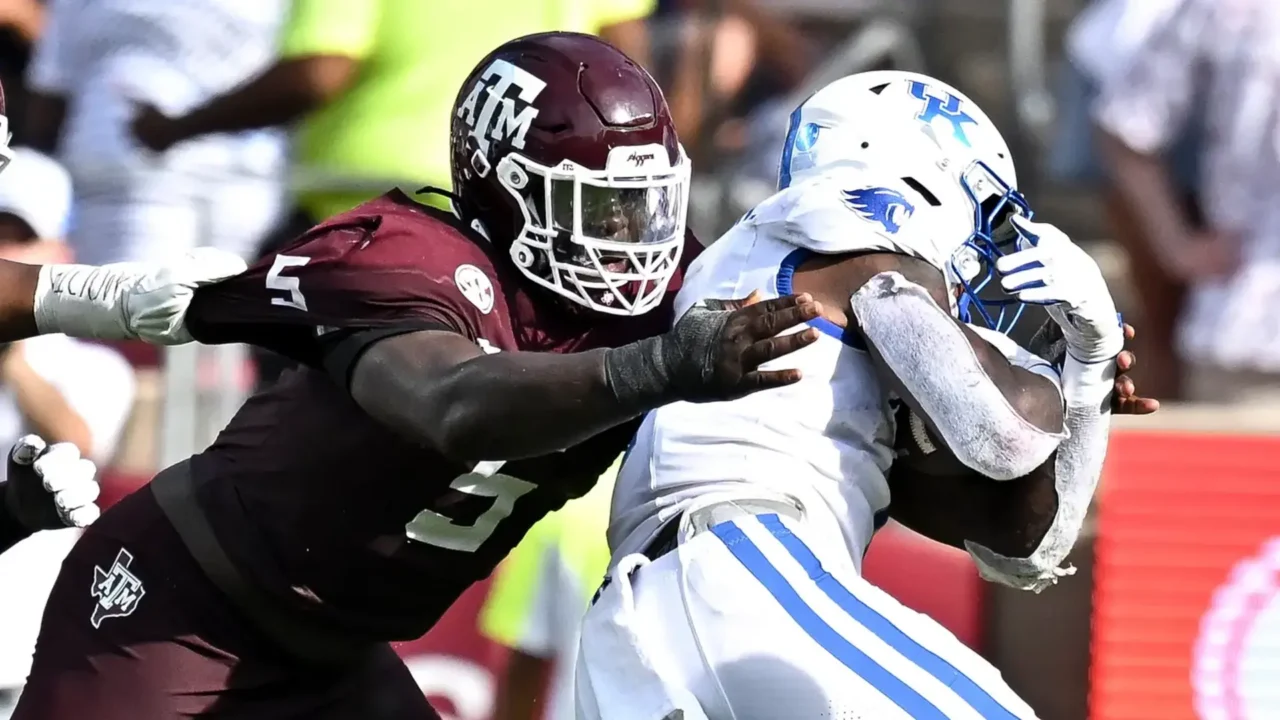
Texas A&M run defense was the story of the day at Kyle Field in a 31-21 loss to Kentucky, with the Wildcats repeatedly working the middle and finishing drives on the ground. The shortcomings against rush-heavy looks are not a one-week anomaly but a pattern that has followed the Aggies into Year Three under the current staff.
That pattern and its impact on the season are laid out in reporting from Sports Illustrated, which frames Saturday’s result as another chapter in a run-defense problem that opponents are scheming to exploit.
Key Takeaways
- The Aggies lost 31-21 at Kyle Field after Kentucky repeatedly attacked the run and controlled physical matchups in the trenches.
- Texas A&M managed just two sacks and three tackles for loss against Kentucky in a game where run defense was the decisive factor.
- Kenny Minchey completed the passing workload with 252 yards and two touchdowns while CJ Baxter paced Kentucky on the ground with 87 yards and two scores on 19 carries.
- The loss continues a troubling trend in the third year of Mike Elko’s tenure where team aggression in the backfield has not translated into consistent run stopping.
Why Texas A&M run defense failed vs Kentucky
The Aggies’ schematic temperament — aggressive blitzing and pursuit designed to create negative plays — has produced sacks but not reliable run resistance.
When Kentucky committed to running between the tackles, the Aggies failed to sustain gap integrity and were repeatedly moved off the point of attack.
Nick Saban’s media-day warning about a “fatal flaw” in the Aggies’ run defense now reads less like preseason chatter and more like a direct explanation for what unfolded at Kyle Field. Kentucky’s lead back, CJ Baxter, finished with 87 yards and two touchdowns on 19 carries, a workload built on hitting creases the Aggies left open.
That contrast — an ability to rush the passer but an inability to hold in short-yardage and early-down situations — turned the game dynamic. Kentucky kept the chains moving, and Texas A&M’s aggression in obvious pass-rush moments did little to flip field position consistently.
Front seven fit and third and short performance
Personnel fit in the front seven has become a talking point for opponents scheming into A&M’s tackle sets. Linebackers and interior defensive linemen were frequently tasked with two-way leverage against offset runs and direct dives, and the Aggies struggled to win those collisions consistently.
Third-and-short performance was especially revealing. Kentucky converted key short-yardage situations into first downs by leaning on downhill runs and power concepts, which put additional pressure on A&M’s subfront bodies and tackling angles. Jason Patterson’s 58 yards on six carries illustrated how even limited snaps in space punished pursuit and tackling errors.
Tackling fundamentals and rotation depth against heavier personnel packages are areas opponents will exploit if the Aggies do not adjust personnel or scheme to hold gaps and set the line for multiple downs. Those adjustments will be necessary to change the physical tone against SEC run attacks.
Run defense trends vs recent rush attacks
| Opponent | How they attacked Texas A&M | Verified context |
|---|---|---|
| Kentucky (this season) | Consistent downhill runs between the tackles, finishing drives on the ground and relying on a lead back rotation. | CJ Baxter rushed for 87 yards and two touchdowns on 19 carries while the Aggies recorded two sacks and three tackles for loss. |
| Texas and Miami (last season) | Both opponents attacked the trenches with direct rushing concepts, forcing A&M to defend length-of-game physicality. | Both Texas and Miami rushed for over 150 yards in their wins over A&M last season, with Texas surpassing 200 yards. |
Run defense implications for Baton Rouge trip and SEC race
Texas A&M will travel to Baton Rouge to face LSU next, and that matchup now carries an amplified significance given A&M’s shortcomings against the run. LSU’s offensive identity and ability to test interior defenders will force the Aggies to show immediate adjustments in gap-control and personnel deployment.
From a roster-construction and recruiting standpoint, these games will be used as reference points in evaluations of interior linemen and run-stopping linebackers. Continued failures in short-yardage and early-down defense could influence how schemes are staffed and which profiles are prioritized on the recruiting trail.
The broader SEC picture and College Football Playoff math hinge on minimizing exploitable weaknesses; persistent run-defense issues reduce margin for error in marquee conference matchups and complicate bowl- and playoff-path projections for a team with championship aspirations.