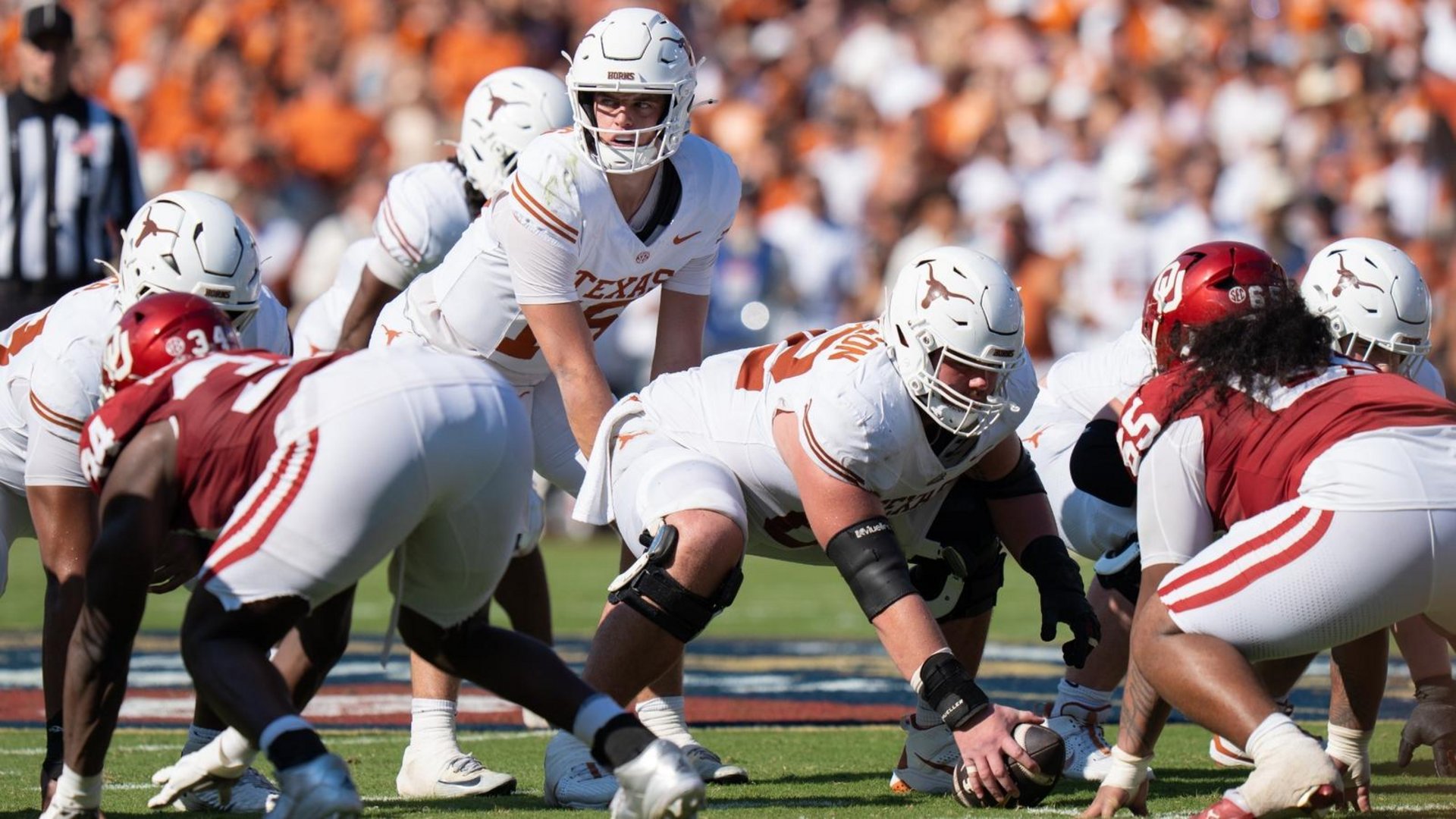
The Texas football loss to Oklahoma ended the Longhorns’ unbeaten start in the most painful way possible. Tate Sandell’s 47-yard field goal gave the Sooners a 27-24 victory and turned a tightly contested rivalry game into Texas’ first defeat (via University of Texas Athletics).
Texas had answers through the air and made Oklahoma work for its yards, but the Sooners found points on a punt return and an interception return. Those non-offensive scores created the margin that the Longhorns could not erase.
The result dropped Texas to 4-1 overall and 1-1 in SEC play. Oklahoma also moved to 1-1 in the conference, setting up a tighter race in the 16-team league.
Key Takeaways
- Oklahoma defeated Texas 27-24 on Tate Sandell’s 47-yard field goal.
- Texas fell to 4-1 overall and 1-1 in SEC play, while Oklahoma improved to 3-2 overall and 1-1 in the conference.
- Arch Manning threw for 260 yards and three touchdowns in a productive passing performance.
- Oklahoma scored on both a punt return and an interception return, turning special teams and defense into the difference.
Texas Football Loss to Oklahoma Turned on Hidden Yardage Plays
Texas’ defensive effort was strong enough to keep the game within reach. The Longhorns allowed Oklahoma 238 total yards, including 83 rushing yards, and recorded nine tackles for loss.
Colin Simmons made an impact up front with three tackles for loss, while Rasheem Biles contributed to a defensive effort that repeatedly disrupted Oklahoma. The production between the lines gave Texas a chance to win even as the Sooners searched for points elsewhere.
Oklahoma’s punt return touchdown changed the value of every offensive possession. The interception return touchdown added another score without requiring the Sooners to sustain a drive, and those plays offset Texas’ work on offense.
That is what made Sandell’s final kick decisive rather than merely dramatic. Oklahoma did not need to dominate the yardage battle to win; it needed to capitalize when Texas gave the Sooners opportunities in phases outside the standard offense.
Texas’ defense can point to the nine tackles for loss and the limited Oklahoma rushing production as evidence of a competitive performance. The next step is preventing those positive plays from being outweighed by return scores and sudden changes in possession.
Arch Manning and Texas Receivers Produced Without the Winning Finish
Arch Manning gave Texas enough through the air to stay in the rivalry game. He finished with 260 passing yards and three touchdowns, connecting with Cam Coleman, Ryan Wingo and Jermaine Bishop Jr. for scores.
Coleman led the receiving group with five catches for 110 yards. His production showed that Texas could create meaningful gains through the passing game, even when Oklahoma’s defense made the final margin difficult to protect.
Wingo and Bishop also supplied touchdown receptions, giving Manning three different scoring targets. That distribution matters for an offense trying to respond after a turnover or return play changes the game’s direction.
Texas lost despite that offensive production because the game was decided by more than total offensive execution. Oklahoma’s return touchdowns and Sandell’s late field goal turned a strong passing day into an outcome the Longhorns could not control.
The performance still gives Texas a foundation for the next stretch. Manning’s accuracy and the receivers’ ability to produce explosive scoring plays remain clear positives, but the Longhorns need cleaner situational football around them.
Red River Rivalry Records Put the Upset in Context
| Category | Texas | Oklahoma |
|---|---|---|
| Overall record | 4-1 | 3-2 |
| SEC record | 1-1 | 1-1 |
| Oklahoma production | Texas allowed 238 total yards | 83 rushing yards |
| Texas defensive disruption | 9 tackles for loss | — |
| All-time series | Texas leads 65-52-5 | |
The comparison shows why the result will sting for Texas. The Longhorns limited Oklahoma’s production and created disruption, yet the Sooners converted two non-offensive plays into touchdowns and finished with the winning kick.
The records also show that neither team has separated itself in SEC play. Texas and Oklahoma both sit at 1-1 in the conference, while the all-time series remains in Texas’ favor at 65-52-5.
For Texas, the lesson is not that the offense failed to show up. Manning, Coleman, Wingo and Bishop delivered enough to keep the game competitive, but the Longhorns needed their special teams and defense to avoid giving Oklahoma scoring opportunities outside the offense.
Texas Faces Rising SEC Pressure Against Florida
Texas returns to conference play against No. 16/15 Florida on October 17. The matchup begins a three-game homestand and gives the Longhorns an immediate chance to respond after falling to the same 1-1 SEC record as Oklahoma.
In a 16-team SEC, one rivalry loss does not erase the rest of the schedule, but it reduces the margin for error. Texas now needs to stack conference wins while avoiding the return scores, turnovers and late-game swings that decided this one.
The roster evaluation should begin with the contrast between the defensive effort and the final score. Simmons’ three tackles for loss, the nine team tackles for loss and the 238 yards allowed point to a defense capable of competing, while the punt return and interception return show where the margin broke down.
Special teams also move to the center of the review after Sandell’s game-winning kick. Texas can take confidence from Manning’s three touchdown passes and Coleman’s 110 receiving yards, but those positives must be paired with sharper protection of field position.
As detailed in the official recap from University of Texas Athletics, the loss altered Texas’ record but not the opportunity ahead. The Longhorns’ path through the SEC now demands a steadier response against Florida and stronger control of the plays that do not come from the quarterback or running game.