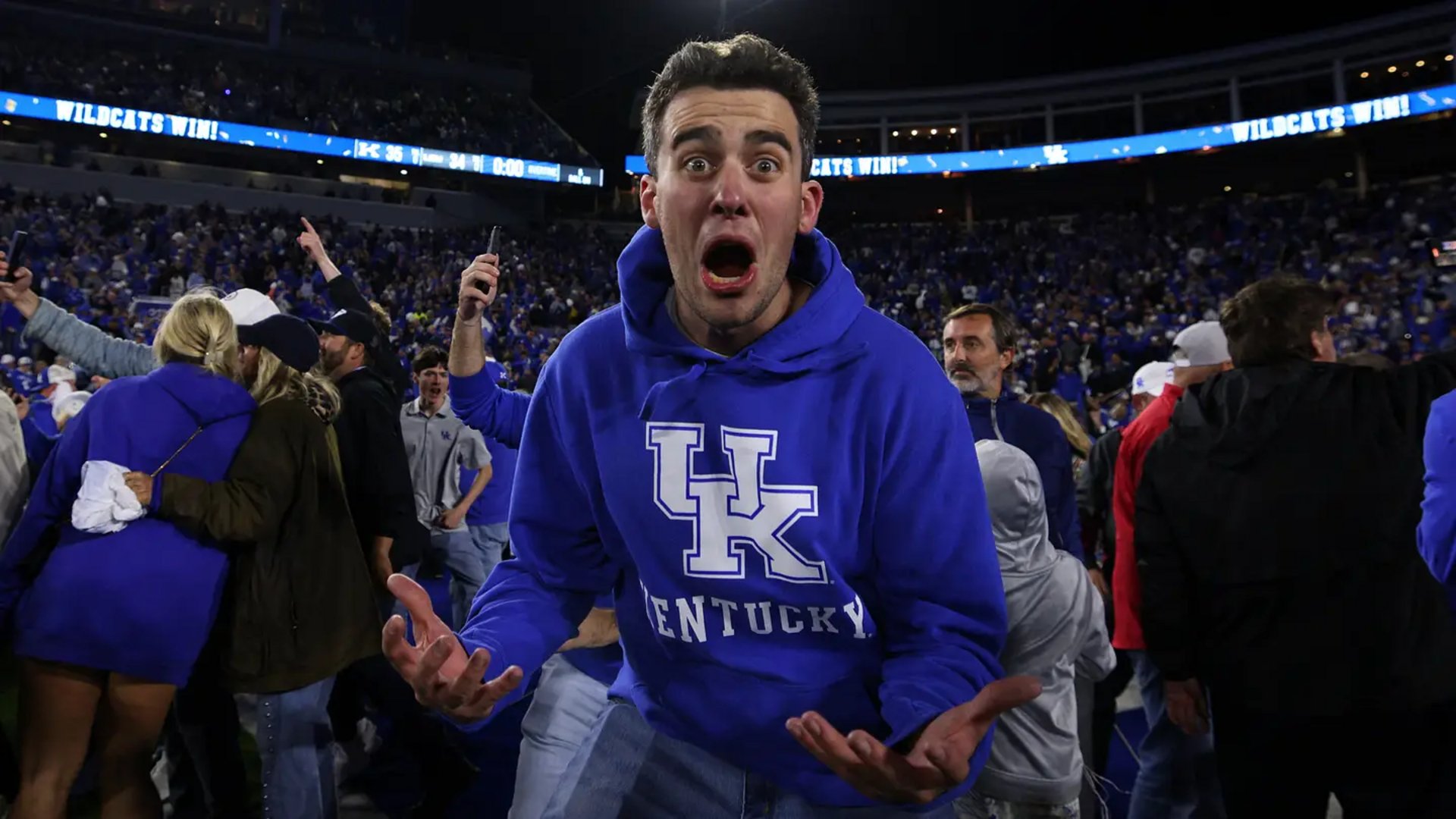
Kentucky’s 35-34 overtime win over LSU at Kroger Field delivered a major result for the Wildcats, but the celebration carried a reported $500,000 SEC fine. The penalty followed fans entering the field after the conference game.
The reported payment goes to LSU, not to the SEC’s scholarship fund, because the teams met in conference play. The account of the fine and the policy behind it is detailed by CFB-HQ On SI.
Key Takeaways
- Kentucky faces a reported $500,000 fine after fans entered the competition area following its conference game against LSU.
- The SEC field-access policy described in the report limits entry to authorized participants rather than spectators.
- For a conference-game violation, the reported fine goes to the opposing school; a non-conference fine goes to the SEC post-graduate scholarship fund.
- Kentucky improved to 5-1 overall and 3-1 in SEC play, while LSU fell to 4-2 overall and 1-2 in the conference.
How the SEC field-access rule led to Kentucky’s fine
The reported penalty stems from the SEC’s policy governing access to the competition area. As described in the report, the field is restricted to players, coaches, officials and authorized personnel; spectators are not permitted to enter before, during or after a contest.
That restriction makes the distinction between celebrating in the stands and entering the playing area central to this story. Kentucky’s victory remains a 35-34 overtime win, but the reported fine concerns field access after the game, rather than the score or the outcome itself.
The policy account also says the SEC changed to a flat $500,000 fine in 2025. Under the reported rule, the amount for a violation is set at that figure rather than varying with whether the game was a conference matchup or a non-conference contest.
The destination of the payment does depend on the type of game. For a conference contest, the report says the fine is paid to the opposing school; for a non-conference contest, the money goes to the SEC post-graduate scholarship fund.
That distinction explains why LSU is the reported recipient in this case. Kentucky and LSU played an SEC game, so the account identifies the Tigers as the school due the payment, rather than the conference scholarship fund.
The report describes a limited safe-exit exception. A school can avoid the penalty if the visiting team and officials leave safely before fans enter the field and there is no interaction between fans and opposing personnel.
That exception makes the timing of a field entry relevant to how the rule is described, but it should not be mistaken for a separate account of precisely how people moved after this game. The supplied information supports the reported fine and the policy’s stated exception, not additional claims about the sequence of events.
The reported rule applies to spectators entering the competition area even when the game has ended. That point is important in a close overtime finish, when a result can prompt a large celebration but the field remains restricted under the policy account.
The fine also has a defined recipient because this was a conference game. The reported distinction between conference and non-conference penalties means the same field-access issue can direct money to different places depending on the matchup.
Kentucky’s overtime finish put the celebration in context
Kentucky beat LSU 35-34 in overtime, a one-point result that improved the Wildcats’ conference record. The reported field entry brought a separate consequence: a $500,000 penalty under the SEC policy account.
The supplied report credits C.J. Baxter with 123 rushing yards and two touchdowns. It also credits Kenny Minchey with completing 23 of 36 passes for 246 yards and recording the winning two-point conversion.
Those reported contributions provide context for the game’s close finish without changing the basis of the fine. The penalty is tied to spectators entering the competition area, not to Baxter’s production, Minchey’s passing line or the final margin.
The records moved in opposite directions after the result. Kentucky improved to 5-1 overall and 3-1 in SEC play, while LSU fell to 4-2 overall and 1-2 in conference play.
That contrast gives the result importance for both teams, but the fine remains a separate matter from the standings. Kentucky earned the overtime win; under the reported policy, the postgame field access carries a financial consequence.
Kentucky and LSU entered the aftermath on different trajectories
| Team | Reported record after the game | Reported game result |
|---|---|---|
| Kentucky | 5-1 overall, 3-1 SEC | Won 35-34 in overtime |
| LSU | 4-2 overall, 1-2 SEC | Lost 35-34 in overtime |
Kentucky’s field-access penalty adds a cost to its SEC upset
The reported fine places a direct financial cost alongside Kentucky’s conference win. The account says the $500,000 payment goes to LSU because this was an SEC game, while a non-conference violation would send the money to the SEC post-graduate scholarship fund.
For the conference, the case underscores the rule’s stated scope: spectators are not authorized to enter the competition area, including after a game. The safe-exit exception described in the report is conditional on visiting players and officials leaving safely before fans enter and on there being no interaction with opposing personnel.
Kentucky’s overtime result and the fine therefore concern two distinct outcomes. The Wildcats improved their record with the 35-34 win, while the reported field-access violation creates a payment obligation to LSU under the conference-game policy.
The reported figures and policy details distinguish the result on the field from the SEC’s response to field entry. For Kentucky, the victory stands in the supplied account alongside a $500,000 cost; for LSU, the loss is paired with the reported payment as the opposing school.