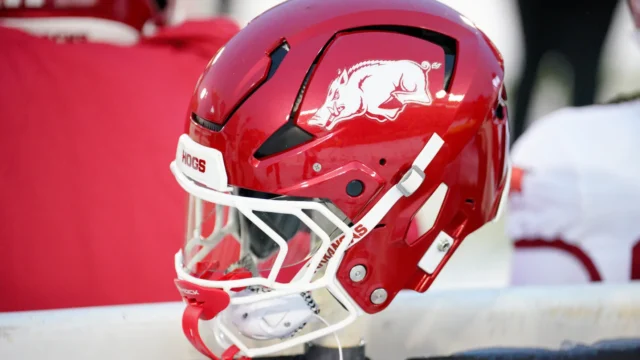

Arkansas preseason SEC rankings have settled into a familiar pattern this cycle: most outlets place the Razorbacks near the bottom of conference lists. That framing appears in the first paragraphs of many previews, but rankings are predictions built on narrative momentum as much as measurable team variance. This analysis lays out where consensus places Arkansas, what history shows about preseason placement versus results, and a compact metric you can apply to temper media bias and set realistic fan expectations.
Where the preseason rankings place Arkansas
This summer’s consensus places Arkansas in the SEC’s lower tier. Publications such as Athlon include the Razorbacks toward the bottom of preseason rankings, and that placement has become shorthand for national takes. The media consensus reflects recent results, roster turnover and recruiting shortfalls, but consensus is not the same as proof.
Rankings are useful: they summarize perceived team strength at a glance. But they are also snapshots taken before camp, and they can overweight narrative signals—coaching headlines, transfer arcs, and prior-year records—over underlying return metrics. A recent practice photo captures that preseason posture visually, with position groups and returning starters forming the basis for evaluation (see image references below for the practice shot and the metric chart).
How Arkansas preseason SEC rankings compare historically
What does history say about preseason placement versus season outcomes? Looking back across recent seasons for the Arkansas Razorbacks, preseason bottom-tier placement correlates with a greater chance of underwhelming finishes, but it is not determinative. There are multiple seasons where teams ranked low in preseason polls finished the year solidly in the middle of the conference or better, and there are seasons where favorable preseason rankings collapsed into disappointing results.
Put another way: preseason lists have signal, but they also carry noise. The past five completed seasons show variability in how Arkansas performed relative to preseason slots. That pattern means fans should treat preseason rankings as context rather than destiny—check the roster continuity and returning-production numbers that actually drive on-field outcomes before accepting a doom-laden narrative (analysis and examples summarized from Best of Arkansas Sports).
A simple metric that tempers the rankings
Best of Arkansas Sports outlines a compact, reproducible metric intended to add perspective to media rankings. The metric blends three straightforward components: returning production, an opponent-adjusted schedule strength factor, and a variance factor for turnover luck and close-game outcomes. Best of Arkansas Sports applies this approach to recent Arkansas seasons to show how a numbers-based check softens some harsh preseason placements (source: Best of Arkansas Sports).
Here is a quick version you can calculate yourself:
- Returning Production: measure the percent of offensive and defensive production returning from last season (0–100).
- Schedule Strength Adjustment: estimate opponent-adjusted expected points differential on a −10 to +10 scale.
- Variance Factor: a 0–10 modifier capturing turnover luck and outcomes in one-score games.
Combine them as: metric = Returning Production + (Schedule Adjustment × 5) + (Variance Factor × 2). Higher metric values imply the team is likelier to outperform a low media slot. Applied to Arkansas in the Best of Arkansas Sports piece, the metric narrows some gaps between media placement and underlying roster continuity, showing that a media bottom-tier label can occasionally overstate the practical difference between teams (Best of Arkansas Sports).
The same Best of Arkansas Sports analysis also mentions coaching-profile discussions (including references to staff names such as Ryan Silverfield) only to illustrate how media shorthand around coaches can influence preseason perception; those coaching references are contextual and attributed to the Best of Arkansas Sports reporting rather than presented here as new evaluation.
What that means for fans and the 2026 view
For Razorback fans the takeaway is pragmatic: use the metric and a short checklist to judge preseason chatter. If Arkansas’ metric sits noticeably higher than its media slot, temper the instinct to accept negative narratives. Specifically, watch three indicators before writing off the season: returning production on offense and defense, early-season health reports, and whether close-game variance (turnovers and narrow results) reverts toward expected values. If those indicators align with a higher metric, Arkansas has a reasonable path to outperform a low preseason billing even inside a tough SEC slate.
Practical steps for fans: compute the simple metric above using publicly available returning-production figures, compare it to media rankings, and follow early-game sample sizes (first three games) for variance adjustments. That approach keeps expectations grounded and reduces the sway of headline-driven pessimism.
Key takeaways
- Preseason rankings are consensus snapshots, not determinative forecasts; treat them as one input among several.
- A compact ranking metric that combines returning production, schedule adjustment and variance provides an objective counterpoint to media lists (see Best of Arkansas Sports for the applied examples).
- If Arkansas’ metric exceeds its media slot, temper pessimism—history and the Best of Arkansas Sports analysis show multiple cases where teams outperformed negative preseason placement.
Source note
This analysis relies on reporting and the metric discussion published by Best of Arkansas Sports. The original piece presents the metric and applies it to recent Arkansas seasons; readers who want the applied season-by-season tables and the author’s commentary can read the Best of Arkansas Sports article linked below (Best of Arkansas Sports).
Frequently asked questions
What happened with Arkansas preseason SEC rankings?
Most outlets placed Arkansas near the bottom of SEC preseason lists this cycle, reflecting recent results and roster concerns. Best of Arkansas Sports argues that a metrics-based check shows that some of that placement may be narrative-driven rather than fully grounded in returning production (Best of Arkansas Sports).
Why does Arkansas preseason SEC rankings matter?
Preseason rankings shape expectations, media coverage and fan sentiment. Using a reproducible metric gives fans a practical tool to assess whether a low ranking is warranted or influenced by bias.
What happens next?
Fans should track the ranking metric, returning-production reports, and early-season injury and variance indicators. Those real-time measures will give a clearer picture than preseason lists alone.
Source: Best of Arkansas Sports — Best of Arkansas Sports