The New York Times published an analysis on 2026-07-01 arguing that the market forces that killed the Southwest Conference are still shaping college football today. The piece frames the SWC’s collapse as a window into how television deals, institutional markets and shifting incentives remade the sport — and why those dynamics still matter for programs such as the Arkansas Razorbacks.
That central claim — that economic pressure rather than a single scandal or event drove broad realignment — sets the scope for this look back and forward. Below we trace the 1990s breakup, map the continuity of market forces into the present, and outline what to watch next for Arkansas and regional competition with Texas programs.
Southwest Conference
What the New York Times reported
The New York Times piece, published on nytimes.com on 2026-07-01, frames the Southwest Conference’s end as part of a longer story about changing commercial incentives in college athletics. The report positions the SWC’s unraveling as a case study in how media markets, revenue potential and institutional decisions can redraw competitive maps.
The NYT authors treat the SWC’s demise as illustrative rather than uniquely deterministic. Their analysis highlights audience concentration, rights monetization and institutional positioning as the key levers that made some schools more valuable partners for broadcasters and potential conference realignments.
How the Southwest Conference fell apart
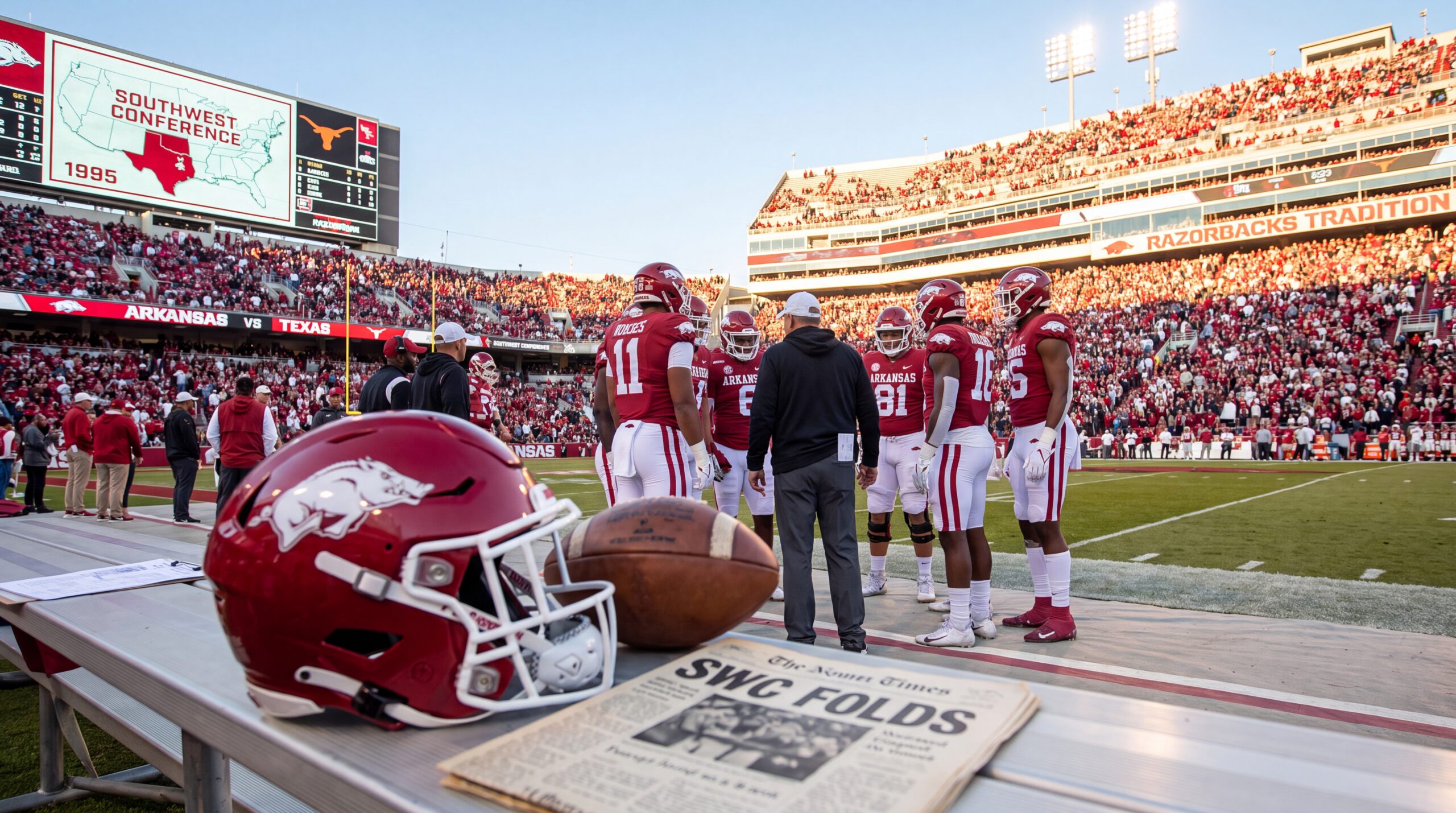
The Southwest Conference, commonly called the SWC, unraveled in the 1990s amid shifting financial incentives and changing media landscapes. Member schools faced a different calculus: local rivalries mattered, but so did which institutions could leverage larger television markets and more lucrative contracts.
That decade saw faster growth in broadcast revenue and the emergence of rights negotiations that rewarded scale and market reach. Smaller or regionally limited conferences found it harder to compete when national cable partners and conferences with broader footprints could promise more exposure and money.
Institutional choices — from seeking more stable TV deals to aligning with conferences that offered bigger revenue shares — accelerated realignment. The SWC’s breakup reflects those converging pressures rather than a single precipitating event.
Market forces then and now
Market forces remain a useful frame for understanding college football’s evolution. In the 1990s the primary pressure was the commercial value of broadcast rights and the uneven distribution of regional media markets. Today’s drivers build on those fundamentals: media value, market size, and institutional positioning.
Newer elements — such as consolidation among broadcast and streaming partners, the College Football Playoff’s leverage, and athlete compensation changes like NIL — layer on top of older dynamics. Conferences that control bigger markets or can aggregate viewership extract more revenue, which in turn fuels further consolidation and bargaining power.
Those contemporary market forces feed a feedback loop: greater revenue enables better facilities, coaching hires and recruiting reach, which then attract larger audiences and more rights money. The result is a stratified landscape where market geography and commercial arrangements shape competition almost as much as on-field performance.
“The market forces that killed the SWC are still affecting college football today.”
Why this matters for the Arkansas Razorbacks
The Arkansas Razorbacks operate within the same regional market dynamics that reshaped the SWC footprint. Proximity to Texas programs, the size of local and regional media markets, and conference affiliation all matter for exposure and recruiting.
For Arkansas, the practical implications are strategic. Media deals and scheduling affect how often the program reaches national audiences. Recruiting competition with Texas-based schools is shaped not only by facilities and coaching but also by which conferences and television packages offer the most visibility.
That means Arkansas’ administrators and athletic leaders will continue to monitor market signals — TV rights negotiations, playoff structure changes, and conference-level revenue sharing — because those signals often translate into tangible advantages on the field and in the transfer portal or recruiting classes.
What comes next
What comes next hinges on how market forces evolve over the next 12–24 months. Key items to watch include negotiations over media rights, any expansion or contraction of postseason access, and how revenue-sharing models adapt to new income streams like name, image and likeness deals.
If major broadcasters or streaming partners consolidate packages, institutions in stronger markets will gain outsized leverage. Conversely, reforms to distribute revenue more evenly would change incentives and could reduce pressure toward further consolidation.
For Arkansas and similar programs, the immediate task is to track policy proposals from governing bodies, monitor broadcast negotiations, and evaluate scheduling and recruiting strategies that respond to shifting exposure opportunities.
Key takeaways
The Southwest Conference’s breakup in the 1990s still offers relevant lessons: commercial markets and media economics can reshape competitive landscapes, often faster than tradition or geography alone. Those forces remain active and have grown more complex with new revenue sources.
Arkansas sits inside those dynamics. Market size, regional competition with Texas programs, and conference-level distribution will influence on-field resources and recruiting reach in the years ahead.
Source attribution and further reading
This analysis draws on reporting by The New York Times. Read the original piece at: The Southwest Conference left a legacy and foreshadowed the future of college football — The New York Times (published 2026-07-01).