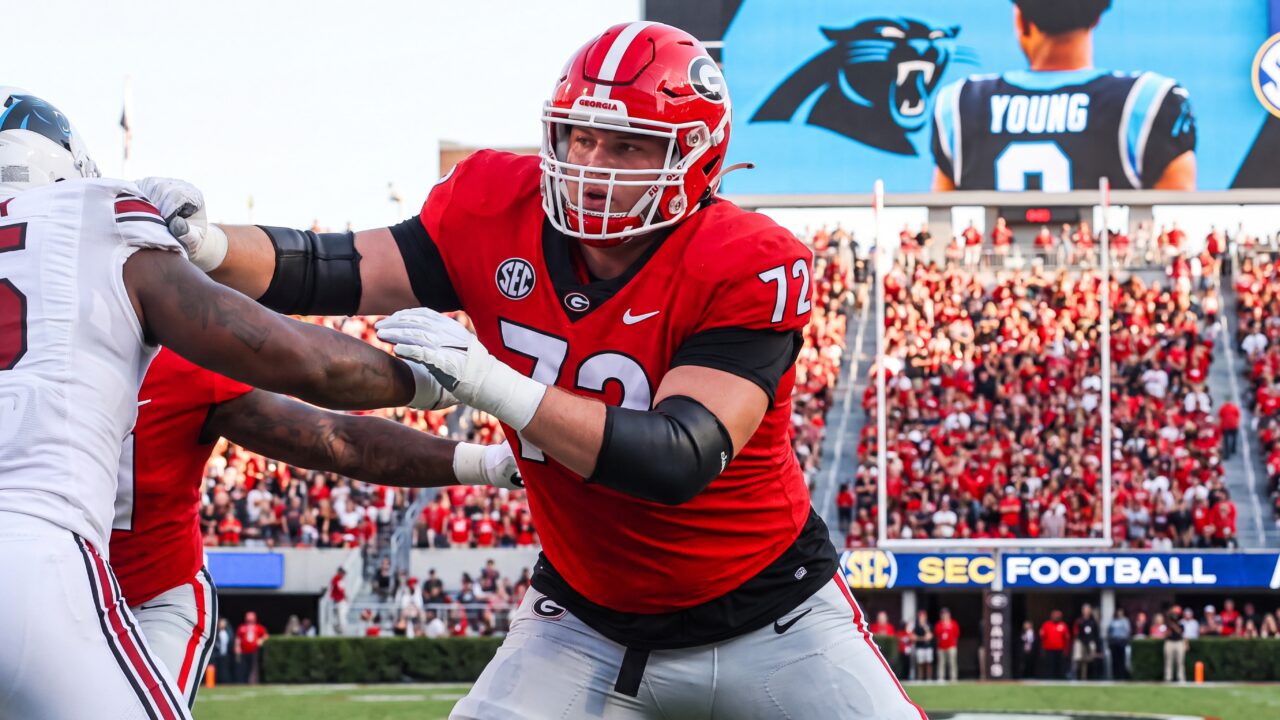
Monroe Freeling arrives in Carolina with a clear scoreboard-facing role: the 19th overall pick who can step into an offensive-line rotation that protects Bryce Young. His lone season as a starter at Georgia and his draft pedigree make him one of the rookies to watch as training camp opens.
Bleacher Report writer Brett Sobleski listed Freeling first on a recent list of NFL rookies with the most to gain, and the early narrative around his pro transition is already forming in local reporting from UGA Wire (Georgia)
Key Takeaways
- Monroe Freeling was selected 19th overall and enters Carolina with a chance to compete for a Week 1 starting job.
- Freeling had one season as a full-time starter in Athens and was a first-round draft selection.
- Analysts placed Freeling atop a list of rookies with the most to gain entering training camp.
- Freeling’s early role directly ties to the Panthers’ need to protect Bryce Young and stabilize their offense.
Monroe Freeling fit on the Panthers offensive line
Freeling’s profile entering the NFL is straightforward: a one-year starter in Athens who drew first-round attention for his size and movement. That lone starting season is the foundation evaluators used when projecting how quickly he could adapt to pro fronts and the speed of pass-rush alignment.
The Panthers drafted Freeling at No. 19 because decision-makers saw immediate traits that translate to an NFL environment. The narrative from draft night and early camp talk places him in a spot where he can earn meaningful snaps if his technique and processing hold up against professional competition.
What analysts said and camp watch points
Brett Sobleski’s placement of Freeling atop a list of rookies with the most to gain highlights both potential and opportunity. Being listed first underscores that evaluators expect a significant swing in Freeling’s standing based on his training-camp performance.
Camp watchers should track a few clear indicators without overstating outcomes: snap-to-snap consistency in pass sets, comfort with NFL play-calling and communication, and how he handles power and speed on the edge. Those measures will show whether a rookie lineman can move from developmental prospect to dependable starter in short order.
College role and rookie outlook table
| Player | College role | Draft or team context | Rookie outlook |
|---|---|---|---|
| Monroe Freeling | Lone season as a full-time starter at Georgia in Athens | Selected 19th overall and on the Carolina Panthers roster | Projected to contend for immediate snaps and charged with helping protect Bryce Young |
| Carson Beck | Former Georgia quarterback who entered the NFL as a rookie prospect | Positioned by analysts as a rookie with developmental upside at the next level | Viewed as a developmental signal-caller who could push for opportunity in camp |
Training camp performance indicators to monitor
For an offensive lineman like Freeling, measurable camp gains may not be public stat lines but they manifest quickly to coaches and teammates. Look for consistent assignment execution in team periods and whether Freeling closes on pressures in pass-pro drills.
Equally important will be how coaches use him early in the preseason — rotating him into crucial third-down or two-minute reps signals a trust level that often precedes a Week 1 start. That usage pattern will tell whether the Panthers view him as a plug-and-play piece or a high-upside project.
How Freeling’s rookie role affects Georgia recruiting and the SEC NFL pipeline
Freeling’s quick path to meaningful snaps would be another concrete example for Georgia’s recruiting pitch: the program continues to send players to the next level who can both be day-one contributors and long-term starters. That narrative helps staff conversations with linemen who value pro preparation.
At a conference level, the Panthers’ reliance on a former Bulldog underscores the SEC’s ongoing role as a primary NFL talent source. Freeling’s success in Carolina would further validate the pipeline from Athens to the NFL and reinforce the tangible development claim used around the conference.