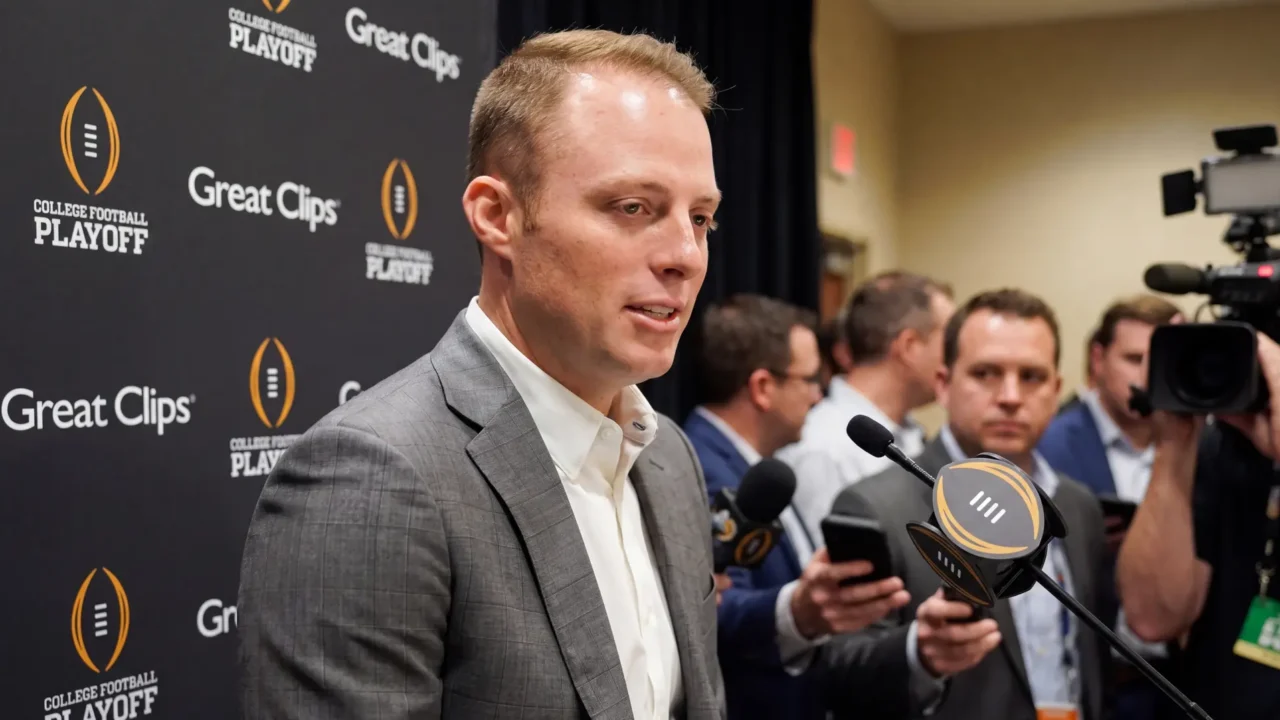
Greg McElroy’s declaration that Louisville is a legitimate Louisville Playoff contender changes the early narrative on who can emerge from the ACC next season.
On his Always College Football podcast McElroy laid out a succinct case, and the original reporting can be read in the linked piece from Saturday Down South, which provided the quotes and market context for this analysis.
Key Takeaways
- Louisville went 9-4 last season and produced a signature upset of the No. 2 team in the country, a game McElroy singled out as evidence of the Cardinals’ upside.
- Three of Louisville’s four losses were decided by a combined seven points, with two of those defeats settling in overtime, underscoring how close the team was to a markedly better record.
- Head coach Jeff Brohm has compiled a 28-12 mark in his first three seasons, and McElroy expects continued improvement under his leadership.
Why McElroy calls Louisville Playoff contender
McElroy framed his argument bluntly: “Louisville went 9-4, and I want to tell you how close it came to being 12-1,” a line he used to open his case on the Always College Football podcast.
He pointed specifically to the Cardinals’ 24-21 upset of No. 2 Miami, a game in which Louisville intercepted Miami quarterback Carson Beck four times and swung a marquee win in Friday-night national view.
McElroy emphasized margin of error as the deciding factor, saying the team was “a couple bounces away from running through the whole league,” and he highlighted that three losses combined for seven points with two requiring overtime.
How roster construction and coaching amplify the case
Central to McElroy’s projection is continuity under Jeff Brohm, now 28-12 through three seasons, which he argues increases the likelihood of incremental roster and schematic improvements heading into the new campaign.
Brohm’s record matters because a settled staff and scheme often convert narrow losses into wins the following year, and that stability feeds recruiting and development cycles.
The Miami upset functions as a recruiting and perception hinge, showing the program can defeat a top opponent while generating takeaways and winning situational moments.
Louisville season context and comparative table
| Item | Verified detail |
|---|---|
| Last season result and signature win | Finished 9-4 with an upset of No. 2 Miami, 24-21, including four interceptions of Miami QB Carson Beck. |
| Close losses and lone blowout | Three of four losses came by a combined seven points with two overtime defeats; only blowout was a 38-6 loss at SMU. |
| Prediction market snapshot (speculative) | Kalshi odds list top CFP qualifier probabilities: Notre Dame 81%, Ohio St. 77%, Oregon 75%, Georgia 70%, Indiana 68%, Miami (FL) 68%, Texas 67%, Texas Tech 64%, Alabama 43%, LSU 42%. |
College Football Playoff stakes for Louisville
McElroy’s projection moves Louisville into ACC dark horse conversation, which alters recruiting optics and nonconference scheduling leverage for the program.
To shift from dark horse chatter to a genuine CFP applicant, Louisville must convert narrow losses into wins, sustain the defensive playmaking that produced the Miami upset, and avoid a repeat of a blowout-level defeat.
Markets and punditry will continue to treat the Kalshi percentages as speculative probabilities, and measurable improvement under Brohm would force a recalibration of Louisville’s national standing.
This analysis draws on the original linked reporting and the quoted remarks presented earlier.