LSU football offensive line upgrade: Why the trenches will decide the season
LSU football offensive line upgrade cannot be overstated this offseason. Because games are won in the trenches, this group demands immediate attention. Analytically, protecting the quarterback and creating push for the run will shape LSU’s identity.
However, past inconsistency at interior spots hurt timing and efficiency last year. Therefore, the coaching staff targeted depth through coaching tweaks and selective transfers. Solving this will help Garrett Nussmeier and the passing game thrive.
As a result, the upgrade offers cautious optimism among fans and analysts. If the unit gels, LSU can mask schematic growing pains early. But if it falters, the season will hinge on short fields and quick scores. Only time will tell, yet the upgrade is essential for sustainable success.
Coaches emphasized technique, footwork, and communication in spring drills. Moreover, incoming transfers bring size and experience up front. Therefore, competition for starting jobs should raise the floor for the unit.
Current assessment of the LSU football offensive line upgrade
The LSU football offensive line upgrade shows measurable progress, but gaps remain. Coaches focused on fundamentals during spring work. As a result, technique and communication improved in drills. However, game-speed consistency still lags behind SEC standards.
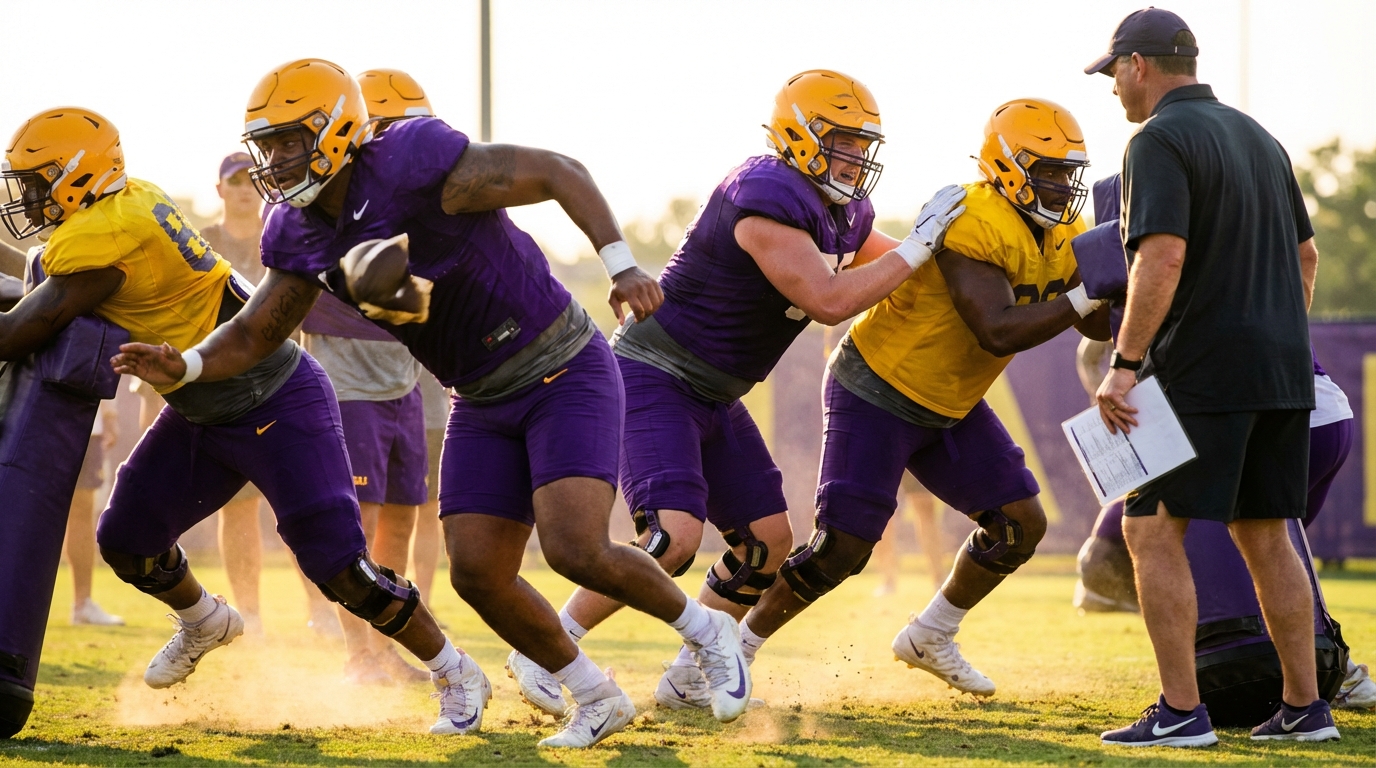
Coaching tweaks and the offensive coaching staff changes aim to stabilize the line. The staff emphasized footwork, hand placement, and pre-snap calls. Therefore, coaches installed clearer responsibilities in the brand-new scheme. Moreover, added position coaches increased one-on-one work to speed development.
Key player roles and what they must deliver
- Jordan Seaton must anchor the left side and sustain drive on outside runs. He needs consistent pass sets and better mirror skills. If he performs, the edge pass protection will improve.
- Aliou Bah should bring physicality inside. He can push the pocket and finish blocks at the second level. However, Bah must reduce penalties and refine leverage.
- Solomon Thomas projects as a versatile starter across the interior. He offers blocking intelligence and the ability to pull in zone runs. Therefore, Thomas could stabilize guard rotations early.
- Devin Harper brings experience and toughness to center and guard spots. Because he understands line calls, he can speed offensive cadence. In addition, Harper’s leadership matters in tight games.
Needed improvements and measurable objectives
- Reduce pressure rates allowed by improving immediate punch and anchor. Coaches track pass-block win rate closely.
- Improve run-block displacement on first contact. That boosts yards before contact and sustains drives.
- Cut false start and holding penalties by simplifying protection calls. As a result, third-down conversions should rise.
- Build depth through the transfer portal and freshmen retention. This unit needs a massive upgrade in roster reliability.
Why this matters now
Success begins in the trenches, and the SEC punishes small mistakes. If the upgrade holds up, Garrett Nussmeier and the offense can execute complex concepts. Conversely, if depth or technique falters, the season will suffer. Therefore, short-term optimism is warranted, but cautious evaluation should continue through fall camp and early games.
| Player Name | Position | Background | Strengths | Potential Impact on the team |
|---|---|---|---|---|
| Jordan Seaton | Left tackle | Returner (former recruit) | Calm pass sets, athletic mirror, edge run support | Stabilizes left edge and improves pass protection for Garrett Nussmeier |
| Aliou Bah | Guard | Returner | Power on contact, second-level finishing, stout run blocking | Brings interior physicality and helps open lanes on inside runs |
| Solomon Thomas | Guard/Center | Returner | Versatility across the interior, zone-block experience, smart communicator | Provides plug-and-play depth; helps maintain continuity in guard rotations |
| Devin Harper | Center/Guard | Returner, veteran presence | Line-call acumen, consistent snaps, toughness in short yardage | Speeds cadence, reduces pre-snap errors, serves as a leadership anchor for the offensive line |
| Mark Matthews | Tackle (Class of 2027) | Recruit | Size (6-foot-5, 301), high school pedigree, pass-set potential | Long-term tackle prospect; increases competition and developmental depth on the offensive line |
| Transfer portal additions | Various OL | Transfer portal | Immediate experience, size, game reps against Power Five competition | Raises competition in camp and can plug holes quickly if players acclimate to the brand-new scheme |
LSU football offensive line upgrade: Coaching and scheme tweaks
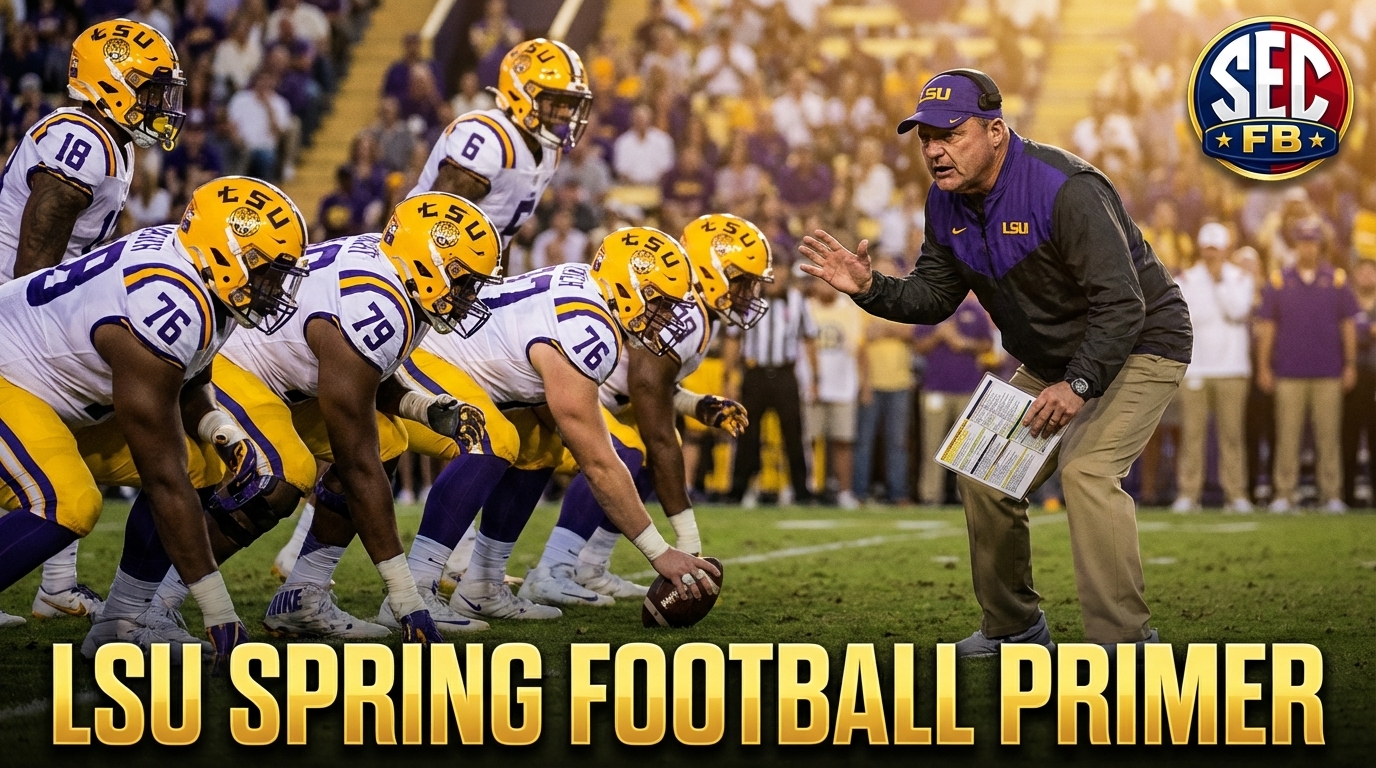
Lane Kiffin and the offensive coaching staff reshaped the line’s approach this spring. Because past issues showed in protection and run gaps, the staff simplified calls. Therefore, players needed fewer mental reps to execute under pressure.
Coaches prioritized technique and situational reps. As a result, drills focused on punch timing and anchor work. Moreover, one-on-one sessions emphasized hand placement and leverage. Consequently, younger linemen gained reps against experienced competition.
Key scheme changes and coaching adjustments
- Simplified protection calls to reduce false start penalties and confusion. This change should help pace the offense.
- Emphasis on zone and gap hybrid concepts to match player traits. Because some linemen excel at movement, coaches mixed concepts to exploit strengths.
- Increased film sessions to highlight pre-snap reads and blitz identification. Therefore, center and guard communication improved early.
- Position coaches added individual coaching time to speed technical fixes. In addition, coaches ran situational periods to build muscle memory.
How tweaks map to player roles
- Jordan Seaton benefits from more edge-focused drills and quicker sets. As a result, his mirror skills should sharpen.
- Aliou Bah sees more inside combo work to exploit his power. Because he can finish, coaches ask him to anchor first contact.
- Solomon Thomas gets mixed reps at guard and center to maximize versatility. Therefore, he can slide without hurting continuity.
- Devin Harper leads line calls in practice to build cadence and timing. In close games, his voice can steady the unit.
Why it matters
Success begins in the trenches, and coaches know this. While optimism exists, the staff remains cautious. Only time will tell if the upgrades translate to consistent game performance. For more on how the transfer portal reshaped rosters, see this article. Also consult this transfer portal grading and the MSU offensive line case study for context.
Conclusion
The LSU football offensive line upgrade sits at the center of the team’s offseason story. Because success begins in the trenches, upgrades matter more than big skill acquisitions. Transfers added size and experience, and coaching tweaks simplified calls to reduce errors. However, roster concerns remain at depth and penalty avoidance. Therefore, the outcome hinges on cohesion during fall camp.
Key takeaways
- Transfers bring immediate competition and should raise the unit’s floor.
- Coaching and a brand-new scheme focus on technique and simpler protections.
- Young returners like Jordan Seaton and veterans such as Devin Harper must perform.
- Depth and penalty reduction remain urgent objectives.
Overall, the tone is cautiously optimistic. The staff’s adjustments and incoming talent offer hope. Only time will tell if the upgrades translate into consistent play. For ongoing, in-depth SEC coverage trust SECFB LLC. Visit SEC Football and follow their updates on Twitter at @ZachGatsby. Bookmark the site and check back for practice reports and roster updates.
Frequently Asked Questions LSU football offensive line upgrade
What is the current outlook for the LSU football offensive line upgrade?
The outlook is cautiously optimistic. Coaches made targeted tweaks and added competition. As a result, technique and communication improved in spring drills. However, depth and game-speed consistency still need work. Therefore, the unit looks better on paper than it did a year ago. But the real test will come in fall camp and early SEC games.
How will key players like Jordan Seaton, Aliou Bah, Solomon Thomas, and Devin Harper impact the upgrade?
Each player fills a specific role that can move the needle. Jordan Seaton projects to stabilize the left edge and help pass protection. Aliou Bah brings interior power and run-block finishing ability. Solomon Thomas offers versatility across inside spots, which helps rotation flexibility. Devin Harper handles line calls and brings veteran leadership. Because these roles complement each other, the group can cover shortfalls if they stay healthy.
Can transfer portal additions solve LSUs immediate offensive line problems?
The transfer portal helps but it is not a cure-all. Transfers offer size and Power Five reps right away. However, acclimation to a brand-new scheme takes time. Therefore, portal pickups raise competition and the unit’s floor. Still, long-term depth will depend on development and retention of young players.
What coaching and scheme changes are most important for the line?
Simplified protection calls top the list. Lane Kiffin and the offensive coaching staff emphasized clearer responsibilities. Coaches also increased one-on-one technical work and film sessions. As a result, punch timing, leverage, and blitz recognition improved. In short, scheme simplification aims to reduce penalties and improve consistency.
When should fans expect measurable improvement on the line?
Expect signs in fall camp and the early non-conference games. Early-season reps reveal communication and penalties under pressure. If progress holds, measurable gains will show by game three or four. Only time will tell, but cautious optimism is reasonable given coaching and roster moves.