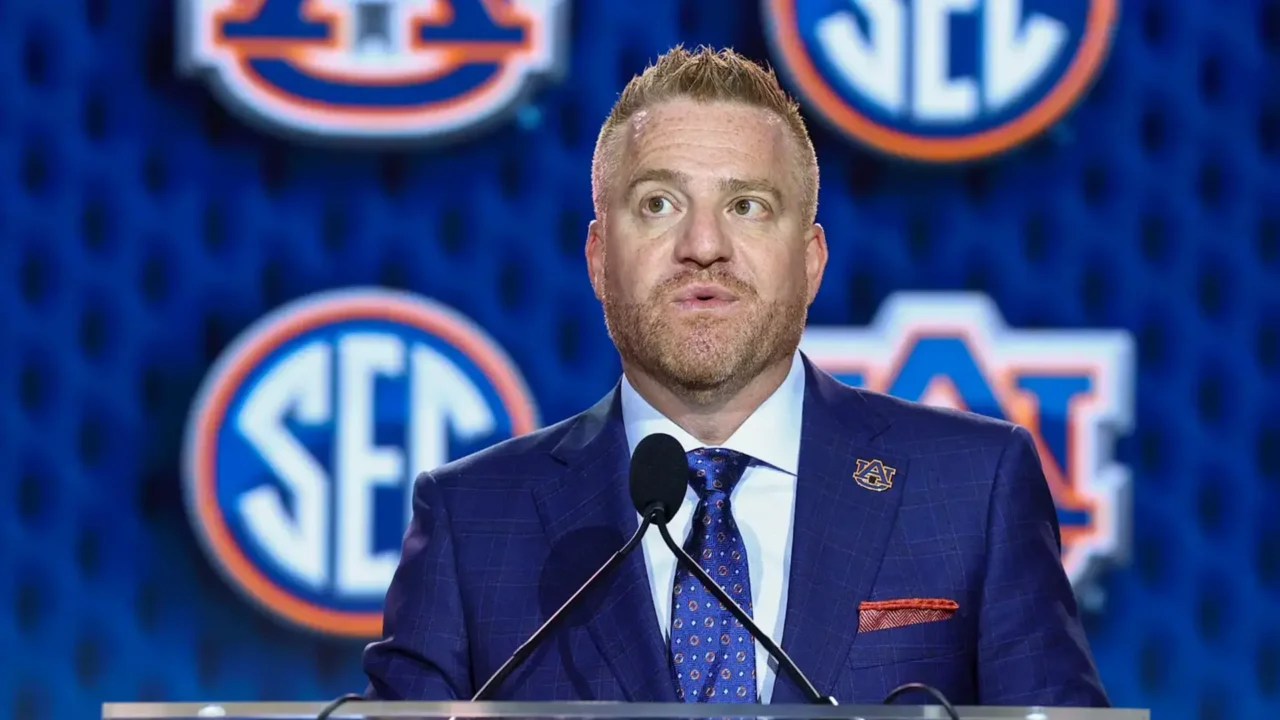
Auburn football enters 2026 with cautious optimism after a string of narrow, frustrating seasons. The Tigers’ recent résumé of close losses is central to why national evaluators see a clearer path to improvement this offseason.
ESPN analyst David Hale placed the program in the “On the Come Up” tier and noted Auburn was 0-6 in one-possession games last year. Hale highlighted schematic and roster shifts cited in Auburn Tigers On SI as drivers of that projection.
Key Takeaways
- Alex Golesh’s arrival signals an offensive identity shift toward a run-first scheme built around the Cignetti playbook.
- Byrum Brown rushed for over 1,000 yards last season and projects to be the fulcrum of the ground game.
- DJ Durkin returns much of his defensive unit, preserving continuity on that side of the ball for 2026.
- The receiver-room turnover and an uncertain offensive line remain key question marks that could limit early-season upside.
What Alex Golesh brings to the offense
Golesh is installing a Cignetti-style playbook emphasizing a physical running game with quarterback mobility and play-action. That schematic foundation aims to control tempo and shorten opponent possessions.
He brought several former USF players to Auburn, including QB Byrum Brown, which should ease schematic installation for the new offense. Incoming pass catchers such as Keshaun Singleton, Jeremiah Koger and Chas Nimrod provide familiarity with those concepts.
The receiver room turnover removes some proven SEC production while adding system fit, and the offensive line’s play will shape how quickly the scheme produces consistent results.
Byrum Brown and the run-first offense
Byrum Brown rushed for over 1,000 yards last season and is positioned as the offense’s primary tempo controller. His running profile fits a plan designed to convert close games by finishing drives on the ground.
Returning backs such as Jeremiah Cobb provide complementary reps to preserve Brown across a long season and offer short-yardage support. The rotation should help manage workload and situational packages.
Converting one-possession losses will depend on the ground game finishing drives and the offense converting short-yardage and red-zone opportunities to complement Auburn’s defensive continuity.
Roster and returning production compared
| Area | 2025 status | 2026 outlook |
|---|---|---|
| Defense | One of last season’s stronger units with established starters and scheme continuity | Returns much of its talent with DJ Durkin overseeing the group, projecting continuity and reliability |
| Running game | Led by Byrum Brown, who produced over 1,000 rushing yards | Brown remains the focal point with Jeremiah Cobb returning as key support in a run-first plan |
| Receiver room | Featured proven playmakers who have departed | Replenished by Keshaun Singleton, Jeremiah Koger and Chas Nimrod, bringing system familiarity but less demonstrated SEC production |
| Offensive line | Was an area of concern entering last season | Still a question mark ahead of the early schedule and a factor that will shape the offense’s effectiveness |
SEC and CFP implications for Auburn’s 2026 rise
Within the 16-team SEC, marginal gains can alter recruiting perception and conference pecking order, so clear improvement on offense and steady defense matter for Auburn’s standing. Early nonconference and conference results will drive how peers and prospects view the program’s trajectory.
Recruiting momentum and NIL conversations often follow on-field clarity, and a defined offensive identity plus defensive continuity would strengthen Auburn’s pitch to prospects. That dynamic can shift recruiting cycles more quickly in the modern SEC environment.
From a College Football Playoff lens, converting one-possession games and winning signature conference matchups are prerequisites to earning serious consideration in postseason discussions.