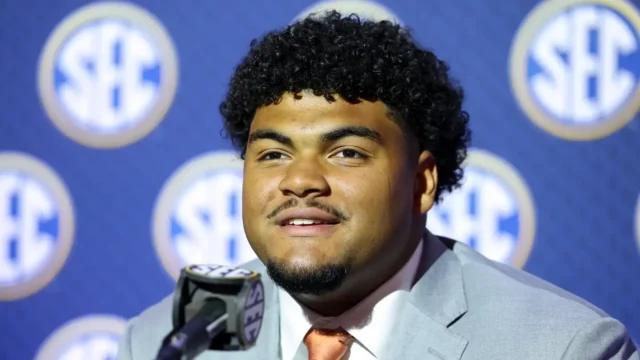

Temporary court rulings allowing multiple transfers to join LSU have pushed questions about LSU operating independently into active debate among fans, boosters and broadcasters.
The state orders include temporary restraining orders allowing Dae’Quan Wright and Zxavian Harris to enter the transfer portal and join LSU, plus an injunction clearing R.J. Luis to return to school and join LSU basketball, and the SEC says it will comply with court orders while weighing penalties as detailed by FOX Sports.
Key Takeaways
- Temporary court rulings tied to litigation over the NCAA’s age-based eligibility model enabled named 2022-class athletes to move to LSU.
- State orders specifically cleared transfers and a return-to-school injunction and reporting lists dozens of incoming transfers on LSU’s ledger.
- Control of media rights, scheduling and conference enforcement would complicate any abrupt shift to independence for LSU.
- Public revenue and valuation figures position LSU as a high-value program, but matching Notre Dame’s long-term broadcast terms would be difficult.
LSU independence legal and roster fallout
The legal challenge asserts the NCAA’s five-year eligibility model for the high school class of 2023 should not be applied retroactively to the class of 2022, prompting state lawsuits and temporary orders.
The immediate roster effect is tangible: state orders allowed named players to enter the portal and join LSU, and reporting indicates the program has added dozens of transfers this season, including a reported 44 incoming additions such as Jordan Seaton.
The SEC’s public posture is to comply with judicial orders while signaling it will weigh penalties, including potential membership sanctions if conference rules are breached.
LSU independence media rights and revenue realism
Media rights monetization is the central hurdle for any school contemplating independence.
Notre Dame’s long NBC arrangement is frequently cited as a benchmark near a roughly $75 million-per-year payout for top independents.
The Athletic’s valuation work places LSU near a roughly $1.3 billion program valuation, and Knight-Newhouse public figures show LSU reporting north of $120 million annually historically and roughly $200 million or more since 2022.
Conference scale aggregates advertising, distribution and sponsorship in ways an individual program cannot immediately match, which makes converting program value into independent media revenue a complex marketplace negotiation.
Media rights and scheduling comparison
| Model | Media rights and control | Business profile and scheduling reality |
|---|---|---|
| LSU | Media rights currently flow through SEC contracts and centralized distribution. | High national profile within the SEC; independence would require building annual marquee matchups and a national broadcast inventory. |
| Notre Dame | Longstanding national broadcast deal and conference relationships provide direct control of primary broadcast inventory. | Unique historic national brand and established independent scheduling that developed over decades. |
| SEC pooled model | Conference distributes centralized media revenue to members, creating predictable pooled payouts tied to league agreements. | Membership bundles scheduling, bowl and CFP pathways and collective bargaining power that a departing program would forfeit. |
SEC membership recruiting and College Football Playoff implications
Any move off the SEC ledger—whether forced by penalties or chosen by the school—would reshape recruiting narratives and portal conversations in Baton Rouge and nationally.
Access to the College Football Playoff for an independent would rely on strength of schedule, marquee wins and committee perception rather than automatic conference pathways, complicating postseason planning.
Revenue and NIL leverage would be tested immediately, as independence requires securing long-term broadcast partners and sustaining donor and corporate support without pooled conference distributions.