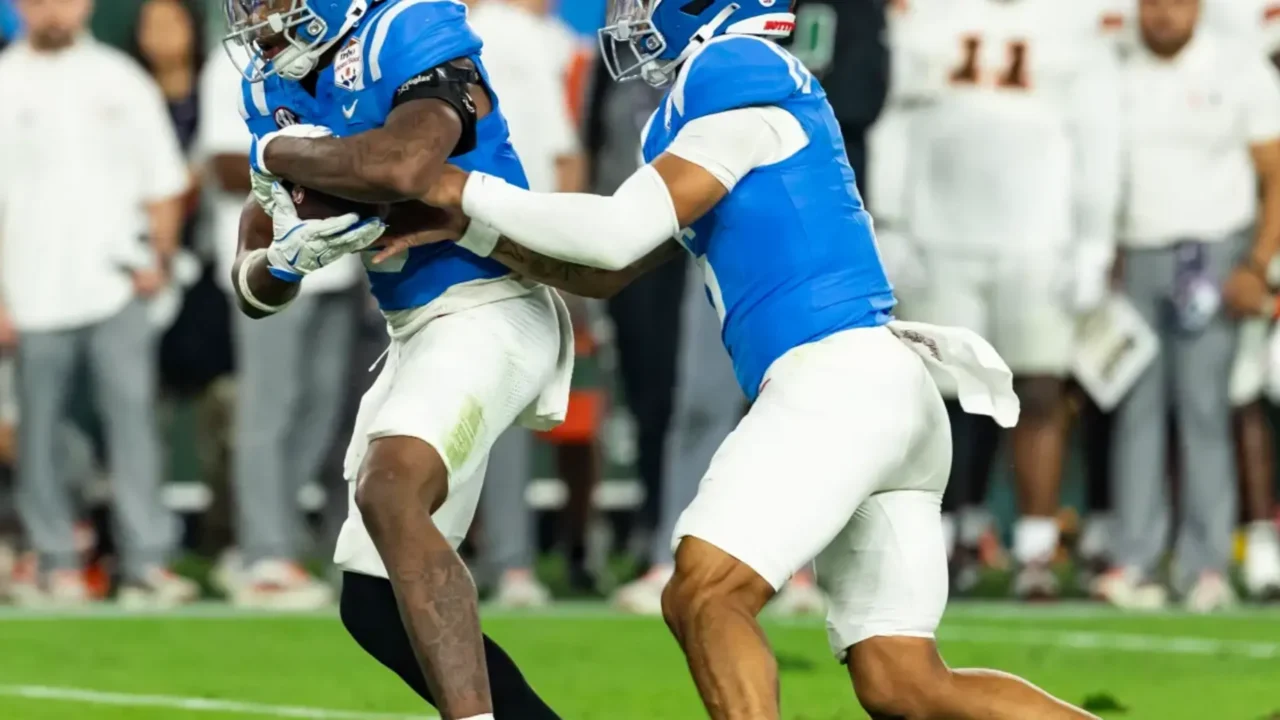
Louisville opens the season against an Ole Miss team that returned its offensive spine and poses immediate schematic questions for the Cards. The Ole Miss Rebels offense centers on a veteran quarterback and a physical, downhill running attack that will test Louisville’s interior defensive front.
The pieces fit around Trinidad Chambliss and Kewan Lacy, with play-calling continuity arriving under John David Baker as the staff looks to replicate playoff form, as reported by Card Chronicle.
Key Takeaways
- Trinidad Chambliss returns to anchor the offense after a 30-touchdown, nearly 4,000-yard passing season.
- Kewan Lacy provides a powerful downhill run game that averaged over 100 yards per contest and multiplied efficiency in the postseason.
- The interior offensive line returns three starters at center and both guard spots, preserving size and length inside.
- Receiver turnover creates questions outside of Deuce Alexander while two new tackles will be tested early.
Why the Ole Miss Rebels offense is built around Chambliss
Trinidad Chambliss is the clear central figure. He finished last season with 30 total touchdowns and nearly 4,000 passing yards, positioning him as the engine of the offense.
Chambliss is a true dual-threat who prefers to throw from the pocket but is also a designed rushing option. The staff routinely uses him on option reads, bootlegs and movement concepts to both create throwing lanes and force defenses to respect the run.
The net effect is a passing attack that balances short, efficient throws for first downs with a genuine vertical threat when opponents sell out on the ground.
John David Baker’s play-calling continuity
John David Baker now takes over play-calling full time after filling the role during the College Football Playoffs. That continuity should limit schematic disruption and keep the offense in established rhythm coming out of last season.
Baker’s approach leans on a dual-presentation: pocket-based passing for Chambliss paired with movement and run-pass options to maximize mismatches. Expect a deliberate mix designed to exploit defensive aggressiveness early.
Run game advantage through Kewan Lacy and the interior line
Kewan Lacy returns as the offensive bellcow after averaging 114 yards per game and running for 24 touchdowns. He also posted 6.5 yards per carry in the playoffs, underscoring an ability to sustain efficiency in high-pressure spots.
The interior offensive line returns three starters at center and both guard spots, a combination the source identifies as both massive and long. That continuity inside should create favorable matchups between the tackles for Louisville’s front and the Rebels’ gap-control rushing plan.
Lacy’s style—low pad level, finishing runs through contact—pairs cleanly with a powerful interior group that prefers to run between the tackles and win on second-level blocking.
Receiver room turnover and new tackle starters
Wide receiver depth is the obvious question for Ole Miss after losing three of last year’s top four targets. Deuce Alexander returns as the lead receiver and will be asked to do more in short-to-intermediate passing fits and YAC situations.
The staff added pieces around Alexander, including transfers and veterans who can contribute. Caleb Cunningham is noted as healthy and expected to take a step forward after an injury-reduced season.
At tackle, Ole Miss will break in Tommie Kinsler and Terez Scott as starters after graduation departures. Kinsler brings game experience from Miami and size; Scott steps up after serving as a backup last year.
Returning production versus departures
| Unit | Key returns | Key departures | Notes |
|---|---|---|---|
| Quarterback | Trinidad Chambliss: 30 TDs, nearly 4,000 passing yards | None noted among starters | Experience and dual-threat skill set remain core to play-calling. |
| Running Back | Kewan Lacy: 114 YPG, 24 TDs, 6.5 YPC (playoffs) | None highlighted | Returns as the primary downhill option between the tackles. |
| Wide Receiver | Deuce Alexander, Caleb Cunningham, Horatio Fields | Three of last year’s top four receivers, Cayden Lee transferred to Missouri | Alexander is the veteran primary; rotation and targets will shift. |
| Offensive Line | Three interior starters returning at center and both guard spots | Both starting tackles graduated | Interior size and length favor gap running; tackles will be newly installed. |
| Tight End | Caleb Odom, Luke Hasz | None highlighted | Both projected for increased roles in intermediate passing and seam concepts. |
How Ole Miss Rebels offense affects SEC positioning and CFP path
Early results from the opener will carry outsized weight for Ole Miss in the 16-team SEC era, particularly when it comes to perceptions of durability and roster depth. A strong offensive showing against Louisville would reinforce the Rebels’ legitimacy as a CFP contender and protect recruiting momentum in the region.
For recruiting and roster construction, maintaining Chambliss and Lacy as cornerstone players helps Ole Miss sell an NFL-ready, pro-style passing attack that still emphasizes physicality up front. Those narrative advantages can translate into clearer positioning in year-one CFP chatter if the offense answers questions about wide receiver depth and tackle continuity.
This piece is informed by reporting linked above.