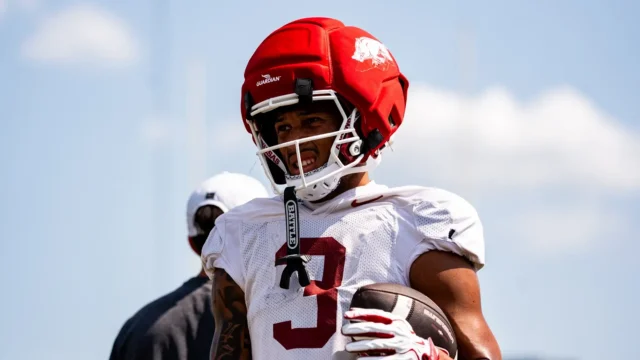

Arkansas vs. North Alabama opened the season at Razorback Stadium with a headline crowd and immediate energy from the stands. The announced attendance was 69,178 and the very first snap produced a 15-yard toss from KJ Jackson to CJ Brown that set an early tone.
Fans tracked the game live and reacted sharply to a defense that dominated early and an offense that flashed explosiveness alongside uneven stretches. Those reactions shaped the postgame conversation across local feeds and game-day coverage, and a fuller compilation of social-media reaction and play-by-play aggregation is available at On3
Key Takeaways
- The announced attendance in Fayetteville was 69,178, reflecting strong local interest in the season opener.
- Arkansas extended a late lead with a Max Gilbert field goal that made it 31-14 in the fourth quarter.
- Destin Wade’s four-yard touchdown pushed the Razorbacks to a 28-14 advantage and was a key short-field score late in the third quarter.
- The Arkansas defense limited North Alabama to almost no first-half production, forcing difficult third-down situations for the visitors.
Arkansas vs. North Alabama offense and first-play setup
The opening possession signaled a plan of quick tempo and short-to-intermediate passing, with the first play going for 15 yards on a connection from KJ Jackson to CJ Brown. That completion energized the crowd and established a willingness to move the ball through the air early.
Scoring mixed big-play elements with work near the goal line, including a Braylen Russell touchdown that put Arkansas comfortably ahead at one point. Fans also noted intermittent three-and-out sequences and periods where receiver separation and timing were inconsistent, prompting calls for sharper situational execution.
Arkansas defense first-half dominance and verified stats
The defensive performance in the first half was the clearest positive for Arkansas through two quarters. That early control allowed the Razorbacks to dictate field position and disrupted North Alabama’s ability to sustain drives.
A widely circulated stat line after one half credited the defense with holding North Alabama to 5 total yards, 30 passing yards, minus-17 rushing yards and just two first downs.
Those numbers forced the opponent into long third-down situations and limited sustained drives, allowing Arkansas to play with a lead and manage the clock in the second half. Local reaction reflected appreciation for the defensive effort while noting the offense must reach comparable consistency against tougher SEC opponents.
First-half verified details and context
| Category | Verified detail |
|---|---|
| Announced attendance | 69,178 at Razorback Stadium |
| North Alabama first-half offensive output | 5 total yards (30 passing, −17 rushing) with 2 first downs |
| Key early scoring plays | First play: 15-yard pass to CJ Brown; Braylen Russell touchdown; Destin Wade 4-yard TD; Max Gilbert field goal to reach 31-14 |
What the opener signals for SEC recruiting and roster construction
The defensive display in Fayetteville should be a clear talking point for Arkansas staff when recruiting defensive prospects who value early-game physicality and front-seven production. Limiting an opponent to essentially no first-half yardage gives coaches a concrete highlight to show defensive recruits and local donors.
The offensive inconsistencies highlighted areas for immediate work in quarterback reads, receiver separation and situational play-calling, and that mix will shape offseason roster conversations and practice priorities before the SEC slate.