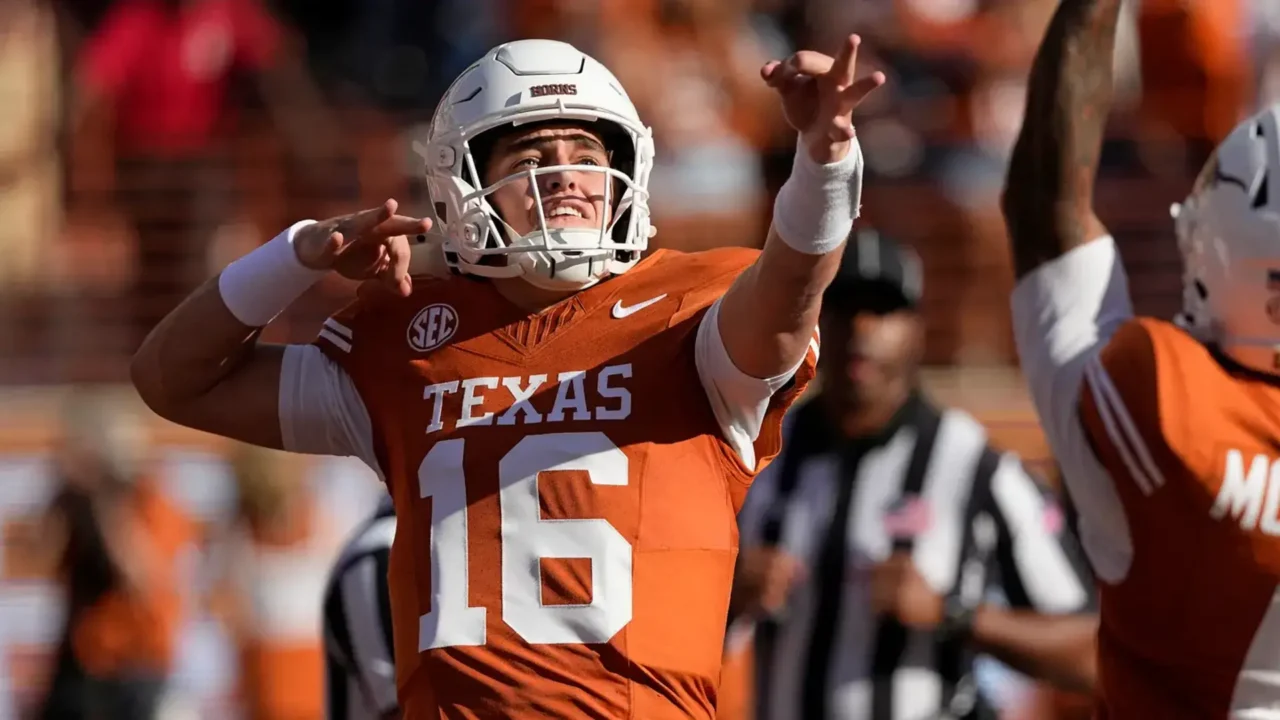
Arch Manning answered a season’s worth of chatter with a polished, efficient performance in Austin, completing 20 of 27 passes for 305 yards and four touchdowns in Texas’ 59-7 win over Texas State
The showing was an early statement about Manning’s development and the Longhorns‘ receiving depth, and it is described in primary game coverage from CFB-HQ On SI that contextualized the performance against last season’s arc
Key Takeaways
- Arch Manning completed 20 of 27 passes for 305 yards and four touchdowns before exiting in the third quarter with Texas leading 42-7.
- Ryan Wingo led the receivers with 121 yards on seven catches while Cam Coleman caught two touchdown passes.
- Manning registered one giveaway in scoring position in the opener, an isolated blemish on an otherwise efficient day.
- Analysts noted clear improvement from Manning’s play late last season and praised his decision-making and deep-ball accuracy in the opener.
What Arch Manning showed in Austin
Manning displayed the controlled efficiency coaches want to see from a second-year starter with accurate downfield throws, steady pocket movement, and smart game management when starters were removed in the third quarter.
The turnover in scoring position was a reminder that tidy box-score lines can still hide teachable moments, but the dominant statistical line and the way Texas sustained drives suggested continuity from the second half of last season.
Veteran analyst Greg McElroy called Manning one of the most improved quarterbacks from early to late last year, and that arc was evident in how Manning attacked the Texas State defense with timing routes and explosive shots downfield.
Why the Manning Coleman pairing matters
The most tangible outcome of the opener was the immediate chemistry between Manning and transfer receiver Cam Coleman, who hauled in two touchdowns and provided a clear perimeter threat.
Coleman’s arrival gives Texas a high-end outside target while Ryan Wingo’s 121-yard day provided a complementary underneath presence that kept defenses from focusing on a single receiver.
If Manning can maintain pocket poise and Coleman continues to win contested throws, that pairing could become a matchup headache across the SEC and a critical component of Texas’ game plan against top defenses.
Manning season splits and opener comparison
| Period | Completion % | Yards | Touchdowns | Interceptions |
|---|---|---|---|---|
| First half of last season | 57.5% | 1,539 | 12 | 4 |
| Second half of last season | 66% | 1,619 | 14 | — |
| Opener vs Texas State | 20-of-27 (74.1%) | 305 | 4 | 1 (scoring position) |
The table compresses Manning’s measurable growth with a clear jump in completion rate and production from the first to the second half of last season and a strong statistical start in Week 1.
Numbers alone won’t settle how he performs against elite pressure units, but the opener reinforced the accuracy gains and decision-making improvement seen late last year.
Ohio State rematch shifts CFP and recruiting outlook
Texas now turns quickly toward a consequential rematch with the No. 1 team in the country, a game that will be a far sterner test of Manning’s progress than a Sun Belt opponent.
Beyond the single-game result, the opener fuels quarterback confidence and provides recruiting momentum by showcasing an experienced starter throwing to high-level targets, which can affect the transfer portal and late recruiting cycles.
Coach Steve Sarkisian praised the performance while noting there were a couple of misreads, reflecting measured optimism as the Longhorns pursue roster polish and CFP positioning ahead of the Ohio State rematch.