Auburn Tigers football: Auburn’s Uphill Climb under Alex Golesh: Recruiting Misses, Program Reputation and Realistic Timelines
Auburn Tigers football stands at a crossroads, and I will take an opinionated analytical view. Recruiting misses have piled up, and the program reputation has taken real damage under recent regimes. Alex Golesh inherits a roster that reflects missed evaluations, underused recruiting pipelines, and a transfer portal strategy that so far has not returned the top tier talent Auburn needs to restore national relevance, so the coaching staff faces a multiyear uphill climb rebuilding depth and trust with recruits and fans.
However, this challenge is not hopeless because clear timelines and measured expectations can guide realistic progress. Therefore this piece will analyze recruiting failures, probe how reputation factors like past spending decisions and coaching turnover affect recruiting perception, and propose realistic timelines and benchmarks that separate hope from plausible plans for on field recovery under Golesh.

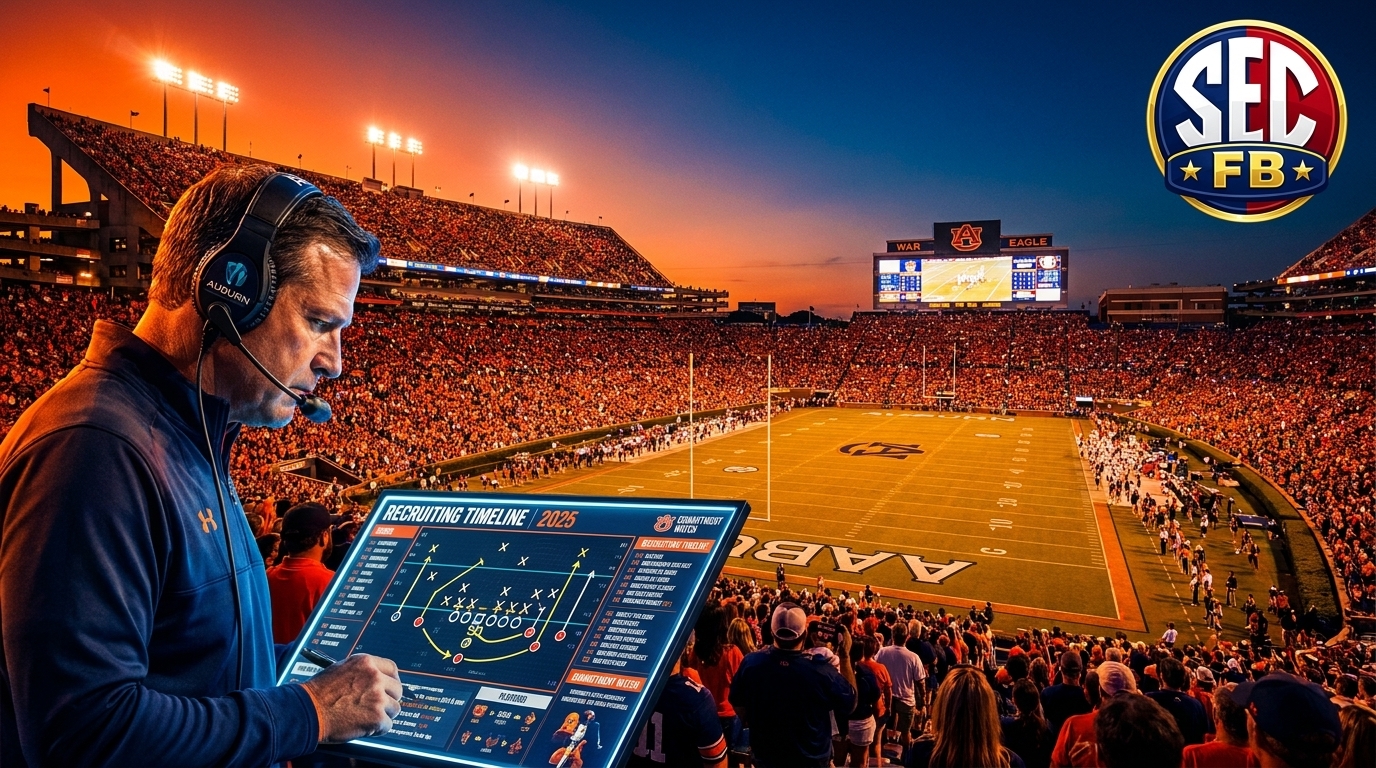
An illustration of a football climbing an uphill path toward a stadium silhouette in Auburn colors.
Recruiting Challenges and Historical Performance for Auburn Tigers football
Auburn Tigers football has suffered a string of recruiting misses that trace through recent coaching regimes. Alex Golesh inherited a roster weakened by inconsistent evaluation and attrition. As a result, the new staff faces immediate gaps at key positions. Therefore the early recruiting wins must focus on fundamentals like trust, scouting, and retention.
Hugh Freeze’s tenure left a scar on the program’s reputation. Reports cite misspending and off-field questions that damaged Auburn’s recruiting cachet. Consequently, the program struggled to sell stability to top prospects. Meanwhile, Bryan Harsin’s short, turbulent run compounded the problem. Harsin failed to deliver recruiting momentum, and transfers and decommitments followed.
By contrast, Gus Malzahn built consistent talent pipelines. Malzahn signed top-10 classes and produced more than 30 NFL draft picks. His success shows Auburn can recruit at an elite level. However, Malzahn’s recruiting footprint is now strongest in Texas and Arkansas, leaving Auburn with regional gaps to rebuild.
Key recruiting friction points
- Missed evaluations at lineman and linebacker positions reduced depth and development windows.
- Transfers and portal churn undermined roster continuity and on-field chemistry.
- Reputation damage from spending issues and turnover made elite targets cautious.
How Golesh can respond
First, Golesh must clearly document recruiting priorities and timelines. Second, he should lean on transfer portal strategies while rebuilding high school pipelines. For context on roster overhaul and portal strategy see this link. Third, early recruiting narratives matter. Read about Golesh’s recruiting outlook here. Finally, quarterback recruiting timelines will shape future classes. Consider the implications at this link.
Recruiting recovery will not be instantaneous. However, realistic timelines, steady communication, and a return to disciplined spending can restore confidence. For broader recruiting context and national perspective, see the Auburn team pages on ESPN and 247Sports at ESPN and 247Sports.
| Coach | Years coached | Playoff appearances | Recruiting class rankings | NFL draft picks produced | Notable program challenges |
|---|---|---|---|---|---|
| Tommy Tuberville | 1999–2008 | Multiple major bowl appearances; under a proposed 24-team CFP he would have had six playoff appearances (“Tuberville six playoff appearances”) | Generally strong classes in peak years; regional recruiting depth | Multiple NFL draft picks; several early-round selections | Built long-term stability; constrained by pre-expansion playoff formats |
| Gene Chizik | 2009–2012 | 1 national title season and major bowl run | Mixed classes with high-profile signees like Cam Newton | Produced high-impact draftees including Cam Newton | Short tenure; staff turnover and uneven recruiting follow-through |
| Gus Malzahn | 2013–2020 | Regular SEC contender; under the same 24-team projection he would have five playoff appearances (“Malzahn five playoff appearances”) | Multiple top-10 recruiting classes | Over 30 NFL draft picks produced | Strong pipelines in Texas and Arkansas; left regional recruiting gaps at Auburn |
| Bryan Harsin | 2021–2022 | No playoff appearances; part of program decline during 2021–2025 losing stretch | Class rankings slipped; difficulty sustaining momentum | Few NFL picks developed under his short tenure | Turbulent run, roster instability and transfer portal churn |
| Hugh Freeze | 2023–2025 | No playoff appearances in his term | Recruiting hindered by reputation issues and reported misspending | Limited NFL draft production during tenure | Misspending cited as a factor in reputation decline; program trust damaged |
| Alex Golesh | 2026–present | No playoff appearances yet; in early rebuild phase | Early recruiting cycles and transfer portal focus; rebuilding pipelines | Too early to have NFL draft production | Inherits damaged reputation, depth gaps and must set realistic multi-year timelines |
How CFP expansion changes Auburn Tigers football playoff math
The proposed College Football Playoff expansion to 24 teams alters the landscape for Auburn Tigers football. Nathan King outlined the common 24-team model and its likely features. He then noted, “Using that rough format, Auburn would have made the playoff 12 times since the start of the BCS era in 1998.” King added it “would have yielded nine games at Jordan-Hare Stadium.” He also said the model “would have given Tommy Tuberville six playoff appearances and Gus Malzahn five.” Those projections reframe Auburn’s historical standing as a missed opportunity under older formats.
Therefore the expansion lowers the short term barrier to entry. Consequently a program in rebuild can aim for postseason relevance sooner. However Auburn’s five year stretch of losing records from 2021 to 2025 complicates that path. Because roster gaps and reputation damage persist, wins will not come without better recruiting and retention.
Expansion also shifts recruiting narratives. Coaches can recruit on the premise of faster playoff access and more exposure. As a result prospects might view Auburn Tigers football as a more attractive platform. Yet perception depends on stability. Reputation issues and past misspending continue to be hurdles.
Fan expectations will change quickly. However managing those expectations matters more than hype. Alex Golesh must balance promise with proof. He should set two to three year benchmarks for competitive improvement. Finally while 24 teams help historically, Auburn still must rebuild roster quality and trust. That work will make those slots meaningful.
Current outlook for Auburn Tigers football under Alex Golesh
Auburn Tigers football under Alex Golesh sits in rebuild mode with cautious optimism. Golesh faces roster holes and damaged recruiting trust after recent turnover. However, he also inherits opportunities in the transfer portal and unmet talent.
Immediate strengths and weaknesses
- Strength: One immediate strength is portal access to impact transfers. For context, Cam Coleman could influence immediate win totals (see Auburn Bowl Chances).
- Weakness: Auburn still has depth gaps at offensive line and linebacker. These gaps reduced development windows in recent seasons.
- Opportunity: Golesh can use clear timelines to sell recruits on quick exposure and playoff paths.
- Threat: Reputation concerns and past misspending still make elite prospects cautious.
Realistic timelines and benchmarks
- Year one: Stabilize culture, reduce transfers, and show clear player development plans.
- Year two: Aim for recruiting class improvement and bowl eligibility through depth gains. Consequently, the portal should supplement high school classes.
- Year three: Compete for SEC bowl slots and target a CFP spot if momentum holds.
Role of key recruits and transfers
Jackson Arnold and Payton Thorne determine quarterback depth and offense timelines. Jarquez Hunter remains vital to the running game and leadership core. Therefore, early retention of these players matters more than one big signing. For recruiting class context and national rankings, see 247 Sports Auburn.
Golesh must balance promise with proof. If he hits year two recruiting marks, fan optimism can grow into sustained confidence.
CONCLUSION
Auburn Tigers football faces a steep climb under Alex Golesh. Recruiting misses and reputation wounds left by prior regimes slowed progress. However, Golesh inherits a program that still holds recruiting potential and strong traditions.
Realistic timelines matter because expectation management will shape success. In year one, the staff must stabilize culture and limit transfer churn. In year two, the focus should shift to stronger high school classes and targeted portal additions. By year three, Auburn should aim for bowl contention and rebuild national credibility.
Recruiting and spending discipline are central. Hugh Freeze’s reported misspending hurt trust, and Bryan Harsin’s turbulence compounded instability. Conversely, Gus Malzahn proved Auburn can recruit elite classes and send players to the NFL. Therefore, Golesh must combine disciplined resource use with clear recruiting narratives.
Hope alone will not restore Auburn to relevance. Instead, steady execution, transparent timelines, and measurable recruiting gains will. For continued coverage and analysis, visit SECFB.com and follow the conversation on Twitter/X at @ZachGatsby.