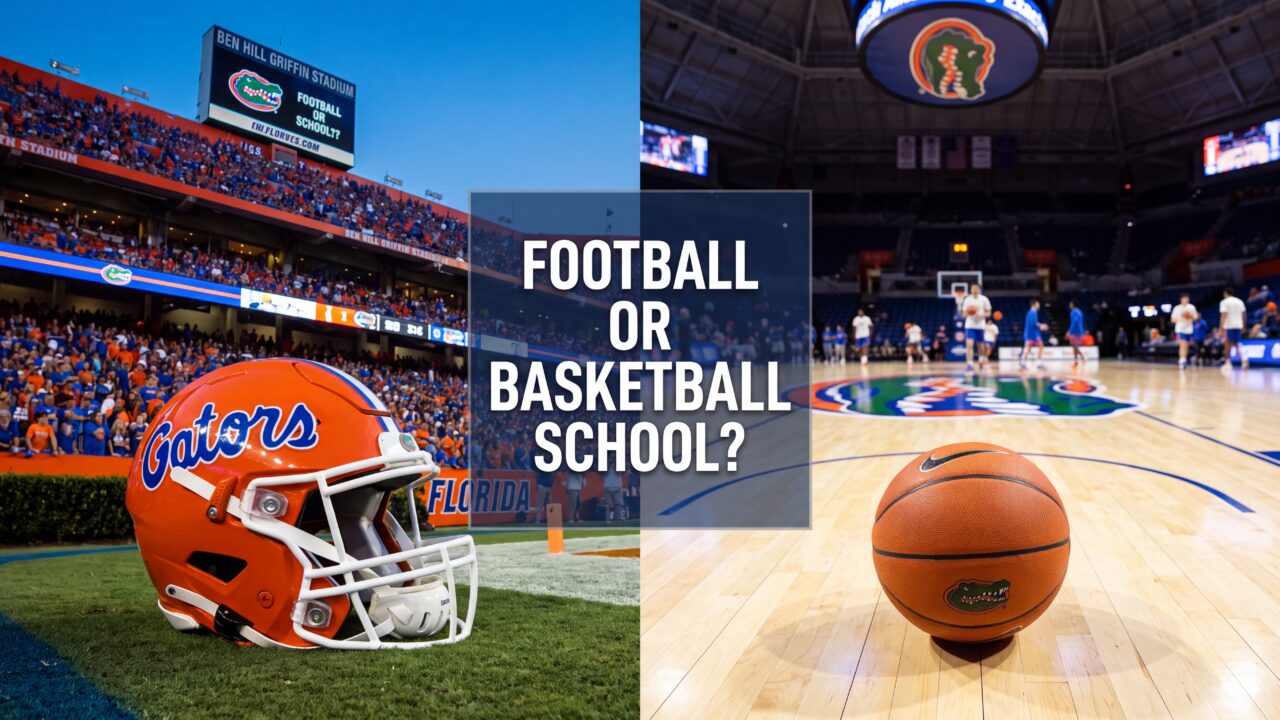
The label “Florida football or basketball school” matters in Gainesville because it changes where boosters, recruits and administrators focus their attention and dollars. That identity drives NIL packaging, stadium and arena priorities, and how coaches sell the program to elite prospects.
Fans treat the debate as a practical roadmap for roster construction and recruiting strategy, not just pride. How the athletic department tilts the balance will shape the next recruiting cycle and the team’s competitive horizons.
Key Takeaways
- Both Florida programs have legitimate national-era success, which makes a single, permanent identity difficult to pin down for fans and recruits.
- Public perception and institutional resource allocation still skew toward football because of scale, attendance and revenue opportunities tied to the stadium experience.
- Recruiting momentum, coaching stability and NIL activation are the clearest short-term indicators that will determine which program commands top local attention.
- A concerted administrative strategy to market one program over the other will directly influence recruiting leverage within the SEC and College Football Playoff conversations.
Florida football or basketball school identity
Both programs carry historical markers that complicate a binary label: football delivered modern-era national titles while basketball delivered back-to-back NCAA championships, and each era reshaped recruiting pipelines. That shared pedigree means alumni pride can swing toward whichever sport is winning at the moment.
Institutional investments and facility projects are concrete expressions of identity. Football’s stadium weekends generate a different scale of local economic activity and donor attention, and that often translates into prioritized capital projects and recruiting infrastructure.
At the same time, basketball’s national runs create outsized marketing moments that reframe perceptions quickly. A single deep NCAA tournament run or an elite recruiting class in basketball can shift national narratives and open short-term revenue and NIL opportunities.
Recruiting and roster signals
Recruiting remains the clearest real-time barometer of which program is trending up. Football’s larger roster and longer depth chart make consistent high-level recruiting classes necessary to sustain competitiveness across offense and defense, while basketball’s shorter roster cycles make single classes or transfers more immediately transformative.
NIL dynamics cut both ways but operate differently across sports. Football’s position-group model creates more distributed NIL opportunities, while a single high-profile basketball recruit can command concentrated attention and commercial value for the program.
The transfer portal also changes how quickly identity can shift; an influx of veteran transfers in either sport can alter roster construction faster than traditional high school recruiting cycles. Coaching continuity remains a stabilizer: program direction and recruiting promises hinge on whether coaches can sell a consistent vision to prospects and donors.
Head-to-head program context
| Category | Football | Basketball |
|---|---|---|
| National championships | Consensus national titles in 1996 and 2006 | Back-to-back NCAA tournament championships in 2006 and 2007 |
| Flagship venue | Ben Hill Griffin Stadium, the program’s primary game-day amphitheater | Exactech Arena at the Stephen C. O’Connell Center, the on-campus basketball facility |
| Recent program markers | Periodic SEC titles and eras of top-25 recruiting that sustained competitive windows | National prominence during the mid-2000s with intermittent NCAA tournament runs since |
| Recruiting footprint | Deep in-state pipeline with a national recruiting reach | Strong regional footprint with nationally-ranked classes tied to coaching profile |
| Market and attendance scale | Large-scale home attendance and broader game-day economic impact | Smaller venue scale but concentrated fan experience and visibility during marquee tournaments |
These qualitative comparisons show the trade-offs between sustained scale and episodic spikes in national relevance. Football’s structural advantages around attendance and revenue often place it at the center of long-term planning, while basketball’s peaks can deliver rapid national attention and recruiting momentum.
Featured image supplied in source metadata
SEC recruiting and CFP leverage for Florida
How Florida resolves the identity question affects SEC positioning and CFP potential because recruiting pipelines and NIL packaging are zero-sum within the conference marketplace. Prioritizing football recruiting resources and NIL bundling will strengthen Florida’s path to sustained CFP contention if those commitments produce roster depth and coaching stability.
Alternatively, leaning into basketball with targeted investment in coaching and recruiting can broaden the program’s national brand and create distinct commercial opportunities outside the football calendar. Either approach reshapes how recruits perceive the university and how boosters allocate finite resources.
For readers tracking the local coverage and recruiting chatter, a more detailed local report is available from Gators Wire, and the featured image is provided in the source metadata.