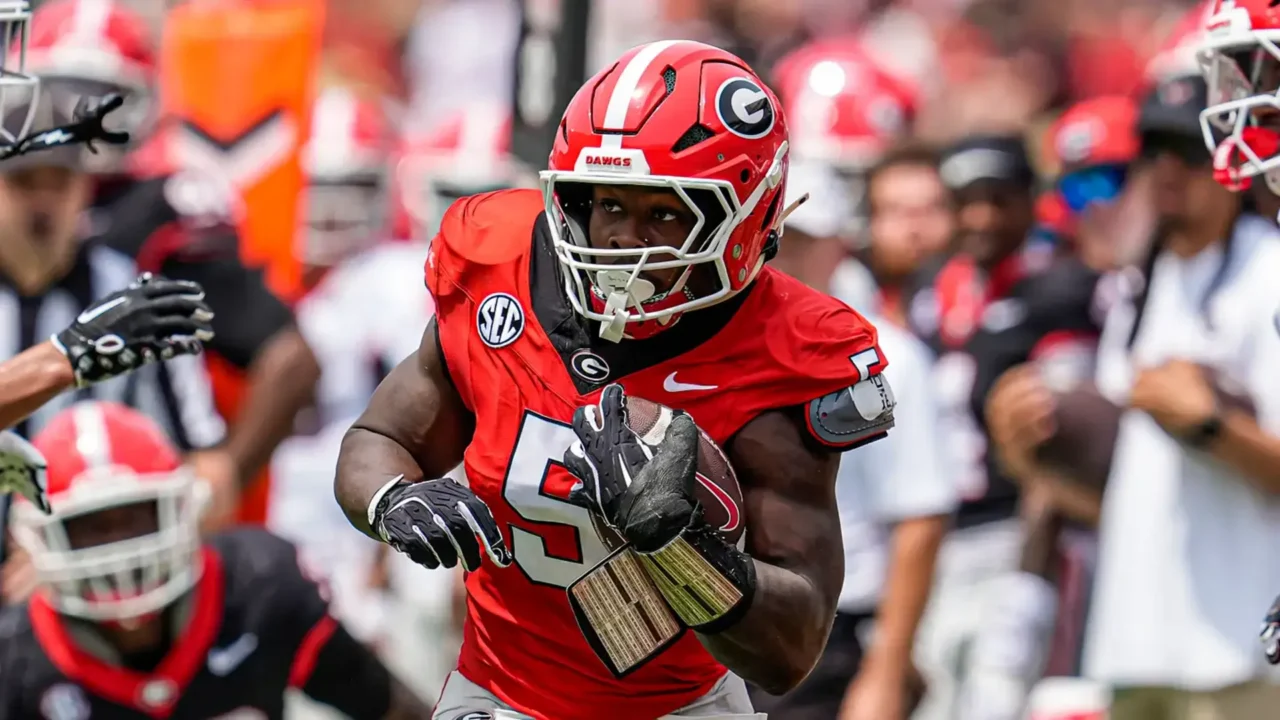
- Georgia returns a core of rushers including Nate Frazier, Chauncy Bowens, Dwight Phillips and Gunner Stockton.
- The Bulldogs aim to build on 2,550 rushing yards (580 attempts in 2025) with a path to 3,000+ rushing yards given returning linemen and backfield continuity.
- Mike Bobo is experimenting with true freshman Kaiden Prothro at receiver while four offensive-line starters return, supporting a run-first posture.
Georgia football 2026 opens with a clear lever: the ground game. Returning a core of ball-carriers and four offensive-line starters gives the Bulldogs an unusual continuity entering the new season.
The push toward a 3,000-yard rushing season and a bigger national profile for Gunner Stockton is detailed in reporting from Dawn of the Dawg, and those threads are the organizing principles for this preview.
Key Takeaways
- Georgia returns a collection of rushers — including Nate Frazier, Chauncy Bowens, Dwight Phillips and Gunner Stockton — that preserves last season’s identity and opens a path to more than 3,000 rushing yards.
- Chauncy Bowens delivered as a true freshman, and his continued growth alongside Stockton gives Georgia versatility in the backfield.
- Mike Bobo’s experiment shifting true freshman Kaiden Prothro to receiver could create a high-upside mismatch if the move sticks.
- Four returning starters on the offensive line provide the continuity necessary for an increased rushing volume and more consistent playcalling.
Georgia football 2026 running game outlook
The math is simple: Georgia ran the ball 580 times last season and produced 2,550 rushing yards, a workload and base that can be built on in 2026. With the same playbook tendencies and a healthy backfield rotation, incremental gains in average yards per carry could push totals north of 3,000 yards.
Gunner Stockton led the team in rushing touchdowns and finished in the top 10 of Heisman voting last season, which anchors both the offense’s identity and its national profile. Nate Frazier, Chauncy Bowens and Dwight Phillips returning means the Bulldogs can rotate without losing the style that produced heavy rushing volume.
Coaches will likely preserve a run-first posture while adding a few more shots downfield to amplify Stockton’s value and diversify defensive stress. The competition for carries and clearly defined roles will shape usage, but the baseline is already established.
Receiver experiment and Kaiden Prothro shift
Mike Bobo’s decision to try true freshman Kaiden Prothro at receiver after recruiting him as a tight end is the most intriguing schematic adjustment of the preseason. Prothro’s 6-foot-6 frame and noted athletic traits create matchup problems on the perimeter if he can adapt to route timing and separation against SEC coverage.
That move remains experimental and it’s unclear if it will stick, but the upside is tangible: a big-bodied outside target would complement Stockton and the rushing attack by forcing defenses to respect the perimeter. If Prothro develops quickly, he becomes both a possession threat and a vertical stretch piece that changes how defenses allocate resources against Georgia.
Rushing returns and offensive line continuity
| Season | Team rushing yards | Rush attempts | Notable backfield or returners | Offensive-line continuity |
|---|---|---|---|---|
| 2025 | 2,550 | 580 | Nate Frazier; Chauncy Bowens; Dwight Phillips; Gunner Stockton | Four returning starters on the offensive line |
| 2022 | 3,000+ | Comparable high-volume rushing attack | Backfield included Nick Chubb, Sony Michel and D’Andre Swift | Different roster, similar run-focused identity |
The table pairs last season’s verified totals with the last time Georgia produced a 3,000-plus rushing campaign, offering a factual comparison that underlines how roster continuity can translate to higher volume and efficiency. Returning linemen reduce the learning curve for run fits and pass protection, which matters when a staff wants to nudge playcalling toward more carries or more aggressive downfield shots.
SEC title and CFP implications for Georgia football 2026
If Georgia increases its rushing output while sustaining defensive performance, the Bulldogs preserve a straightforward path to contention in the SEC and to favorable College Football Playoff positioning. A dominant ground game neutralizes opponent schematics and creates game-control windows that matter to committee perception.
Stockton’s top-10 Heisman placement last season already puts him on national radars, and a full-season push with improved passing balance would elevate both his award stock and Georgia’s résumé. Projections about awards like SEC Freshman of the Year for an experimental position switch should be treated as contingent, but the structural pieces are in place for meaningful individual and team gains.
This analysis was informed by the original reporting linked earlier.
Frequently Asked Questions
Which rushers return for Georgia in 2026?
Nate Frazier; Chauncy Bowens; Dwight Phillips; Gunner Stockton.
What schematic experiment is noted in the preview?
Mike Bobo is trying true freshman Kaiden Prothro at receiver after recruiting him as a tight end.