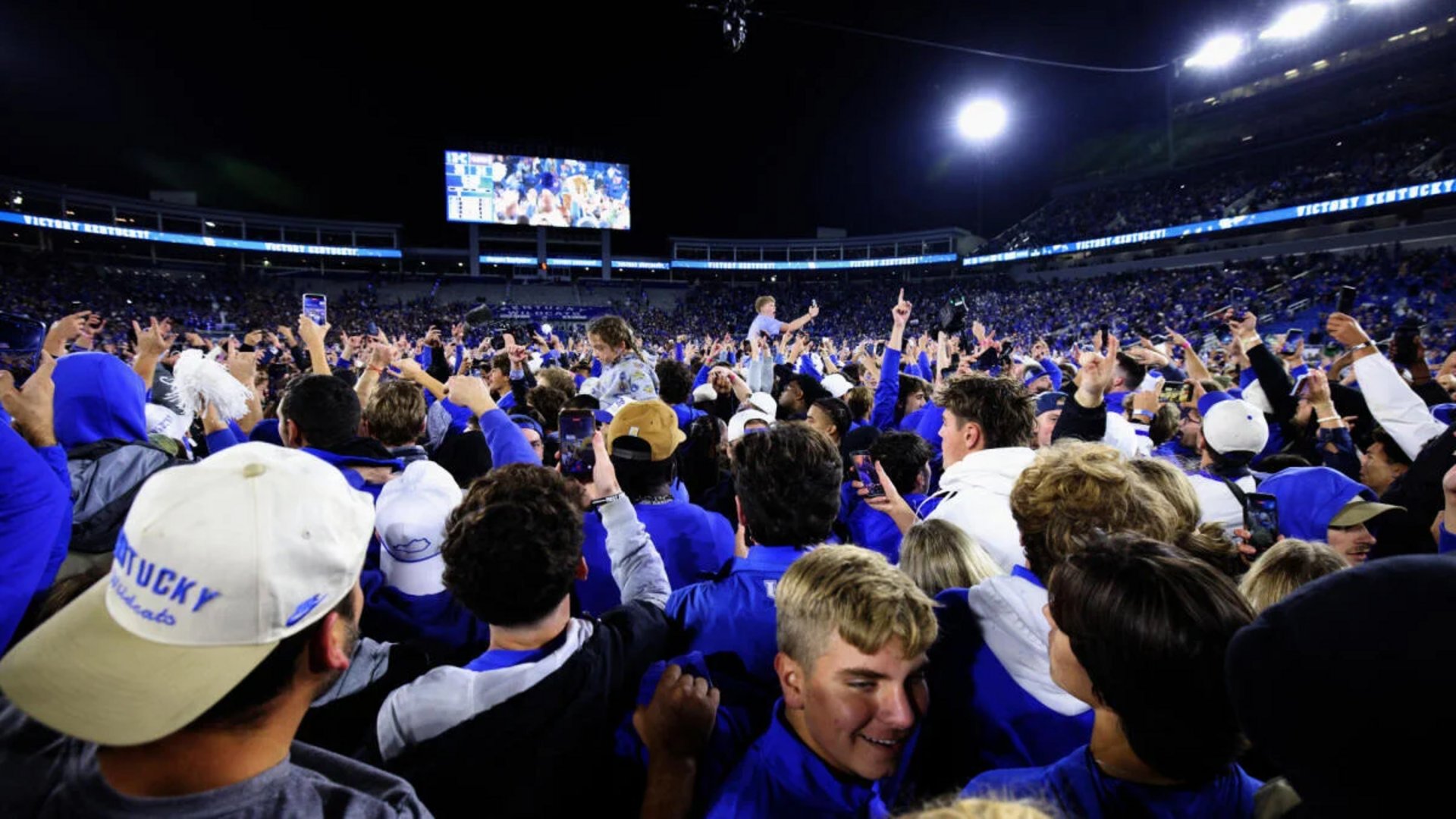
Kentucky beat LSU 35-34 in overtime, then fans entered Kroger Field to celebrate. The Wildcats were fined $500,000, payable to LSU, for the field access violation, as CBS Sports details.
The win was Kentucky’s first at home over a top-10 team since 2021, and the Wildcats rose to No. 15 in the Week 7 AP Poll. The celebration followed a successful two-point conversion in overtime, but the result did not remove the SEC’s restrictions on spectators entering the competition area.
The Kentucky SEC field-storming fine puts attention on two separate matters: the importance of the win and the conference’s expectations for field access. The policy sets a general restriction and allows the SEC to waive a fine when specified planning and safety conditions are met.
Key Takeaways
- The SEC fined Kentucky $500,000 after spectators entered the competition area following the Wildcats’ 35-34 overtime win over LSU.
- The fine is owed to LSU, and the incident involved the SEC policy restricting spectator entry to the competition area before, during or after a contest.
- Kentucky’s win was its first home victory over a top-10 opponent since 2021, and the Wildcats rose to No. 15 in the Week 7 AP Poll.
- The SEC may waive a fine when the stated conditions are met, including advance planning and communication and the safe departure of visiting personnel and officials before fans enter.
Why Kentucky Received the SEC Field-Storming Fine
The central issue was spectator access to the field after the game. The SEC’s competition-area policy bars spectators from entering the area before, during or after a contest, placing responsibility on schools to manage access when the game ends.
At Kroger Field, fans entered the competition area after Kentucky completed its overtime win. The SEC imposed a $500,000 fine, which is payable to LSU. Those are the basic facts behind the penalty: a postgame entry onto the field and a conference rule governing that access.
The result itself was significant for Kentucky. The Wildcats beat LSU 35-34 in overtime, recording their first home win over a top-10 team since 2021. The victory also preceded Kentucky’s rise to No.
15 in the Week 7 AP Poll.
The finish came on a successful two-point conversion in overtime. Will Stein earned his second such win of the campaign. That context explains why the moment carried particular weight for the program, but it does not change the separate question of whether spectators were allowed onto the playing surface.
That distinction matters when considering the fine. The conference’s rule addresses entry to the competition area, rather than the quality or significance of the game that came before it. A consequential win and a violation of the access policy can therefore be part of the same postgame story.
For Kentucky, the immediate consequence was financial: the $500,000 fine goes to LSU. The broader policy question is how schools can prepare for postgame celebrations while complying with the conditions the SEC has set for field access.
How the SEC Field Access Policy Works
The SEC eliminated its escalating fine system ahead of the 2025 season. That change means the earlier system of increasing penalties for repeat violations is not the framework to use when describing the current policy.
The policy also provides for a possible waiver when a school meets the stated conditions. A school must plan in advance and communicate its policy to fans, while visiting personnel and game officials must safely leave the field before spectators enter.
Those requirements are conditions for the SEC to consider in deciding whether to waive a fine; they do not make a waiver automatic. Advance planning, communication and the safe exit of visiting personnel and officials all matter under the stated terms.
The timing condition is especially clear: visiting personnel and officials must be able to leave safely before fans enter the competition area. A school’s advance communication and planning are also part of the conditions, rather than substitutes for that safe departure.
This framework separates the general restriction from the potential waiver. The policy restricts spectator access to the competition area, while the waiver conditions describe circumstances in which the SEC may waive a penalty. It is not accurate to treat a celebration plan as a guaranteed exemption.
The conference’s approach also makes preparation relevant before the final whistle. A school needs to have addressed its plan in advance and communicated it to fans; the conditions cannot be established merely by pointing to the emotion of a postgame celebration after spectators have entered.
SEC Field Access Rules and Kentucky’s Incident
| Policy point | What it means |
|---|---|
| Competition-area access | Spectators are restricted from entering the competition area before, during or after a contest. |
| Kentucky incident | Fans entered Kroger Field after Kentucky’s overtime win over LSU, and the Wildcats received a $500,000 fine payable to LSU. |
| Possible waiver conditions | The SEC may waive a fine when the school plans in advance, communicates its policy to fans, and visiting personnel and officials safely leave before spectators enter. |
| Policy change | The SEC eliminated its escalating fine system ahead of the 2025 season. |
The table distinguishes the general restriction, Kentucky’s reported penalty and the conditions relevant to a possible waiver. These points should not be conflated: the existence of waiver conditions does not mean every postgame field celebration qualifies.
Nor does the policy make the game’s outcome a factor in whether spectators entered the field. Kentucky’s two-point conversion, the overtime score and the Wildcats’ top-10 win are important context for the celebration, while the access rule concerns who entered the competition area and when.
Kentucky’s SEC Standing Meets the 16-Team Conference’s Standards
Kentucky’s win over the LSU Tigers added a notable result to the Wildcats’ season. The victory was the program’s first home win over a top-10 opponent since 2021, and Kentucky’s rise to No. 15 in the Week 7 AP Poll gave the result a national ranking context.
Those developments make the game relevant beyond the final score, but they do not alter the SEC’s field-access policy. The fine and the ranking describe different consequences of the same weekend: a penalty tied to spectator entry and an AP Poll position following a significant win.
In a 16-team SEC, the same conference policy applies across a broad membership. Each school must account for the stated field-access restrictions and, if seeking a possible waiver, meet the advance planning, communication and safe-departure conditions described by the league.
For Kentucky, the practical issue is clear without diminishing the win: the Wildcats earned a 35-34 overtime victory, while the postgame entry onto the field resulted in a $500,000 fine payable to LSU. The policy’s waiver language leaves the SEC discretion to waive a fine when its stated conditions are met, rather than promising that a school’s plan will prevent a penalty.