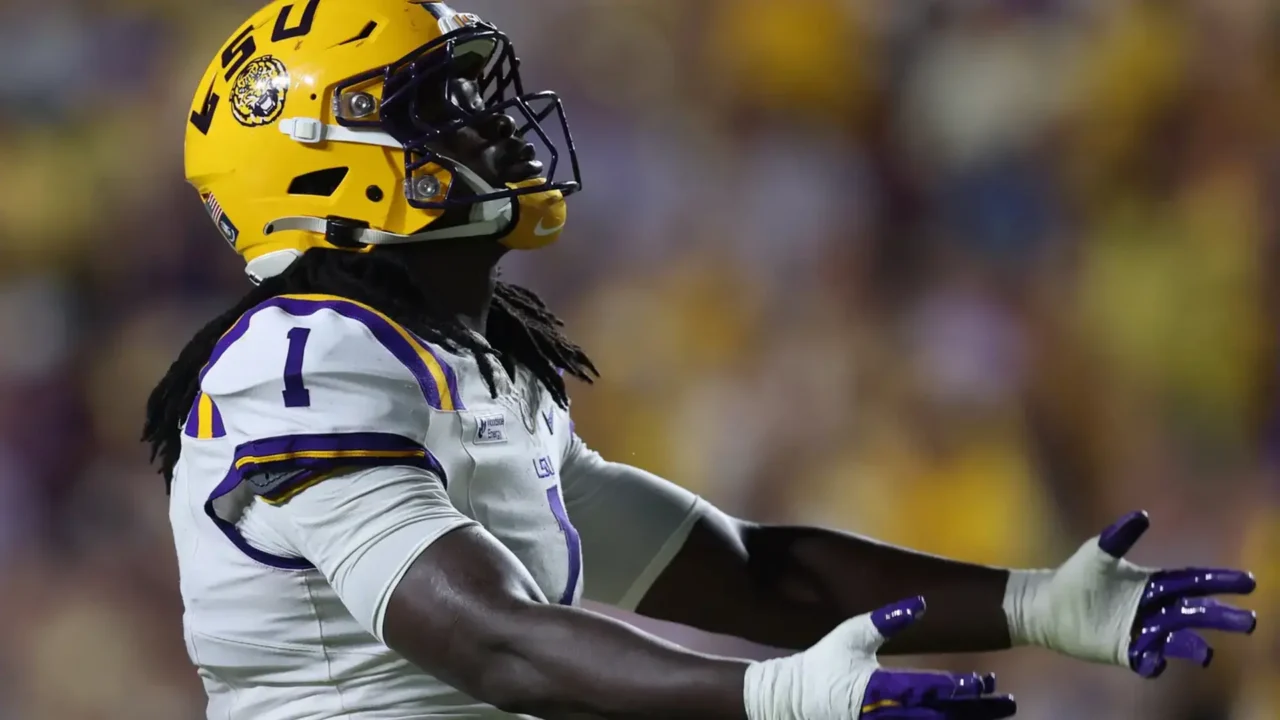
The LSU football defense has quickly become the most convincing part of the Tigers’ early identity. Its pass rush is creating problems from the edge and interior, giving LSU a way to control games even when the offense is still finding consistency.
The unit has recorded 19 sacks through the first month of the season and leads the SEC in that category, as detailed by LSU Tigers On SI. The performance against Texas A&M offered the clearest evidence of the defense’s value, as the Aggies were held without a touchdown while managing two field goals.
That combination of pressure and red-zone resistance matters in SEC football, where a single defensive stand can change the direction of a game. LSU now has a foundation it can carry into the more demanding portion of its schedule.
Key Takeaways
- Princewill Umanmielen leads LSU with seven sacks and 41 sack yards, establishing the Tigers’ top edge threat.
- True freshman defensive tackle Deuce Geralds has four sacks, giving LSU immediate interior disruption.
- TJ Dottery has 24 total tackles and provides steady activity behind the defensive front.
- LSU’s defensive depth extends across the line and secondary, allowing the Tigers to pressure opponents without relying on one player.
LSU Football Defense Is Winning With Pressure
The defining feature of the LSU football defense is its ability to attack quarterbacks from multiple points. The Tigers are not relying solely on an outside rusher or a single favorable matchup. Pressure is coming from both the interior and exterior of the defensive line, which makes protection decisions more difficult for opposing offenses.
Princewill Umanmielen has been the most visible piece of that attack. The defensive end leads LSU with seven sacks and has produced 41 sack yards, giving the Tigers a reliable edge threat who can change a possession with one snap.
Umanmielen’s importance goes beyond the individual plays. An edge rusher who consistently forces the quarterback to speed up can affect the entire structure of an offense, limiting the time available for routes to develop and making the secondary’s job more manageable.
His presence also gives LSU a clear answer when opponents attempt to establish the pocket. The Tigers can threaten from outside while asking the interior to collapse space, creating complementary pressure that is difficult to solve with a single protection adjustment.
Deuce Geralds has added another dimension from the middle. The true freshman defensive tackle has four sacks and has already emerged as one of LSU’s most productive pass rushers, an encouraging development for a front that needs disruption to come from more than one level.
Geralds’ emergence is especially valuable because interior pressure can disrupt an offense before a quarterback reaches the top of his drop. It can also prevent the pocket from opening clean escape lanes when edge rushers are closing from the outside.
TJ Dottery has supplied the activity behind that front. His 24 total tackles reflect a linebacker who is involved across the defense, whether the play requires pursuit, cleanup work or support around the line of scrimmage.
The broader point is that LSU’s pressure is not built around one player. Umanmielen gives the Tigers an established edge presence, Geralds is developing into an interior threat, and Dottery helps connect the front seven to the rest of the defense.
LSU Pressure Production Shows a Balanced Defensive Foundation
| Defensive piece | Verified production or role | Why it matters |
|---|---|---|
| Princewill Umanmielen | Seven sacks and 41 sack yards | Provides a consistent outside threat that can force quarterbacks off schedule |
| Deuce Geralds | Four sacks as a true freshman defensive tackle | Gives LSU disruptive potential from the interior of the defensive line |
| TJ Dottery | 24 total tackles | Supports pursuit and helps sustain the defense around the line of scrimmage |
| Defensive line and secondary | Depth across multiple levels | Allows LSU to pressure opponents without depending on one matchup |
| Texas A&M game | Opponent held without a touchdown and limited to two field goals | Shows how pressure can support a strong overall defensive result |
The table illustrates why LSU’s defensive start deserves attention without reducing the unit to one sack total or one standout performer. The Tigers have production on the edge, movement inside and enough activity at linebacker to keep plays from extending.
That balance also helps explain the contrast between the defense and the early concerns around LSU’s offensive line. While the reporting notes struggles up front on offense, the defensive line has supplied the kind of disruptive production that can keep LSU competitive while the offense works through its own issues.
Depth in the secondary is another important part of the equation. Pressure is most valuable when the coverage behind it can hold long enough for the rush to arrive, and LSU has resources across both the trenches and the back end.
LSU Football Defense Can Shape the SEC Race
The next challenge is sustaining this identity through SEC football. A productive pass rush can travel, but conference offenses will test LSU with different protection schemes, quarterback styles and a steady succession of physical games.
That is why the Texas A&M result matters as context rather than a finish line. Holding an opponent without a touchdown shows what the unit can do, but LSU will need the same discipline and depth when games become tighter and possessions carry greater standings consequences.
The defensive front could also influence roster construction under Lane Kiffin. Umanmielen’s production gives LSU an established edge presence, Geralds’ emergence strengthens the interior outlook, and Dottery’s activity offers a dependable link between pressure and pursuit.
For a program trying to climb the SEC, those developments create a more stable foundation than a defense built around one star. They also give future roster decisions a clearer purpose: preserve the speed and variety that allow LSU to attack from multiple levels.
Recruiting benefits when young players can contribute quickly and veterans can produce in visible roles. Geralds’ early impact gives LSU a useful example of interior talent being integrated into a defense that already has established contributors.
The expanded conference demands that kind of depth. In the 16-team SEC, teams cannot expect to survive on a narrow rotation or a single method of winning, especially when the schedule eventually produces a difficult late-season stretch.
There are also College Football Playoff implications for any SEC team that can consistently turn pressure into stops. LSU does not need to be defined by broad national claims at this stage, but it does need to prove that this pass rush remains productive when the quality of competition rises.