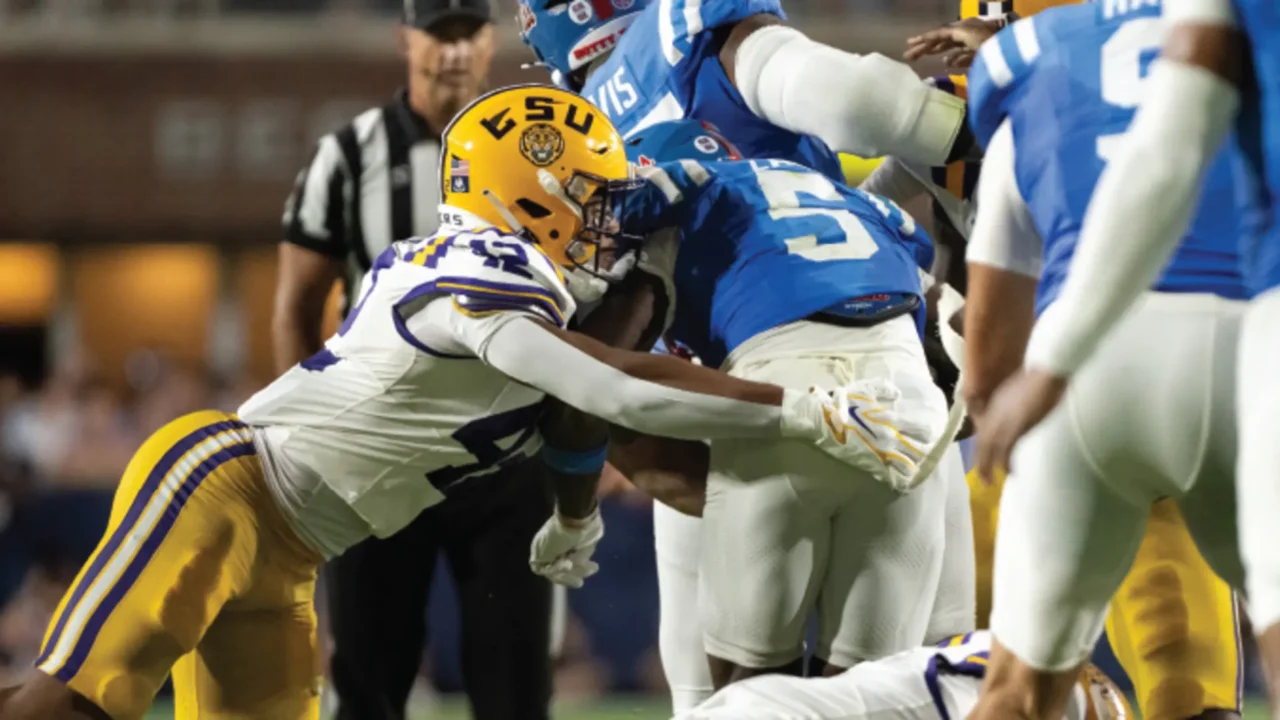
Marcel Reed has been the disruptive element in two consecutive meetings with LSU, and the Tigers’ defense heads into College Station with urgent schematic questions after the loss in Oxford
The stakes are higher because LSU will try to solve that problem without hybrid star Dashawn Spears, and the original reporting that frames this matchup can be read TigerRag.com |
Key Takeaways
- Marcel Reed has produced 310 total yards and four touchdowns in one meeting and changed another game after entering in the second half.
- Dashawn Spears tore the ACL and will miss the remainder of the season, forcing position shifts in LSU’s secondary.
- LSU entered the Ole Miss game with the nation’s highest pressure rate but needed a second-half adjustment to slow Trinidad Chambliss.
- Across two games versus Blake Baker’s LSU defenses, Reed has rushed for 170 yards and five touchdowns while Texas A&M holds a combined +39 scoring margin.
Why Marcel Reed keeps giving LSU fits
Reed is a dual-threat quarterback whose legs have repeatedly exploited the specific rush and pursuit tendencies of Blake Baker’s schemes
In one meeting at Tiger Stadium Reed rushed 13 times for 108 yards and two touchdowns and passed for 202 yards and two scores, finishing with 310 total yards and four touchdowns despite two interceptions
In the later meeting Reed entered during the third quarter, carried nine times for 62 yards and three touchdowns, and completed both passes for 70 yards to swing the game even when he began on the bench
Those performances expose a recurring tactical weakness: Reed turns small breakdowns in rush discipline into explosive gains by extending plays and attacking the perimeter
LSU personnel response and scheme changes
Dashawn Spears’ season-ending ACL tear forces LSU to reconfigure the STAR role that is central to limiting Reed’s threat
When Spears left the Ole Miss game Tamarcus Cooley shifted to STAR and Jhase Thomas moved into Cooley’s safety spot, creating two internal adjustments instead of a single substitution
The STAR must cover the slot, fit the run, tackle in space and carry option responsibility against motion and designed quarterback runs; any hesitation opens the edge for Reed to exploit
LSU’s corrective path will rely on controlled aggression: maintain coordinated interior pressure, compress the pocket without overextending edge rushers and force Reed to sustain drives with his arm rather than his legs
Reed vs Baker defenses data and context
| Meeting | Rushing performance | Passing performance | Result context |
|---|---|---|---|
| 2024 game (entered in 3rd quarter) | 9 carries for 62 yards and 3 rushing touchdowns | Completed both passes for 70 yards | Entered in the third quarter and helped swing the game |
| Tiger Stadium meeting | 13 carries for 108 yards and 2 rushing touchdowns | 202 passing yards and 2 passing scores; 310 total yards and 4 total touchdowns | Produced the 310-yard, four-touchdown performance despite two interceptions |
| Combined two games | 170 rushing yards and 5 rushing touchdowns | Multiple passing performances producing game-changing drives | Texas A&M holds a +39 combined scoring margin |
SEC and CFP implications for LSU
This matchup alters LSU’s margin for error in SEC play because a repeat of Reed’s previous production would complicate the Tigers’ path toward a conference title and CFP résumé
Defensive shortcomings against mobile quarterbacks influence recruiting conversations about scheme fit, shape roster construction decisions at hybrid spots, and raise the stakes for LSU’s execution without Spears