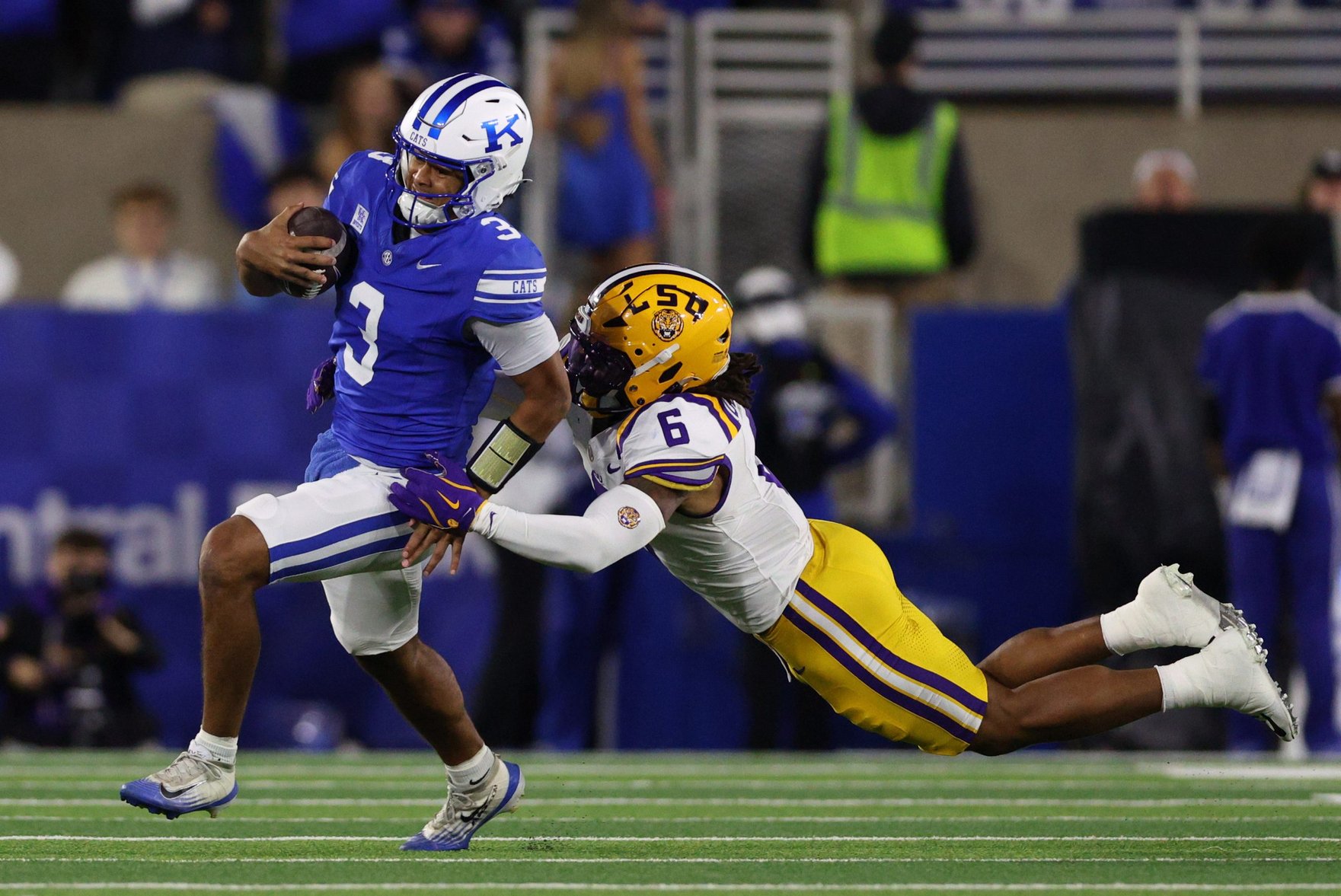

Marcel Reed did not soften the language after Texas A&M’s 35-6 loss at LSU, calling the current moment “rock bottom” and placing blunt accountability on himself and the unit around him.
The defeat dropped Texas A&M to 0-2 in SEC play and amplified concerns about protection, play-calling and Reed’s on-field regression as noted in Texas A&M Aggies On SI.
Key Takeaways
- Texas A&M lost 35-6 at LSU and dropped to 0-2 in SEC play after an earlier 31-21 home loss to Kentucky.
- Marcel Reed completed 10 of 26 passes for 106 yards with one interception, finishing with a 38.5% completion rate and a 31.3 passer rating.
- Reed rushed 10 times for minus-13 yards, removing a complementary element the offense had used previously.
- The game exposed protection problems, schematic issues, and decision-making under pressure that the Aggies must address quickly.
Why Marcel Reed struggled in Baton Rouge
Film from Death Valley showed consistent pressure and constricted passing windows that prevented Reed from operating cleanly.
Reed himself admitted, “We had trouble up front, and some of that’s on me,” which put emphasis on both protection and quarterback processing.
Those surface problems translated into stark numbers: 10-for-26 for 106 yards, one interception, a 38.5 completion percentage and a 31.3 passer rating.
Statistically and situationally, the offense could not sustain drives or convert under duress.
Reed’s rushing line — minus-13 yards on 10 attempts — removed a complementary element the Aggies have relied on in the past.
Without effective scrambling or designed runs to change the pocket, opposing fronts could focus on collapsing throwing lanes.
LSU’s third-quarter adjustments tightened throwing windows and increased contested catch opportunities for A&M receivers.
The Aggies lacked quicker-release concepts and schematic answers that would have neutralized the surge and given Reed simpler, higher-percentage reads.
Pressure up front amplified indecision in the short passing game, turning what should be rhythm throws into contested attempts.
That sequence compounded into stalled drives, forcing the A&M offense into predictable down-and-distance situations where LSU could dictate play selection.
Quarterback mechanics under pressure and timing with the receiving corps also appeared off, a compounding issue when pass protection fails.
Those timing breakdowns are addressable in practice but require deliberate early-week work on tempo, pocket patience and simplified progressions.
Play-calling choices fed into the problem when the offense failed to counter LSU’s pressure with quick-game concepts or protective counters at critical junctures.
Adjustments were attempted, but the on-field responses were not enough to swing momentum back toward the Aggies.
Baton Rouge head-to-head results
| Game | Result | Notes |
|---|---|---|
| 2023 at LSU | Texas A&M 49–25 LSU | A&M produced a dominant offensive performance in the prior meeting in Baton Rouge |
| 2024 at LSU | Texas A&M 6–35 LSU | A complete reversal in result with LSU controlling the second half and pulling away |
| 2024 vs Kentucky (home) | Texas A&M 21–31 Kentucky | An earlier SEC home loss that left the Aggies 0-1 in conference before traveling to LSU |
The turnaround from a 49-point road outing in 2023 to a six-point showing in 2024 underscores how quickly matchups and execution can flip between seasons.
Momentum swung decisively in the third quarter this year as LSU tightened the game plan and A&M failed to respond.
SEC Standings and Aggies Path Forward
Being 0-2 in conference play immediately narrows the margin for error if Texas A&M hopes to contend in the SEC; the practical path forward demands significantly improved consistency and near-flawless conference results.
On the roster side, the performance shifts scrutiny toward offensive line play, Reed’s decision-making under pressure and schematic balance.
Short-term priorities will include shoring up protection, installing quicker reads and emphasizing practice reps that rebuild pocket fundamentals and timing.
Accountability from players, led by Reed’s blunt assessment, sets an expectation that improvement must appear on short notice to keep conference goals realistic.