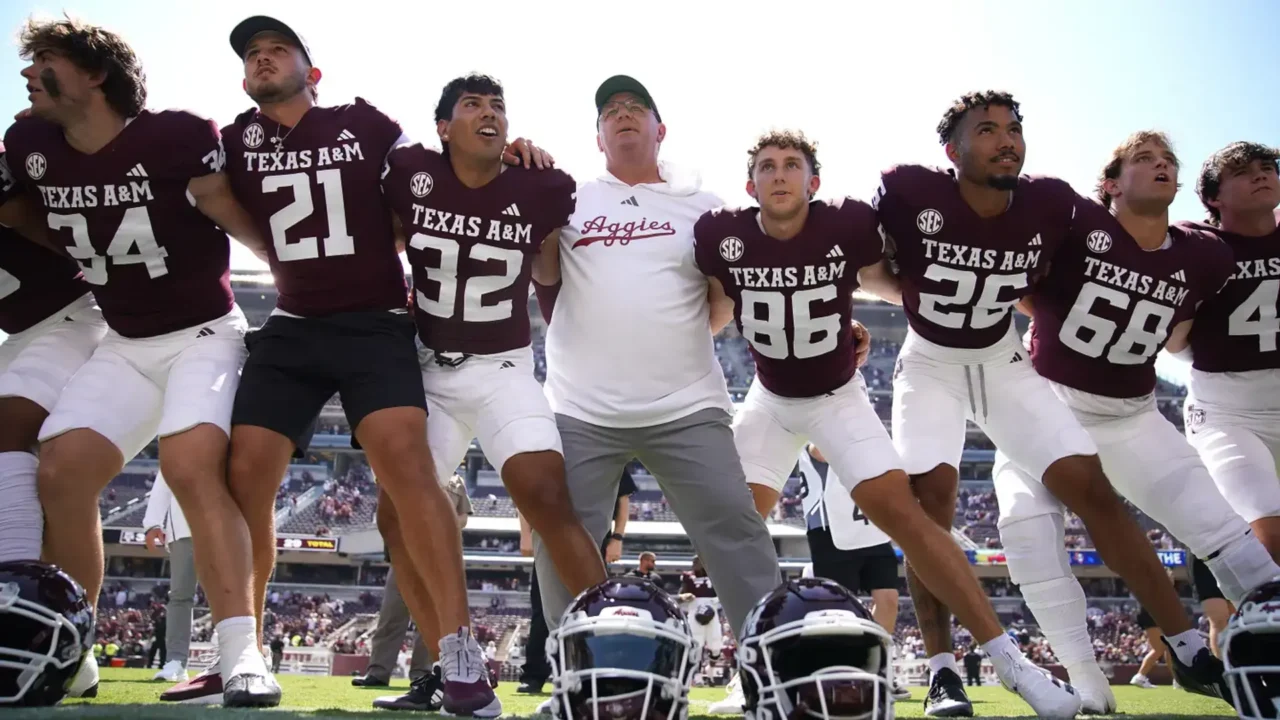
Texas A&M has spent less in the portal than some of its SEC peers, but roster construction under Mike Elko has produced depth that matters where it counts for a College Football Playoff push.
The narrative of headline spending obscures a different story of sustained development and targeted additions, as outlined by Texas A&M Aggies On SI, and that contrast is central to evaluating this roster now.
Key Takeaways
- Mike Elko Texas A&M roster depth is strongest at offensive skill positions and built largely through development and selective transfers.
- The Aggies’ portal spending is estimated near $33 million, well below Texas and LSU, yet the roster remains competitive in the SEC.
- Receivers are likely the team’s strongest position group, giving the offense multiple ways to create matchups.
- Secondary and linebacker spots remain question marks despite overall SEC-level athleticism on the roster.
Mike Elko Texas A&M roster depth at the offensive skill positions
The offense is the immediate evidence of the roster-building philosophy: depth through developing starters and adding high-upside complementary pieces.
Quarterback depth is tidy with Marcel Reed leading and Brady Hart developing behind him, giving the staff insurance without needing headline portal moves.
At running back, Rueben Owens projects as the lead and sophomore Jamarion Morrow is described as developing quickly, which preserves continuity and a reliable rotation.
The receiver room stands out as perhaps the deepest group on the roster. Mario Craver returns as a reliable target while Miami transfer Isaiah Horton adds an outside dynamic, and star returner Terry Bussey is evolving into a multi-use weapon.
Defensive interior and core standouts
The Aggies took some turnover in the trenches but kept foundational pieces that stabilize both lines of scrimmage.
Defensive tackle DJ Hicks is listed as an SEC standout anchoring the interior, while center Mark Nabou Jr. provides a corresponding presence on offense.
Coaching continuity and the influx of freshmen and transfers who clear the program’s recruiting standards are expected to help units such as the Wrecking Crew and the Maroon Goons cohere as the season progresses.
The biggest defensive questions are in the secondary and at linebacker, where the staff has athletic talent but will need to convert that into consistent play in tight, late-game moments.
Portal spending and defensive turnover comparison
| Program | Reported portal spending (estimate) | Defensive turnover benchmark |
|---|---|---|
| Texas | Close to $50 million | Not specified in available reporting |
| LSU | A bit over $40 million | Not specified in available reporting |
| Texas A&M | About $33 million | No. 113 in total turnovers and three interceptions reported |
How Aggies depth affects College Football Playoff and SEC positioning
Depth built through development and selective additions gives Texas A&M a practical edge in a long season where injuries and matchup swings decide standings.
Returning production was substantial last year at roughly 72 percent, and coaching upgrades turned that continuity into a CFP-caliber team, which suggests roster construction here is correlated with late-season competitiveness.
On the recruiting trail, the staff can sell development and meaningful playing time rather than one-off splash spending, an argument that matters to prospects weighing long-term growth versus immediate NIL-driven offers.
For SEC pecking order, the Aggies’ model presents a roadmap for sustained contention without matching the largest portal budgets, but improvement in the secondary and linebacker units will be decisive in head-to-head league games and playoff evaluation.