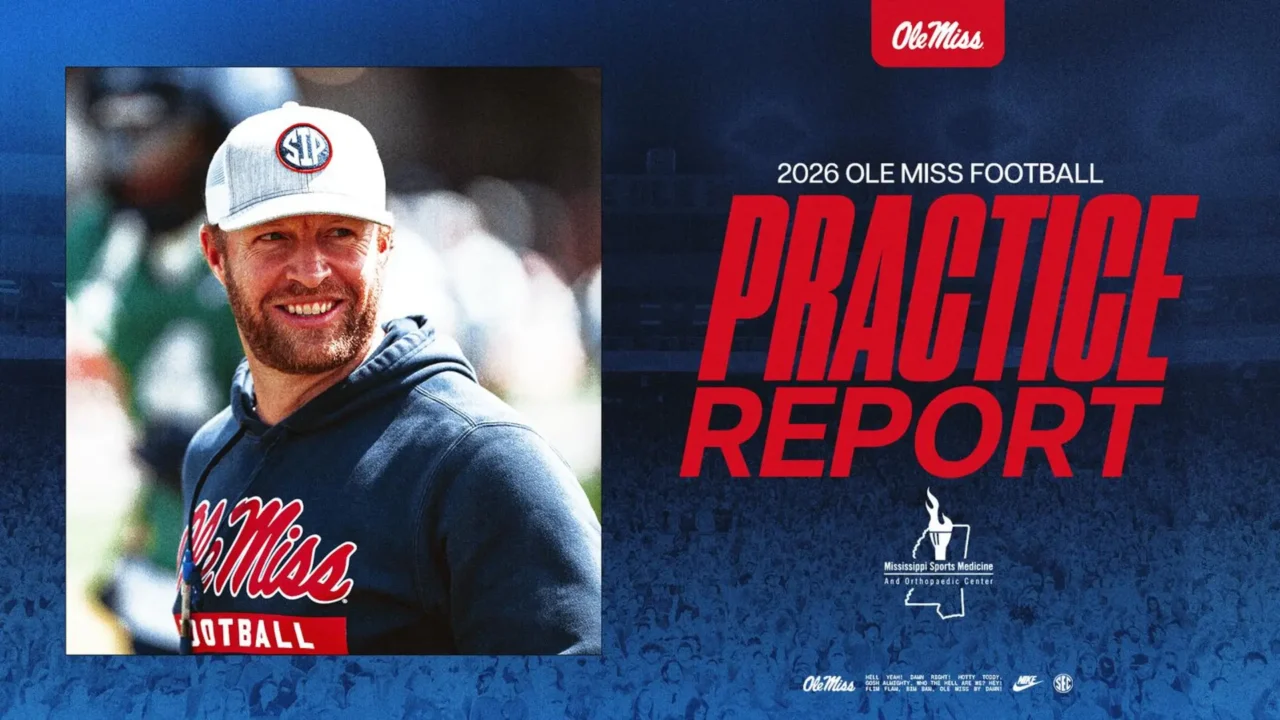
Ole Miss entered the second week of fall camp in Oxford intent on carving a clearer identity for the 2026 season opener against Louisville, and coaches are sorting personnel and roles to match that plan.
Offensive coordinator John David Baker outlined those priorities in a detailed practice report published by Ole Miss Athletics, stressing that the offense will lean on pace, a strong running game and tight end versatility.
Key Takeaways
- Baker plans to fit the offense to the roster rather than radically retooling schemes, emphasizing players who can execute consistently.
- The offense will prioritize playing fast, running the football, playing physical and creating explosive plays as guiding principles.
- The tight end room is being developed as a multi-role group where playing time is earned through reliability and consistent execution.
- Baker phrased his evaluation approach as “trust over talent” and highlighted Trinidad Chambliss’s leadership growth as central to unit cohesion.
Baker on Ole Miss offense identity
Baker framed his return to Oxford around recognizing what has worked for the Rebels and aligning the current roster with those foundational principles.
He said he isn’t focused on putting a personal stamp on the program but on identifying strengths and using players where they can succeed.
He distilled the offense to four pillars—play fast, run the football, play physical and create explosive plays—that will guide practice tempo and play-calling as the staff prepares for Louisville.
Tight end room roles and Chambliss leadership
Baker described the tight end group as diverse in skill set and said coaches are working to determine where each player fits best within the offense’s demands.
He called the position “probably one of the hardest positions to play in our offense” because tight ends must block in the run game and serve as vertical or intermediate receiving options.
The coordinator tied quarterback development to making teammates better, noting Trinidad Chambliss must grow as a leader to elevate linemen, tight ends and running backs.
Baker used a coaching shorthand that will shape opportunity: “At the end of the day, it’s about trust over talent.”
“Can I trust you to do your job?” That approach will determine who earns early snaps.
Why the tight end battle matters for game planning
With an emphasis on a physical run game and explosive plays, tight ends will be judged on blocking technique, route reliability and availability from play to play.
Versatility in the tight end room allows the staff to create matchup problems, mix personnel packages and sustain a downhill running attack while preserving seam and vertical threats.
For a coordinator stressing pace, dependable tight ends shorten the pre-snap window for defenders and reduce the need for frequent substitutions.
How Baker’s scheme and roster approach shape fall camp decisions
Baker’s plan to use the roster’s existing strengths creates clear evaluation criteria in practice: who plays fast, who sustains blocks and who executes reliably under pressure.
That orientation prioritizes repeatable traits over one-off flashes and will influence depth chart movement in the coming weeks.
For tight ends and receivers, the pathway to early playing time is straightforward under Baker’s standards: earn the coaches’ trust by doing your job consistently every rep.
Positional role expectations
| Position group | Primary role expectation |
|---|---|
| Tight ends | Multi-functional role: pick up blocks in the run game, execute varied routes and provide reliable hands, with opportunities earned through consistency and coach trust |
| Wide receivers | Focus on creating explosive plays and dependable route execution to stretch defenses and complement the run game |
| Quarterback | Measured by ability to elevate teammates; leadership growth and making others better are central expectations for Trinidad Chambliss |
SEC recruiting and CFP implications for Ole Miss offense
Emphasizing a physical, run-first offense with dependable, versatile tight ends creates a recruiting profile that will target blockers and multi-role tight ends across SEC talent markets.
The “trust over talent” framing signals roster construction that favors dependable, scheme-fit players, which can affect depth and consistency across a long SEC schedule.
Early execution against Louisville will serve as a practical test of the offense’s identity and inform how the Rebels are evaluated in early conference and CFP conversations.