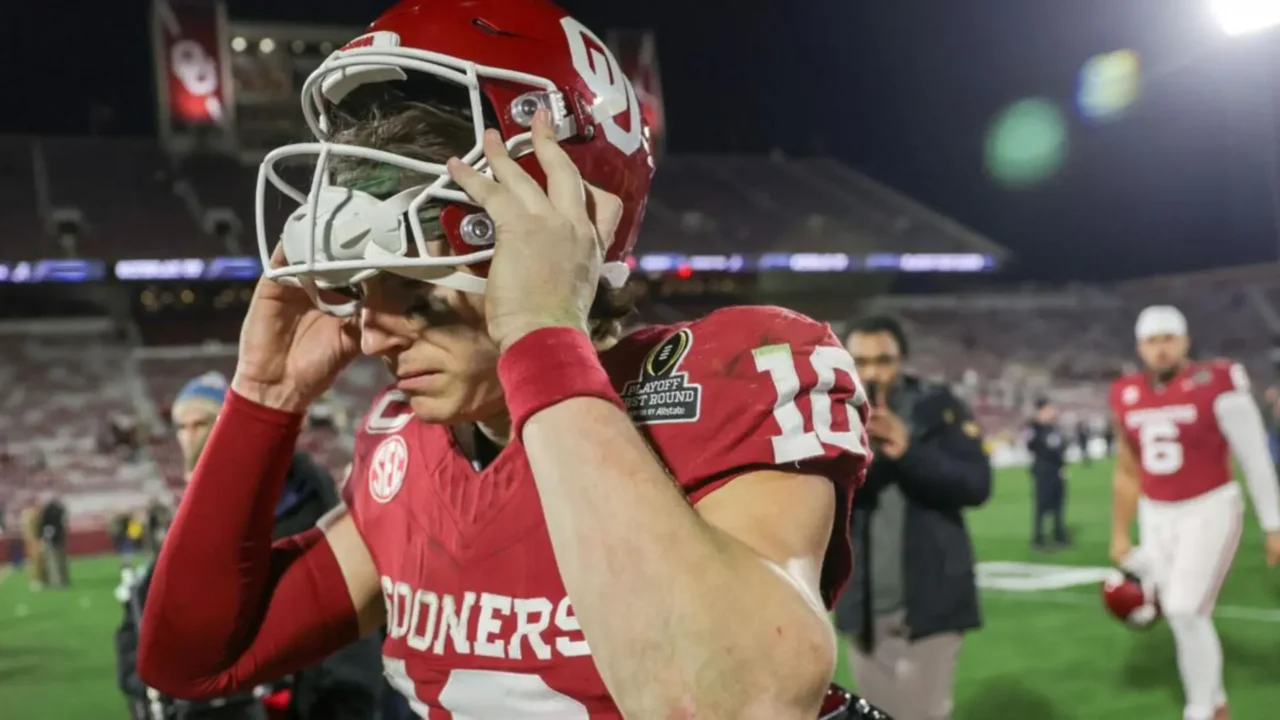
OU football doomsday scenarios matter because a handful of roster and schematic vulnerabilities can turn a lofty preseason projection into a lost season quickly at a program with national expectations.
Mason Young frames those vulnerabilities as linked failures that amplify one another and force staff decisions under duress, and for context and attribution see Tulsa World
Key Takeaways
- The piece identifies five discrete doomsday scenarios that could derail the Sooners‘ season if multiple risks materialize simultaneously.
- OU’s run game and the receiving corps behind Isaiah Sategna are singled out as the most consequential offensive vulnerabilities to monitor.
- Thin depth across key positions means single injuries or schematic failures can cascade into prolonged losing stretches.
- These scenarios would carry tangible recruiting and College Football Playoff implications that change how the program is perceived and operated.
OU football doomsday scenarios centered on the run game
The most urgent scenario presented is a stalled or ineffective rushing attack that forces the offense into one-dimensional play-calling.
When the run game fails, play-action loses credibility and opposing defenses can load the box while disguising pressure packages.
An inability to establish the run exposes the offensive line and play-calling decisions and creates short fields for the defense through quick three-and-outs.
That dynamic reduces time of possession, increases strain on the defense, and magnifies the cost of turnovers.
Doomsday scenarios tied to receiving depth behind Isaiah Sategna
The second major scenario concerns a perceived drop-off beyond Isaiah Sategna that leaves quarterbacks with fewer reliable intermediate and boundary options.
When a single target commands repeated attention, coverage schemes compress the available windows for throws and force decision-makers into higher-risk plays.
If supporting pass-catchers fail to deliver consistent separation, the offense becomes predictable and less explosive, which compounds pressure on the run game and the offensive front.
That pressure can accelerate an offensive slide as opponents prioritize taking away Sategna and daring the second options to beat them.
How combined failures translate into cascading on-field problems
Several of the five scenarios are explicitly framed as cascading risks where one shortcoming exposes another and accelerates a season-long slide.
For example, a stalled run game invites more aggressive defensive fronts that further limit passing options and create turnover-prone situations.
Special teams miscues, injuries along the offensive line, or lack of experienced depth at key positions are cited as common triggers that can flip a manageable problem into sustained losses.
The piece treats these outcomes as plausible pathways rather than predetermined outcomes, leaving coaching response and depth chart resilience as decisive variables.
Roster depth versus returning production
| Area | Primary vulnerability | Why it matters |
|---|---|---|
| Run game | Questionable consistency and schematic reliance | A weak run game limits play-action, increases pressure on the passing attack, and shortens drives, reducing clock control and defensive rest |
| Receiving depth behind Isaiah Sategna | Perceived drop-off after the top target | Lack of reliable secondary options allows defenses to focus coverage and reduces explosive-play potential |
| Offensive line depth | Inexperience or attrition under load | Line issues magnify both run-game problems and quarterback pressure, accelerating turnover risk |
How those risks affect SEC positioning and CFP hopes
In the expanded SEC environment, strength of schedule and conference wins are primary drivers of College Football Playoff access, so the described scenarios would quickly erode OU’s margin for error.
Recruiting and NIL conversations shift when a program shows schematic or depth weaknesses, because perceived instability influences prospect choices and market power.
Monitoring the run game, the depth chart behind Isaiah Sategna, offensive-line continuity, and turnover margins will provide early signals on whether the team is trending toward recovery or toward one of the doomsday pathways sketched in the piece.