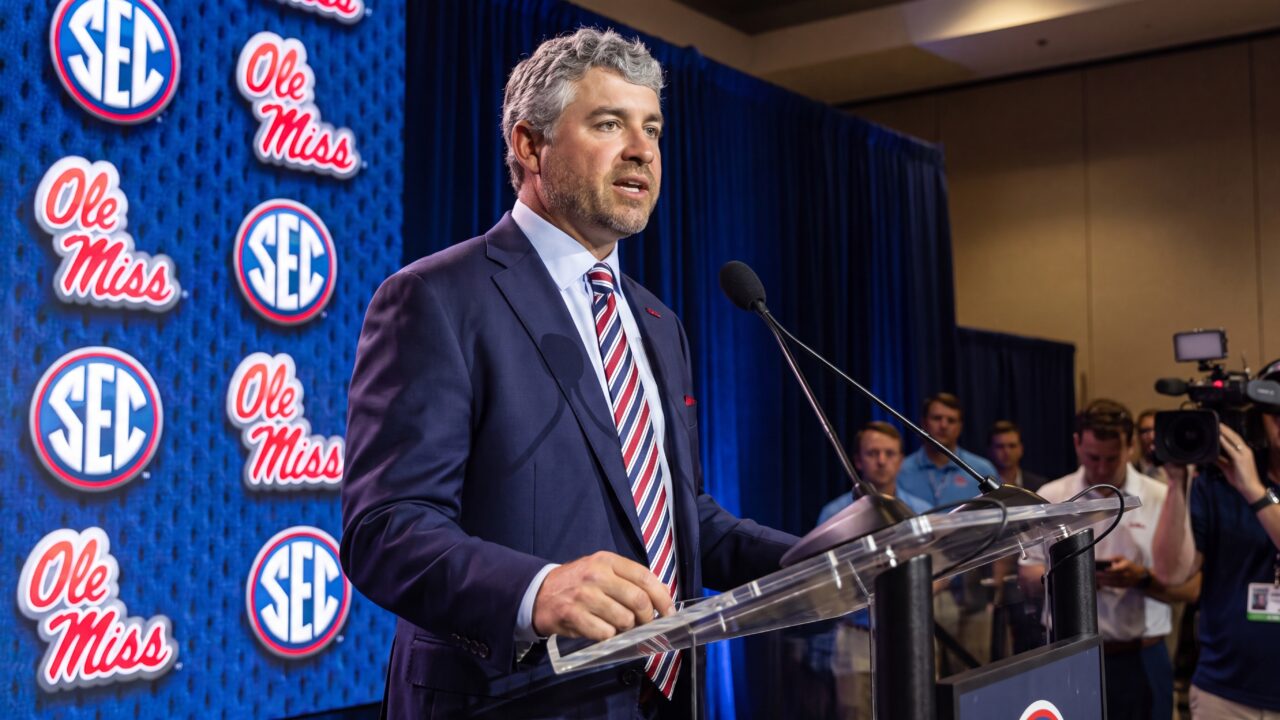
Pete Golding’s SEC Media Days appearance marked his public debut as a head coach in the conference and set the offseason narrative for Ole Miss heading into fall camp.
Golding stressed culture, thanked university leadership and walked through staff moves, roster turnover and a new strength model in remarks captured in the media-day transcript published by Saturday Down South.
Key Takeaways
- Golding publicly credited university leadership for increased investment and thanked the chancellor and athletic director for their support of the program.
- He retained key coaches across offense, defense and special teams while hiring Paul Constantine as the new strength and conditioning coach.
- Ole Miss added a major influx of players this spring, reaching 51 total newcomers from transfers and high school signees.
- Golding emphasized culture with a simple Rule No. 1 that players should be a good dude, and he noted the Rebels open the season against Louisville at a neutral site.
Staffing, training and continuity
Golding made staff continuity a central message, saying stability was vital for player development and scheme retention.
He specifically named returning assistants Joe Judge, John David Baker, John Garrison, B Brown, Randall Joyner and Coach Schoonover as retained pieces across the three phases of the game.
On the strength side, Golding announced Paul Constantine as the new strength and conditioning coach and described a shift to a velocity-based training model focused on bar speed.
Staff retention and the new strength model
Retaining positional and coordinator continuity was presented as a corrective after offseason turnover and a priority for teaching young players the program’s language.
Golding cited the advantage of keeping an existing offensive system with John Garrison returning as offensive line coach and bringing back John David Baker to co-offensive duties.
The shift to velocity-based training was framed as a structural change intended to modernize preparation and improve daily development during spring and summer work.
Roster turnover and what 51 new players means for depth
Golding confirmed the Rebels added 50 new players in the spring—29 via the transfer portal and 22 from high school—and later added a couple more in May to reach 51.
He framed the influx as intentional, focusing on character and fit alongside talent, and highlighted newcomers who have already emerged as cultural leaders in the locker room.
That level of turnover creates immediate competition for starting roles and depth across multiple position groups while increasing the urgency of installation and teaching pace.
Golding’s leadership and culture message
Throughout his media-day remarks Golding tied on-field work to culture, repeatedly returning to a simple standard: “Rule No. 1 in our program is be a good dude.”
He described the move from Tuscaloosa to Oxford as “strictly a family decision” and used that personal note to underline buy-in from the community and the program.
Golding positioned culture and character as both a recruiting filter and a retention tool, saying new players have matched the program’s expectations off the field as well as on it.
Roster and staff context
| Area | Confirmed details | Program implication |
|---|---|---|
| Roster additions | 29 transfers, 22 high school signees, plus a couple more added in May for 51 total | Large influx increases competition and depth while raising the need for focused teaching and installation. |
| Staff continuity | Retained Joe Judge, John David Baker, John Garrison, B Brown, Randall Joyner and Coach Schoonover | Continuity preserves schematic knowledge and reduces install time for returning players. |
| Strength and conditioning | Hired Paul Constantine and shifted to a velocity-based training model | The new model emphasizes bar speed and an NFL-informed approach to conditioning and periodization. |
SEC recruiting and playoff implications for Ole Miss roster
Golding’s combination of staff continuity, a modernized strength approach and a large incoming class creates immediate recruiting and roster-construction talking points across the conference.
How quickly the coaching staff integrates newcomers and applies the velocity-based S&C program will affect early-season depth and the team’s ability to match the SEC’s physical demands.