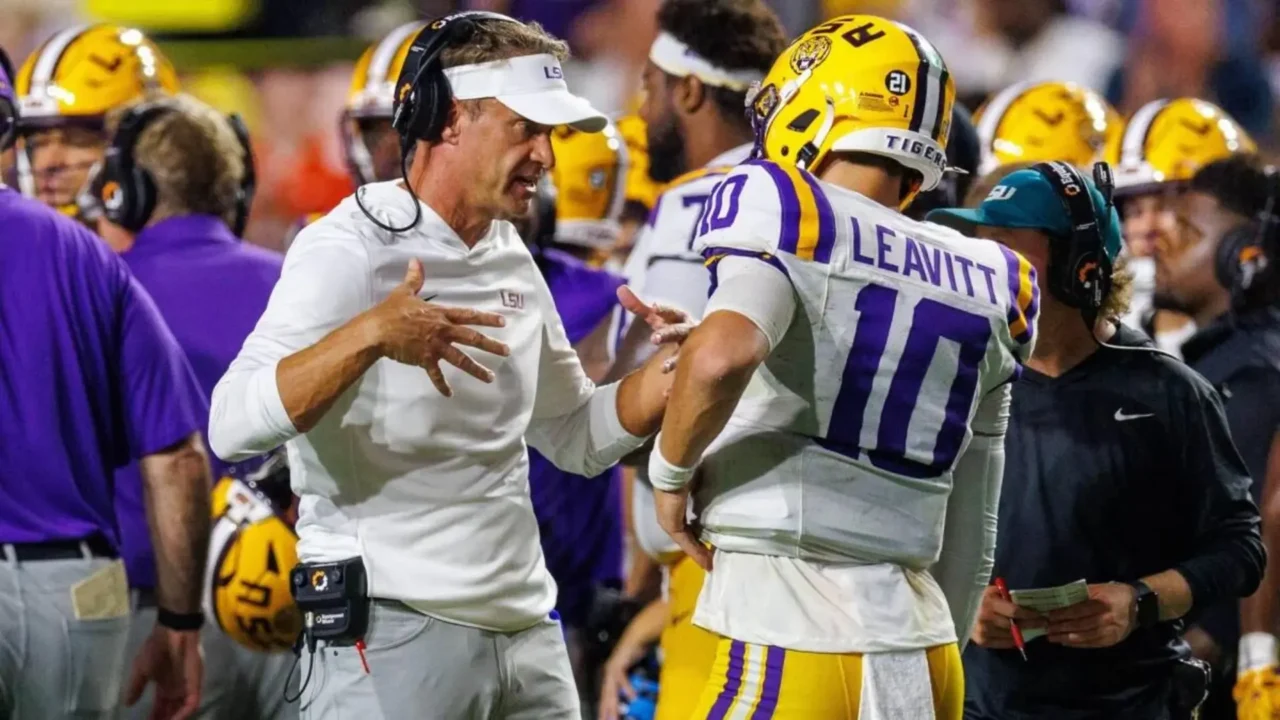
Sam Leavitt being listed as doubtful on the SEC initial availability report immediately altered game planning for LSU’s trip to Oxford.
Sources tell CBS Sports that Leavitt sat out Wednesday practice with an upper-body issue but participated in a light Thursday walkthrough, a mix that has sharpened questions about who will start for LSU on game day.
Key Takeaways
- The SEC initial availability report listed Sam Leavitt as doubtful for the LSU vs Ole Miss game.
- Leavitt missed Wednesday practice with an upper-body issue and then joined a Thursday team walkthrough.
- The SEC defines the “doubtful” designation as indicating a less than 25% chance a player will participate in the game.
- Reporting shows Ole Miss listed players as doubtful 14 times over two seasons, and 13 of those players did not play.
Timeline of Leavitt’s availability
Matt Zenitz reported Leavitt sat out Wednesday practice with an upper-body injury and was subsequently listed as doubtful on the SEC initial report.
He returned to the team for a Thursday walkthrough that staff described as light, a sequence that commonly triggers a doubtful designation while leaving some uncertainty for game planners.
Kiffin’s history with doubtful tags
Bud Elliott’s reporting documented a pattern in which players at Ole Miss were labeled doubtful 14 times across the last two seasons, and in 13 of those instances the players did not play.
That history has conditioned opponents and media to treat late availability tags from this program with skepticism, while acknowledging that a genuine injury remains possible in any individual case.
League rules and enforcement
The SEC’s policy defines “doubtful” as roughly a less than 25% chance to play, and the league can investigate suspected misuse of availability reporting.
The conference’s enforcement framework includes escalating financial penalties for football violations, and head coaches can face increasing fines if violations occur.
An SEC spokesperson noted that during the 2025 season four of 46 starters labeled doubtful on a Wednesday initial report ultimately played in the game, and on a national CFP scale one of six starter-level players labeled doubtful on an initial report played.
Doubtful designation historical outcomes
| Scenario | Verified outcome or context |
|---|---|
| SEC 2025 initial reports | Four of 46 starters listed as doubtful on a Wednesday initial report played in the game (9%). |
| CFP 2025-26 national context | One of six starter-level players labeled doubtful on an initial report played in the game (17%). |
| Missouri quarterback Beau Pribula | Listed doubtful on a Wednesday initial report in Week 13 and then played all 77 offensive snaps against Oklahoma. |
| USC running back Bryan Jackson | Listed out on a final pregame report, later entered the game and the conference fined the program. |
Impact on SEC playoff positioning and roster construction
Leavitt’s doubtful tag affects immediate game planning because play-calling, quarterback rotation, and defensive preparation depend on which signal-caller the Tigers will use.
How a program manages high-profile short-term availability also sends signals about depth and medical transparency to recruits and boosters, which can influence roster construction and long-term positioning in the conference.
Repeated or aggressive use of doubtful labels raises the risk of league scrutiny and potential fines if an investigation concludes reporting rules were violated.